










































Wayfinding to Help the Vaccine Opportunistic
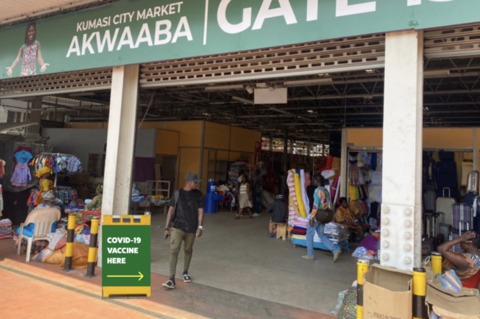
"Existing wayfinding at vaccination points was inconsistent, lacking information and did not engender trust or confidence in the service being provided."
During the COVID-19 pandemic, in Kumasi, Ghana, the United Nations Children's Fund (UNICEF) Ghana and Common Thread collaborated with local civil society organisations (CSOs) and the Ghana Health Services (GHS) to help make vaccination as salient and easy as possible. Organised as a response to low COVID-19 vaccination uptake in the country, the 2-month project included a rapid assessment to develop a solution that prioritised "vaccine opportunists": people who had no objections to vaccinating, as long as vaccination services were clearly visible, available, and easy to access. Prototyping efforts focused on prompts for vaccination, support for finding such services, and information to help prime people for what to expect. The goal was to reduce friction so that individuals would need to exert as little effort as possible to get vaccinated.
In order to get a more complete picture of the journey to vaccination - and all the potential barriers along the way - Common Thread spoke to vaccinators and people receiving their COVID-19 vaccines at static and mobile vaccination sites in Kumasi, an urban area with a high population density and unvaccinated population. Interviews revealed little resistance to vaccination; instead, people often had multiple competing priorities and were therefore unlikely to go out of their way to find a vaccination site. It was a question of prioritisation, convenience, and perceived cost - not hesitancy. In other words, if someone was at a market and happened to hear an announcement giving the location of a nearby vaccination site, that might be enough to get them to get the vaccine then and there. In fact, the investigation revealed that periodic market announcements drove more people to the vaccine site(s).
Armed with insights from the field, Common Thread brought people together to learn more. They held a day-long co-design workshop with regional level stakeholders from GHS, UNICEF, and CSOs in Kumasi. The goal was to brainstorm and iterate on potential wayfinding solutions to help the vaccine opportunistic get fully vaccinated. Participants collaborated on the mission to reduce uncertainty towards the vaccination process, cue people to get vaccinated, and instil trust and confidence in the vaccine and the vaccination process.
The team returned with key insights and ideas for effective "wayfinding", which is an information system that enables people to move through their environment to a desired destination with ease. Tools that are used to help people find and access certain locations and services include colours, symbols and icons, effective language, sound, light, and/or a designed environment (e.g., paths and rails). Beyond providing direction, when wayfinding is used to guide a user to a particular public service, it may act as a visual prompt for people to access it. Furthermore, a consistent visual marker for a service may help establish familiarity with and confidence in the service.
Once the prototypes were developed, organisers built a rapid field testing kit and engaged in-country partners to get feedback from vaccinated and unvaccinated adults in Kumasi on the messaging, look, and feel of the prototypes. Feedback underscored the need to translate the messaging into Twi (or other local languages, as appropriate) and adapt the hairstyle and clothing of the woman illustrated in the prototype signage to resonate with the community in which the sign is placed. Organisers note that, wherever possible, information on wayfinding materials should be adapted to include the particulars of the vaccination site, especially their hours of operation. Setting expectations of the requirements and steps of the vaccination process can reduce any potential friction that might cause a person to abandon the effort before following through to vaccination. Such communications should include information about requirements (paperwork, age), cost, and expected wait times.
The UNICEF team will take this feedback forward by working with health authorities in Kumasi to invest further in learning how renewed wayfinding and investment in reducing friction for opportunistic vaccinators will impact vaccination rates at these sites.
Immunisation and Vaccines.
As of February 25 2022, less than 16% of Ghana's population was fully vaccinated against COVID-19. Despite having enough vaccines to inoculate 88% of the population with at least one dose, only about half of the country's available vaccines had been administered as of April 2022.
"Give Me a Sign: How Wayfinding Can Help the Vaccine Opportunistic", by UNICEF Ghana and Common Thread, Medium, April 29 2022 - sent from Anastasiia Nurzhynska to The Communication Initiative on May 5 2022. Image credit: Common Thread
- Log in to post comments