










































Village Voices for Development
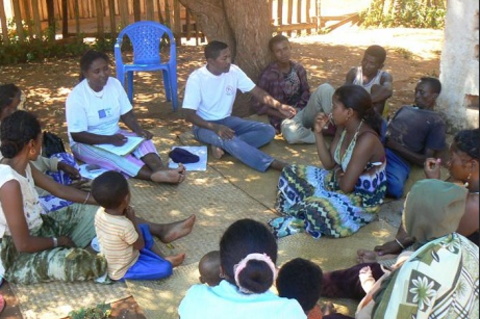
Launched in February 2012, the Village Voices for Development (VVD) project uses radio and mobile phones to enable dialogue between non-literate villagers and decision makers about local development issues and strategies. In doing so, the project seeks to address communication gaps, give voice to local people, and improve local governance. Launched by the Andrew Lees Trust in partnership with Andry Lalana Tohana (ALT), the project is funded by Adsum Foundation, the Swiss Embassy, and Media Support Partnership (MSP).
Village Voices for Development (VVD) worked with existing radio listening groups, local associations, non-governmental organisations, regional authorities, and service providers in the Androy region of Southern Madagascar to develop participatory radio programmes in question and answer formats. These were accompanied by debates and phone-ins designed to engage and enable villagers to talk directly with their local leaders and service providers about important development issues. Two local FM radio stations broadcast the programmes to listeners who had the opportunity to participate by calling in to the programme. To date (Dec 2012), more than 40 radio programmes and 5 radio phone in programmes have been produced and broadcast, reaching approximately 10,000 listeners in the Androy region.
The project works with ten Radio Listening Groups in rural communities and enables them to identify, prioritise, and record their concerns, questions, and aspirations. Once recorded, their questions and concerns are played to local decision makers, such as local authorities, regional service providers, and NGOs. The response of the decision maker is also recorded and the material edited together to produce a radio programme that broadcasts questions and answers as if in a live discussion - an exchange that would rarely take place in the highly hierarchical Malagasy social structure. The ten groups were issued with mobile phone and credit to use them for the phone in programmes. For socially sensitive themes, such as land tenure, the team has developed a mini radio drama to aid discussion.
Monthly monitoring of the impacts of the programme content enables villagers to revisit key themes and ask more questions if they are not satisfied with the answers provided. Requests for information and or services are monitored and action or lack of action is tracked and addressed in subsequent programmes. This form of public accountability aims to increase transparency and the performance of local authorities, service providers, and NGOs, to reduce corruption and reinforce the democratic process.
The ALT team began work in February 2012 by identifying 10 of the most dynamic Radio Listening Groups in communities across the Androy Region of southern Madagascar and introduced them to the project. The project team met with and explained the project to key decision makers in the region including the local authorities, the service providers for health, education, hospital, environment, water and forest, land management, rural development, and the police force, and also UNICEF and World Food Programme, and requested their participation in the project to respond to questions raised by the local community. A baselines survey was carried out with villagers and decision makers to establish prior levels of human rights knowledge, ability to act on rights, and mechanisms to engage with local decision makers.
In Madagascar, radio is still the most popular and the most readily available media. More than 70% of the population cites radio as their main source of information and 91% interviewed in a United Nations Development Programme (UNDP) survey said they felt that media had the potential to change their lives. ALT has been working with rural radio for more than ten years as a means to provide access to information and non-formal education for village communities.
Local Governance
According to The Andrew Lees Trust, in the south more than two thirds of the rural population are local producers living in poverty and facing annual food shortages due to extreme climate conditions and regular drought. They are isolated and marginalised by vast geographic distances, poor infrastructure, and low literacy rates. A national communications for empowerment study by UNDP in 2008 demonstrated that there were few mechanisms in place that afforded local people an opportunity to interact with policy/decision makers and almost none were available through the media.
From 1999 to 2009 ALT’s Project Radio set up more than 3000 listening groups across the south of the island and broadcast more than 3400 educational programmes to over 800,000 listeners. ALT has been working to increase the voice of local people in its radio programming and via other media. Village Voices for Development represents the next step in developing mechanisms for facilitating the voice of local people and uses radio and mobile telephony to offer opportunities for local citizens to engage in public debate and decision making.
VVD is being implemented by Andry Lalalana Tohana (ALT Mg), reinforcing the north south transition to a Malagasy owned and led NGO - a sustainability strategy realised by Andrew Lees Trust in 2010.
Andrew Lees Trust, Andry Lalana Tohana, Adsum Foundation, the Swiss Embassy, and Media Support Partnership (MSP).
Andrew Lees Trust website and Village Voices for Development [PDF] on October 9 2012 and email from Yvonne Orengo on December 5 2012.
- Log in to post comments