










































Use of Interactive Voice Response Technology to Address Barriers to Fistula Care in Nigeria and Uganda
Fistula Care Plus Project, EngenderHealth (Tripathi, Arnoff); Population Council (Bellows, Sripad)
"Digital health technologies have the potential to increase access to care for chronic maternal morbidities, such as obstetric fistula, and for women facing stigma, geographic isolation, and other sociocultural barriers to care seeking."
Untreated fistula can become a chronic disability, leaving women socially isolated and unable to work. Digital health technologies have the potential to address maternal health needs such as fistula care, yet there are challenges with their use in low-resource settings, such as the common reliance on SMS and other text-based media requiring functionally literate audiences. This study documents the process of developing and implementing a fistula screening and referral hotline using interactive voice response (IVR) technology in Ebonyi and Katsina states in Nigeria and Kalungu district in Uganda, and it describes service usage results and stakeholder perspectives associated with the hotline. The intervention was carried out by Fistula Care Plus (FC+), an initiative of EngenderHealth and the Population Council with United States Agency for International Development (USAID) funding. For the free fistula screening hotline, FC+ partnered with Viamo.
The study explores the context in which the intervention was developed and the literature-based theoretical model on which it is grounded: Socioeconomic and cultural factors - along with poor accessibility, and poor quality of care provided at, medical facilities - contribute to delays in the decision to seek care and/or receipt of adequate and appropriate treatment once a facility is reached. The intervention design was guided by the Capability, Opportunity, and Motivation determines Behavior (COM-B) Model, synthesised from a review of 19 behaviour change frameworks. To that end, the intervention was designed to increase women's capability, motivation, and opportunity to decide to seek and to access fistula screening and treatment services. To achieve this, as described in detail in the article and summarised briefly below, the intervention used 3 communication pathways to disseminate fistula information and screening resources: a free IVR hotline paired with mass media messaging, trained primary health centre (PHC) providers, and trained community agents.
FC+ and Viamo developed the hotline in particular for hard-to-reach women living with fistula who have not been reached through existing community outreach efforts. Using her mobile device, a caller can flash into a toll-free number. The caller first chooses her language (English, Igbo, Hausa, or Pidgin in Nigeria, and Luganda in Uganda) and is then asked her age, followed by the key fistula symptom screening question, "Do you currently experience constant leakage of urine or feces from your vagina during the day and night even when you are not urinating or trying to urinate?" For women who answer "yes", the hotline collects data on demographics, etiology of fistula, and experienced barriers to treatment. Women who screen positively within the intervention catchment areas receive a follow-up via phone from a community agent. Women who screen negatively both within and outside the intervention catchment areas hear a message saying they should visit their nearest health facility to have the symptomsevaluated. FC+ worked with local taxi companies to establish a transport voucher mechanism, whereby positively screened women and a companion are entitled to travel for free to and from the fistula treatment facility.
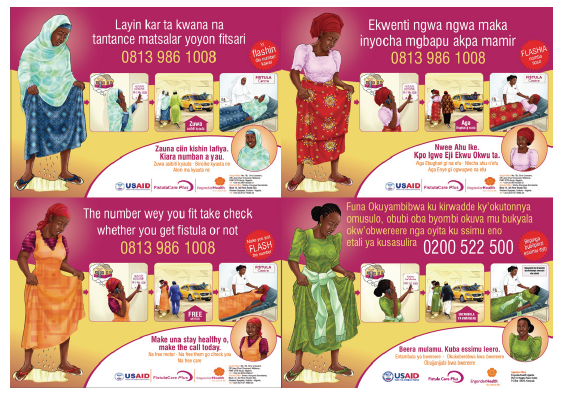
Prior to launch, a prototype version of the IVR hotline was tested for issues including clarity of terms and acceptability of the pre-recorded messages by voice actors, and the script and audio recordings were revised to reflect user feedback. In addition to mass media advertisements, the fistula hotline was widely advertised through graphic, low-text flyers disseminated by community agents and PHC providers at community venues.
FC+ trained doctors, midwives, nurses, and community health workers with the aim of strengthening fistula screening and referral at the primary health care facility level. Local partners also trained community volunteers: to conduct community outreach activities on birth preparedness, safe delivery, fistula symptoms, and treatment services; to advertise and utilise the fistula hotline to screen women for fistula; and to follow up with positively screened women to facilitate their free transportation to the treatment facility using the voucher.
This study presents findings specifically on service usage and stakeholder perspectives related to the IVR hotline. Quantitative and qualitative data were gathered during intervention implementation, at baseline, midline, and endline, as well as through ongoing programme monitoring.
The intervention was implemented from June 2017 to April 2018 in Ebonyi, July 2017 to April 2018 in Katsina, and July 2017 to June 2018 in Kalungu. Over a period of 10-12 months of implementation, depending on the intervention area, 566 women completed the IVR hotline screening process. Across the areas, 415 (73%) hotline callers screened positive for fistula symptoms. Assuming proportional geographic distribution of fistula, it can be estimated that 696 women are living with fistula in Ebonyi state (69 in the Ikwo local government area - LGA) 1,895 women in Katsina state (104 in Katsina LGA), and 758 women in Kalungu district. Based on these assumptions, approximately 15.4% of fistula cases in Ebonyi State, 2.5% in Katsina State, and 5.3% in Kalungu District were screened through the implementation of the IVR hotline.
Hotline users and implementation partners reported positive impressions of the hotline, particularly the ability to preserve anonymity in seeking information and referral for fistula symptoms. Respondents noted that the hotline helped reduce stigma associated with disclosing fistula symptoms, with some community agents attributing client volume at fistula treatment centres to the hotline. Among the challenges to hotline use were limited mobile phone ownership and poor cellular network connectivity, affecting operability by women and community agents. In Uganda, community agents reported difficulty in linking with hotline callers for follow up and community skepticism about the confidentiality afforded by community-agent-initiated calls.
Data reveal that modifications were made from the initial programme plan in response to challenges identified by implementation stakeholders. For example, community partners felt that, despite mass media advertisement and communication materials, awareness of the IVR hotline was inadequate. So, larger-format posters were produced and displayed at PHC facilities as well and distributed through community agents. In Ebonyi, language comprehension posed a challenge despite pre-testing of messages, necessitating adequate retranslation of the IVR platform.
In short: "The use of a client-facing IVR interface integrated with complementary health systems and community support appears promising to improve access to care for women living with fistula, particularly those who face care-seeking barriers such as stigma, low literacy, and social or geographic isolation. The hotline may also help women avoid delays in care seeking due to inadequate capacity at PHC sites, as it appears user-friendly and effective in reaching large populations, if accompanied by adequate publicity to community health partners." However, "the necessity of in-person contacts for referral follow-up and transportation support suggest that a digital health intervention alone may not yield sufficient impact in addressing barriers to fistula treatment in low-resource settings."
The researchers conclude that further programme experience and evaluation is needed to understand the options for integrating the IVR hotline or other interventions using mobile technologies for screening and referral into broader digital health platforms that are sustained by national health systems or commercial business models. The final evaluation of the intervention's effects is underway as of this writing; findings regarding its overall influence on fistula case detection, as well as barriers to and completion of treatment, will be reported separately when this evaluation is complete.
See also:
- Related Summary, below, which describes the collaborative effort, including the use of a participatory action-research approach, to develop the intervention; and
- The video below (also available here), from an April 9 2020 virtual panel featuring guest panelists from the FC+ project, Population Council, Viamo, and USAID sharing lessons learned for the sustainable scale-up and integration of digital health solutions for health screening and treatment programmes, as well as for interventions to address stigmatised and neglected conditions.
mHealth 2020;6:12 | http://dx.doi.org/10.21037/mhealth.2019.12.04; and "Press 1 for Yes, 2 for No: How digital health platforms connect women to maternal health services", by Lauren Bellhouse, MPH, March 2 2018.
- Log in to post comments