










































Unite for a Better Life Programme
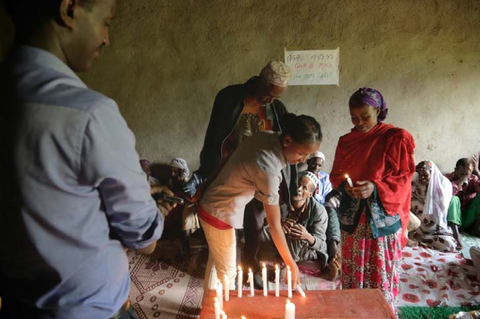
The Unite for a Better Life is a study intervention being implemented in Ethiopia to prevent and reduce intimate partner violence (IPV) and HIV. The programme, which involves facilitated discussions about gender norms and sexuality, is integrated within the traditional Ethiopian coffee ceremony, an important culturally established forum for community discussion. The intervention is being implemented and tested by EngenderHealth and Abdul Latif Jameel Poverty Action Lab (J-PAL) with the Ethiopian Public Health Association and Addis Ababa University School of Public Health.
The coffee ceremony is deeply rooted in Ethiopian culture and social life and may take place several times a day within a home or village. The ceremony usually involves roasting green coffee beans over hot coals, sampling the aromatic smoke, grinding the beans, and preparing and drinking the coffee. Typically, three rounds of coffee are prepared from the same beans, and discussion occurs over the course of several hours. While men and women can participate together, typically it is the women who perform some of the key activities related to preparing the coffee.
The programme strategy to integrate conversations about gender norms and sexuality and to conduct skill-building sessions within the coffee ceremony seeks to increase acceptability, ensure cultural sensitivity, and facilitate gender-transformative behaviours. For example, during the sessions, men are engaged to prepare the coffee, a role that would be usually be done by women. They also discuss task sharing and how to divide household duties in an equitable way.
The programme involves 14 different interactive sessions on a wide variety of topics. The curriculum, which was specifically designed and tested for the programme, includes the following sessions:
- Program Introduction and Understanding Gender
- Act like a Man, Act like a Lady
- Healthy Sexuality
- Healthy and Unhealthy Relationships
- Gender, Power, and Control in Relationships
- Joint Decision Making
- Negotiating Men’s and Women’s Roles in and outside of the Home
- Gender Norms and Communicating with Your Partner
- Talking to Your Partner about Preventing HIV
- Gender Norms and Violence
- Setting Personal Boundaries and Sexual Consent
- Nonviolent Ways to Resolve Conflict and Dealing with Anger
- Understanding Violence and Supporting Survivors
- Empowering Change and Program Closure
These sessions are led by trained male and female facilitators. They undergo a six-day training which includes facilitation skills (active listening, leading group discussions, safety issues, and dealing with challenging situations) and practice (teach-back sessions). The groups meet twice a week, with around 20 community members per group.
To rigorously measure the programme’s impacts, the intervention is implementing a cluster randomised controlled trial in four districts in Ethiopia. The programme has three intervention arms and one control arm: groups of women alone, groups of men alone, and couples participating together. The control arm involves short informational session on violence reduction. The study will assess the impact of the programme on reported IPV in the past year, and it will also compare impacts for the three intervention arms. The results are expected in 2018.
Gender-based violence, HIV
Intimate partner violence is a pervasive problem in Ethiopia with 71% of Ethiopian women having experienced physical and/or sexual IPV in their lifetime. IPV has significant immediate and long-term health, social, and economic consequences and is also linked to an increased risk of HIV.
EngenderHealth, Abdul Latif Jameel Poverty Action Lab (J-PAL), the Ethiopian Public Health Association, and Addis Ababa University School of Public Health.
- Log in to post comments