










































Tuamke Sasa Project
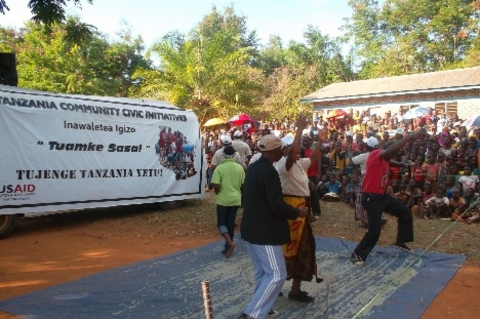
Launched in January 2013, the Tuamke Sasa project is working to encourage a human rights approach in the democratisation process in the Morogoro and Dodoma regions in Tanzania. The project is using theatrical performances to reflect key issues in human rights and democratisation in the country, with an on-site legal advisory tent on human rights, especially for women. The project is implemented by the Tanzania Community Civic Initiatives (TACCI), in collaboration with the Faculty of Law at St. Augustine University of Tanzania (SAUT), and the Nyanza Folklore Research Institute.
The main objectives of the project were to:
- elaborate basic human rights issues, as they relate to the democratisation process;
- spell out basic human rights issues that affect women;
- show how failure to participate in the electoral process is a self-denial of one's basic rights;
- show how an accountable government can only come from participation in the democratisation process;
- reinforce the importance of participation in the electoral process for young people, as the future of the nation belongs to them;
- reinforce the participation of women in the democratisation process as an essential element for their liberation; and
- elaborate and heighten awareness of the constitutional obligations of the audiences, so that they can demand more from their representatives.
The project employed the following approaches:
Theatre Activities: Tuamke Sasa used a modified version of Magnet Theatre - a form of community theatre designed to not only entertain and educate, but to involve audience members in the action and encourage participation and reflection that is key to sustained behaviour change. They performed twice in each location. Facilitators encouraged audiences to participate in the performances and organisers reported that audiences were quite vocal on ways in which governance can be improved in their communities. The core themes of the plays centred on the human rights approach in the democratisation process. Key to this is to emphasise the fact that many of the problems in their communities can be attributed to weaknesses in governance, and that they have a duty to demand better governance.
Human Rights Tent:Next to the performance area, tents were set up in which two lawyers facilitate counselling for women and children on their rights. Women are advised about the laws that protect them and the steps they can take to seek remedies. They are also advised to get active in the political process as the best guarantee for fighting back against human rights violation against them. They are encouraged to participate in the electoral processes in order to elect good leaders. They are also urged to attend village meetings so that their voices can be heard. Women are particularly encouraged to seek elected office at local level.
Post-performance Discussion: The discussions during and at the end of the performance is participatory. The facilitators engaged the public in contextualising the play by raising critical human rights issues in their communities and relating them to the democratisation. Discussions following performances raised recurrent issues such as: lack of enforcement of laws and rules by local government officials, especially those which relate to the violations of women’s rights; lack of enforcement of inheritance laws, especially for widows; lack of knowledge of basic and constitutional rights by both the leaders and general population, especially in the rural areas; early marriage of school-going girls; petty corruption; and many more.
Gender, Human Rights, Governance
According to TACCI, in April 2013, 94,897 people had been reached through 34 performances in 17 places, with an average of 2,791 people per performance. The human rights tent attracted a total of 785 people with 449 adults and 336 youths. Females accounted for 48.9%, males for 51%.
For future performances they are considering modifying the programme to include a "Countdown to Local Government Elections 2014", so that the audience can be ready for getting more involved in local governance as a starting point for more involvement in national elections.
Tanzania Community Civic Initiatives (TACCI), The Faculty of Law – St. Augustine University of Tanzania (SAUT) Nyanza Folklore Research Institute
Email from Augustin Hatar on May 21 2013.