










































Tua Cena Campaign
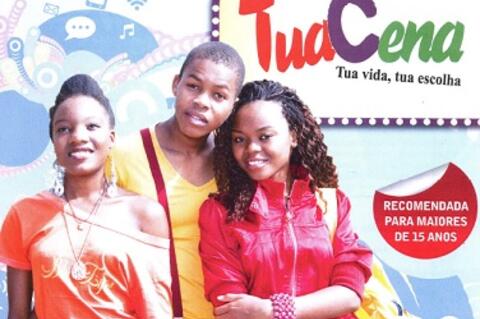
To educate young people about SRHR, the campaign uses different media to communicate information and encourage interaction. The campaign focuses around a central character created by N’weti called Mana N'weti (Sister N’weti). She was conceptualised as the a figure of interaction between N'weti’s audience and N'weti, as well as a friend and a counsellor.
The Tua Cena activities include the following:
- A booklet was produced for 15-24 year-olds to highlight SRHR information.
- A weekly 20-minute television insert, called "Tua Cena" was broadcast within a weekly show – Atracções – on Miramar TV. Mana N'weti led information sharing and discussions on a weekly topic over 24 episodes.
- A radio show called "Tua Cena" followed a similar format to that of the TV show. Twenty-six episodes on SRHR were aired weekly, with a topic, a debate session, and some participation from the audience. Here too "Mana N'weti" was mentioned as the go to source for the audience’s concerns, questions, feedback.
- An sms platform was created for the audience to communicate with "Mana N’weti" and interact with the TV show. According to N’Weti, 15,358 SMSs were received between March 2012 and December 2013.
- The Mana N'weti’s Facebook page (with over 4000 followers in mid 2014) is a channel of communication with the audience where they can have their concerns and questions answered, and provide their feedback. The interaction is either public, on the wall of the page, or private through Facebook’s messaging application/service.
- To answer the questions posed to "Mana N’weti" on Facebook and/or via sms, N’weti works with a group of counsellors (activists, nurses, etc.) who are proficient on SRHR issues.
According to N’Weti, the vast majority of those engaging with the campaign are 15-24 year olds (both on Facebook and as the SMS users). However there are a considerable percentage (roughly 6%) of people aged 25 and above who also communicate with "Mana N’weti", but often about how to help/engage/communicate about SRHR issues with their children, nieces and nephews, and grandchildren. N’Weti notes that when comparing the relationship that is created with the audience on SMS versus Facebook, the relationship via SMS is more often a once off, question and answer type relationship. On Facebook, people tend to develop longer lasting relationships, that can go on for several months.
Youth, Sexual and Reproductive Health
Project monitoring results showed that people used the SMS service mostly to ask about sexual practices (1,642 SMS received on this topic) and sexual life, while very few people asked about homosexuality and male circumcision (24 and 29 SMS received per topic, respectively). 1,306 people sent SMS related to pregnancy and fertility and only 75 people asked about family planning. Overall the content of the SMS shows concerns in falling pregnant but a huge gap in knowledge about prevention and correct use of family planning methods. At the same time, 1776 people asked about HIV and AIDS and sexually transmitted infections, but once again (as with pregnancy and family planning) the misconceptions, wrong information, and gaps in knowledge about prevention and correct use of resources was found to be significant.
Regarding the branding, the project noted that because "Mana N’weti” has gained the trust and sympathy of the audience, she has become associated with this work and only secondly do people recognise the brand "Tua Cena". This will be taken into consideration for future planning around the campaign.
N'weti
Email from Ilundi Durão de Menezes from N'weti on January 31 2014.
- Log in to post comments