










































Trois Toutes Communication Campaign
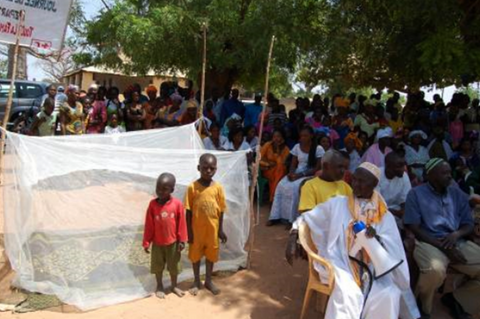
The Trois Toutes campaign messages emphasise the improved financial, physical, and medical security and increased health sustainability that comes from the effective use of LLINs: mothers benefit from the comfort of knowing their children are sleeping safely and are protected from disease-carrying mosquito bites; families benefit by saving money that would be spent on expensive medicines when family members are sick with malaria; and communities benefit from having stronger and more productive community members. JHUCCP describes how, during a live broadcast on a community radio station during the first phase of the distribution, a recipient of ten nets was asked how he felt about saving 50,000 CFA (the cost of the nets). The guest replied that he is saving more like 500,000 CFA from not going to the clinic or buying the medicines.
According to JHUCCP, the campaign is built around an overarching communication strategy, but each region developed its own communication plan in coordination with local groups and with the consideration of local customs and resources. Message dissemination occurs through local radio programmes, home visits by community volunteers in Trois Toutes branded clothing, and through religious and political leaders. In addition, a nation-wide television campaign is being planned. The Trois Toutes brand and logo has been embraced by Senegal’s National Malaria Control Program (NMCP), and was adopted by the Ministers’ Yearly Caravan in September 2010, which focuses on building awareness about preventing common rainy-season illnesses such as diarrhoea and malaria.
As part of the campaign, NetWorks and the National Malaria Control Program (NMCP) brought together over 20 health educators, technicians, and radio disc jockeys to familiarise them with Senegal’s national universal coverage strategy; develop and pre-test ten radio spots in Wolof and French on LLIN universal coverage and good net use and care; develop and adopt a musical theme for the “Trois Toutes” slogan; and plan to produce the same series of spots in Bambara, Malinke, Peuhl, and Madingue. Workshop participants learned how to use radio to promote ideal behaviours to reach public health goals, particularly those related to improved net use, care, and repair. They examined radio formats including writing techniques, and applied new skills to the recording, pre-testing, and final production of radio messages. The workshop resulted in the development of ten spots in French and Wolof. Following the workshop the spots were translated and recorded in four more languages.
The Trois Toutes campaign accompanies Senegal’s universal coverage LLIN distribution. Planning for the distribution began in April 2010 with coordination and partnership at the national level, using lessons learned from the pilot distributions. At the community level, volunteers went house to house to register the number of people living in the house and the number of sleeping spaces. During the visits the volunteers discussed the importance of having every member of the family sleep under a net every night, all year long. The volunteer gave the family’s representative a coupon to be used a few days later at the distribution site. Just prior to the distribution day, health post nurses set up distribution sites in each community, and laid out each family's allotment of nets labeled with the date, the village, and family name to encourage use and reduce leakage into the market. While families wait to be called up, local community-based groups and health officials spoke to everyone about using the nets, and how to care for them, and repair them. Families were called up one by one, and redeemed their coupon for the nets assigned to them.
In each region, community health workers and volunteers planned post-distribution house visits. These follow-up visits assisted families with hanging nets, and reinforced messages on consistent use and ways to care for and repair nets. They also provided an opportunity to monitor use rates and alert health staff to any issues that the community is facing, such as washing practices that contribute to nets tearing, or the desire to convert rectangular nets into round ones to make hanging easier.
Malaria
The Trois Toutes campaign was developed by the Center for Communication Programs’ NetWorks project, part of a five-year United States Agency for International Development (USAID) funded global programme focusing on malaria prevention with LLINs. NetWorks promotes the use of nets through behaviour change communication and efficient distribution of nets through mass and routine channels, and uses research to improve policy both at country and global level.
Johns Hopkins Bloomberg School of Public Health Center for Communication Programs (JHUCCP), Malaria Consortium, Catholic Relief Services, Mennonite Economic Development Association (MEDA), London School of Hygiene and Tropical Medicine (LSHTM), International Procurement Agency (IPA), and the United States Agency for International Development
NetWorks website and JHUCCP website on September 20 2011.
- Log in to post comments