










































Training Manual: Gender Leadership in Humanitarian Action
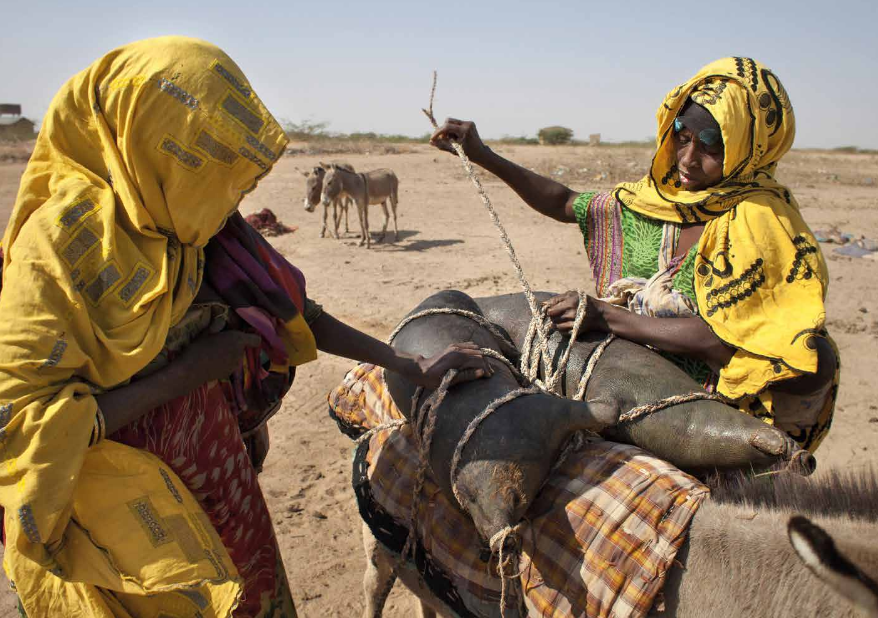
The purpose of this training manual is to support the institutionalisation of gender equality and women's rights in all humanitarian action. It was developed by Oxfam to support the implementation of the project Institutionalizing Gender in Emergencies: Bridging Policy and Practice in the Humanitarian System, supported by the European Commission's Humanitarian Aid and Civil Protection department (ECHO) from 2015 to 2017. The manual pulls together a range of sources, adapting and updating them for an integrated 5-day training module designed to develop gender leadership in humanitarian action in a country context. The aim of this initial training is to develop a critical mass of committed gender leaders who can together influence changes in policy and practice at different levels across the humanitarian system.
The facilitator is provided with context and guidance in the opening sections of the resource. He or she learns how, due to prescribed gender roles, inequalities and resulting discrimination against women and girls in many societies tend to leave them more marginalised and more vulnerable to harm in humanitarian crises. The opportunity to access assistance and recover from crisis is also impacted by gender. Indeed, humanitarian assistance can either reinforce or challenge pre-existing gender inequalities and vulnerabilities and traditional gender stereotypes or roles. Thus, it is widely acknowledged that working with the differences experienced by women, girls, men and boys results in a more effective response. "Yet despite evidence of the above, and the existence of a plethora of gender mainstreaming tools, the differential impact of disasters on women, girls, men and boys is still often overlooked."
The manual proposes that, given the challenges of institutionalising gender equality within the humanitarian machinery of organisations, gender leadership is needed to take this agenda forward effectively. The leadership model proposed is Srilatha Batliwala’s model of Feminist Leadership for Social Transformation, which distinguishes itself from other forms of leadership in that it adopts an explicitly feminist political agenda, with women's empowerment and gender equality at its heart.
Case studies and examples in the training focus on emergency food security and vulnerable livelihoods (EFSVL), water, sanitation, and hygiene (WASH), and shelter and protection. The course is designed to include a maximum of 24 participants from different organisations and, primarily, is for those who have experience in humanitarian work, particularly those in strategic or technical roles such as programme managers and technical team leads. It is for those who wish to learn how to develop gender leadership in humanitarian programming within their organisations. It assumes some basic knowledge of gender issues and is therefore pitched at intermediate level, but can be adapted for more beginner-level participants since it includes a review of the basic gender concepts. Participants are also asked to do some online preparation prior to attending the training.
By the end of this workshop, participants are expected to:
- understand the rationale and principles behind promoting gender equality and women's rights in humanitarian action, the challenges of doing so, the fundamental need to change attitudes and beliefs, and the need to promote a more equal balance of power between women and men;
- know the key global standards and approaches which guide good practice on gender in humanitarian action, and be confident in carrying out a gender analysis and using it to shape programme design and implementation;
- have identified how their own personal beliefs about gender impact on their work, understand the need to transform the attitudes and beliefs of others, and feel inspired to champion change on this issue;
- understand what gender leadership in humanitarian action is, and feel inspired to promote it, both within their organisation and in the wider humanitarian community; and
- have developed a plan for their role in leading change on gender equality in humanitarian action.
312
Oxfam website, April 13 2017.