










































Through Children's Eyes
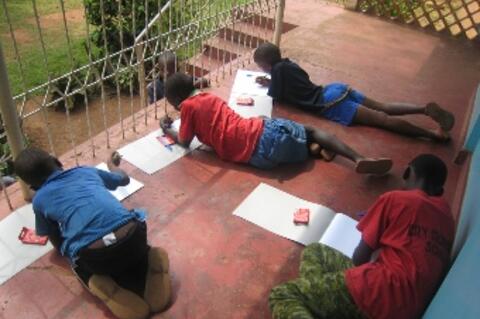
The project involved 3 groups of children between the ages of 9 and 12 in 3 different parishes in IDRC's Focus Cities Research Initiative project community in Uganda: Bwaise, Makerere-II, and Kasubi. The 3 parishes reflected a socio-economic range, as well as a range in severity of the environmental challenges in the city.
Each group consisted of 10 children, 5 girls and 5 boys. All completed 2 sets of drawings. One set illustrated environmental problems near their homes, and another set illustrated issues affecting the local community. More than 60 drawings were produced in all. After each drawing session, the group sat in a circle on the ground, and each child presented their drawing and shared their story. According to the organisers, this was an important part of the process because the children's intended message can be easily lost when drawings are interpreted through adult eyes.
The field research found that with the exception of Kasubi, the parish least affected by serious environmental problems, the themes were remarkably similar: sanitation, water quality, health issues, flooding, and loss of personal possessions and homes because of the flooding. The biggest concern for the children in Kasubi was hygiene in the local market and the fact that produce was being sold near latrines and open toilets. According to the organisers, adults had never raised this particular concern in the community meetings, so it was interesting that the children did. In the other parishes, many drawings featured a flooded home or area around a home. They often showed the same elements: sewage coming out of the toilet, a dead body, a child drowning.
Organisers say that what came through in all the drawings was how well the children understood the connections between human activity and the environmental and health issues occurring in the community. When the floods come in the rainy season, the latrines become blocked, and sewage flows into the floodwater; then, the untreated water comes into the houses and also contaminates drinking water. The children drew this sequence of events, along with the clearly stated outcome: "We get sick."
Environment, Natural Resource Management, Sanitation, Children
Through Children's Eyes was part of IDRC's Focus Cities Research Initiative. Through its Urban Poverty and Environment (UPE) programme, IDRC is supporting collaboration between local government authorities, research institutions, and community organisations on projects that link poverty alleviation, environmental management, and natural resource use for food, water, and income security in 8 cities around the world.
IDRC website on October 13 2008 and January 28 2010.
- Log in to post comments