










































Symbolic Narratives and the Role of Meaning: Encountering Technology in South African Primary Education
Cape Peninsula University of Technology (Van Zyl); Loughborough University London (Sabiescu)
Information and communication technology (ICT) holds promise for educational institutions in disadvantaged communities. However, it is precisely in those environments where stakeholders have the most difficulty in assimilating technologies. Drawing on the results of a long-term, design-based research study with South African primary school teachers, this article examines how teachers' engagements with technology are framed, conditioned, and embedded in multi-levelled "technology encounters". Izak van Zyl and Amalia Sabiescu argue that such encounters give rise to meaningful representations of technology that influence, in direct ways, further engagements with technology in the classroom and ultimately shape both the teaching and learning process.
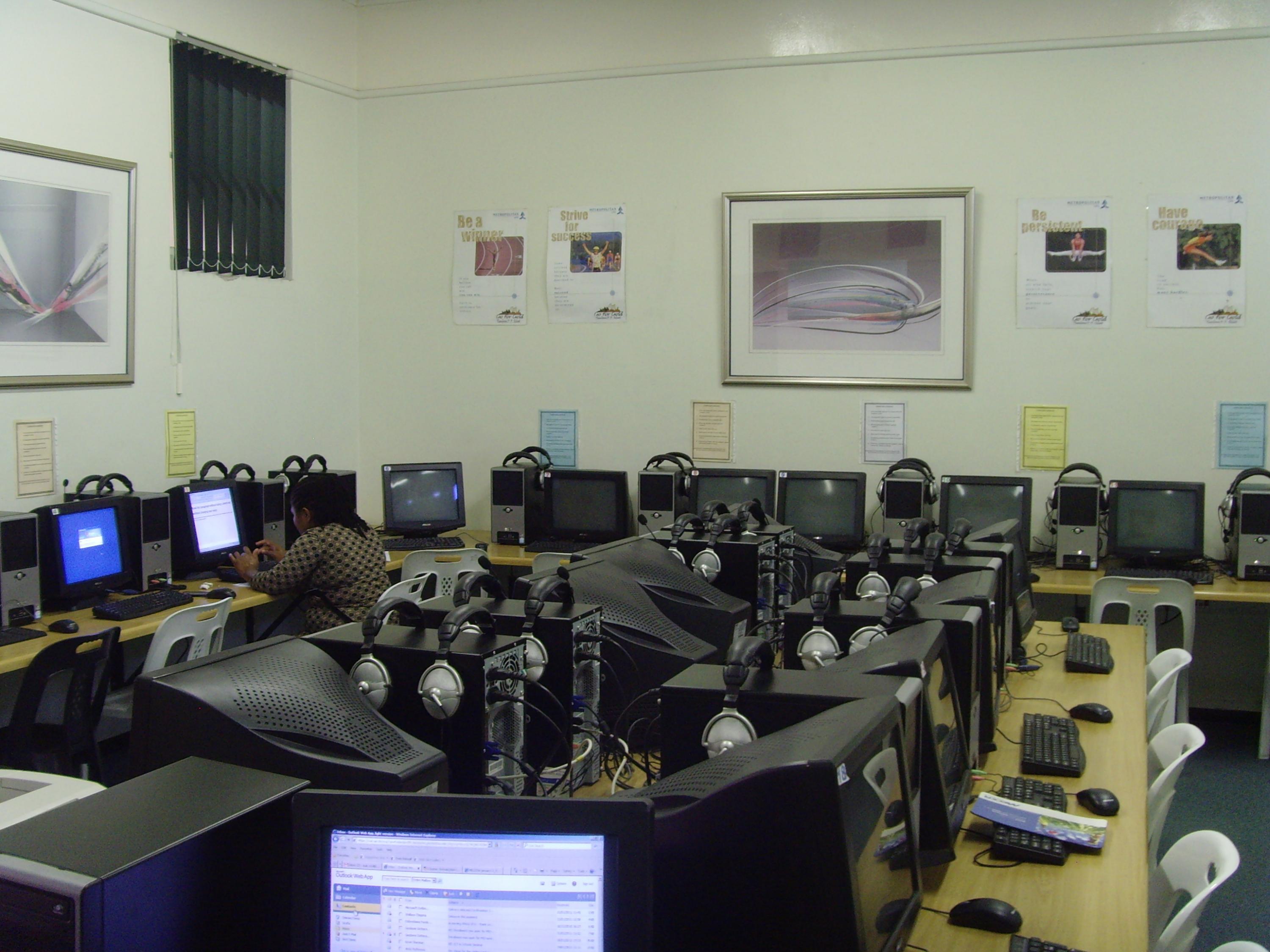
This was an independent study with some of the participating schools in the former Khanya project, which was conceived in 2001 by the Western Cape provincial government with the goal of installing computer labs within all primary schools in the Western Cape by the end of 2011. Experiences from the study reported here indicate many opportunities and challenges in terms of the technology-for-education model propagated by Khanya. According to Van Zyl and Sabiescu, "the underlying causes for the accomplishments and failures of the Khanya model are best articulated by adopting a perspective that goes beyond an instrumentalist and pragmatic approach to the investigation of technology usage."
To begin, the authors contextualise the introduction and adoption of ICT for education in South African primary schools. In the case of the Khanya programme, teacher training was often felt to be inadequate or non-existent. Overall, Van Zyl and Sabiescu say, "the literature describes a challenging and complex environment for the deployment of digital technologies in South African schools, where effective integration and adoption requires active participation at several levels, including government and policymakers, donors, civil society, school management, educators, and learners. Yet, within and across these levels, differing and even counterproductive attitudes toward technology emerge. These attitudes may instill or deter ICT acceptance and eventual adoption. It becomes important, then, to learn about the many perceptions of, and meaningful engagements with, technology in teaching and learning. Infrastructural and policy challenges aside, the many social meanings and representations that are attached to ICTs can significantly influence the adoption process. A study of social meanings attached to ICTs appears to be critical..."
Thereafter, Van Zyl and Sabiescu discuss some of the pertinent literature relating to social meaning(s) of technology. They adopt a social constructionist and sociocultural approach, which they use to shed light on the importance of meaning attribution and symbolic interpretation in the analysis of technology adoption and appropriation in scholarly environments. This perspective helps illuminate the fact that, "When technology is integrated in a new scholarly environment, both teachers and learners re-imagine technology and its uses from a standpoint firmly rooted in their own sociocultural contexts." Furthermore, "the meanings attributed to technology by pre-service teachers in South Africa are context-bound and display attributes generated by the experience of living in a resource-limited context."
Next, the article provides background to the research project and outlines its methodological approach. In brief, the 6 participating schools were generally under-resourced and under-equipped. They were situated within communities with diverse histories, experiences, and sociocultural norms and values. In this way, schools are at once heterogeneous and embedded in larger political and educational structures. This article reports on the ethnographic activities that Van Zyl and Sabiescu undertook: in-depth discussions, participant observations, and critical reflections at the 6 schools. In addition, participants were regularly engaged through weekly computer literacy workshops, in which the ethnographers acted as facilitators and mentors. In this way, the research became action-oriented.
In documenting some of the insights gathered during this ethnographic inquiry, Van Zyl and Sabiescu explore the various social interactions and technology encounters that take place in teachers' daily lives. They examine:
- The social function of the teacher - "[T]he research opened up to a new analytical perspective with respect to ICT integration in schools, asking the following: How can ICTs, as artefacts initially alien to teachers, be integrated so that they are not merely instructional devices in a simplistic teaching-as-information-delivery paradigm, but that they enable teachers to both express their multifaceted roles and enact meaningful teaching-learning interactions?"
- Encountering digital technology in meaningful ways - Van Zyl and Sabiescu argue that the technology encounter is an interpretive and symbolic act; it is not merely a causal meeting, and it includes interactions with both material and intangible objects. The researchers recognise their own role in shaping some of the technology encounters in the primary schools partaking in the study.
- Macro- and meso-level encounters - At both macro (worldwide) and meso (national - e.g., South Africa) levels, Van Zyl and Sabiescu suggest, local institutions purposefully leverage digital technology in the belief that it can support development - for instance, in the educational sphere.
- Micro-level encounters - The general sentiment among teachers is that technology makes life easier, makes information accessible, and increases productivity at work. The functional value of technology is also closely linked to its educational benefits. However, not all teachers were confident in their own ability to use digital technology for educational (or other) purposes.
- Encountering technology symbolically - Computers are not just instruments but are objects imbued with meaning, and the authors' emphasis remains on micro meanings - those held in multiple everyday contexts, such as particular areas, functions, and enclaves within a school. What results is "a complex assemblage of symbolisms, an ecology of meaning." Such complexity is reflected in the fact that there may be a "sense of technology enthusiasm" co-existing with a perception of computers as "monstrous, generationally confined, or challenging to understand".
Van Zyl and Sabiescu identify an inherent tension between the functional and socio-symbolic roles of technology, fuelled by direct and indirect technology encounters at different levels. They observed several utilitarian themes at the outset of the study:
- Pragmatism: ICT symbolised as being practical and functional.
- Necessity: digital as critical to the progress of the school and to the advancement of the teaching profession.
- Pessimism: narratives conveying mistrust and cynicism towards technology integration, as well as frustration and fear.
- Optimism: narratives ranging from a view of technology as entertaining and engaging, to a pronounced romantic vision of technology, to a belief in its capacity to enlighten and transform.
Ultimately, Van Zyl and Sabiescu found that "the symbolic narrative that characterises the technology-in-education experience is, paradoxically, both perceptible and elusive....Teachers, for instance, desired to use technology, but also insulated themselves against it. In public (e.g., interviews), they were passionate and optimistic about educational technologies. In practice, they were often passive and indifferent to acquiring digital literacy skills....Many of the teachers, moreover, had not encountered ICTs as a real educational tool; hence there existed no benchmark by which to gauge successful adoption."
In conclusion, while it may be evident that, at the macro level, the globalisation of digital technology has strongly affected the teaching profession, which resonates both nationally and regionally in South Africa, the authors argue for the importance of closely and critically scrutinising more micro-level encounters when seeking to understand the integration of technology for teaching and learning. They propose that these encounters are interpreted subjectively from the viewpoint of individual teachers, and they culminate in the emergence of symbolic narratives: complex assemblages of symbolisms, meanings, understandings, and interpretations that arise through and therefore come to influence further technology engagements. Van Zyl and Sabiescu stress that symbolic encounters are highly situational and may vary across institutional, personal, and cultural modalities. Thus, they urge, a closer examination of teachers' symbolic narratives is needed in order to shed light on the reasons underpinning the processes of appropriation, integration - or, alternatively, rejection - of ICT in specific urban economically poor and under-resourced environments.
The African Journal of Information and Communication (AJIC), 18, 95-115. https://doi.org/10.23962/10539/21654; and email from Izak van Zyl to The Communication Initiative on April 12 2019. Image credit: Izak van Zyl