










































Stronger with Breastmilk Only
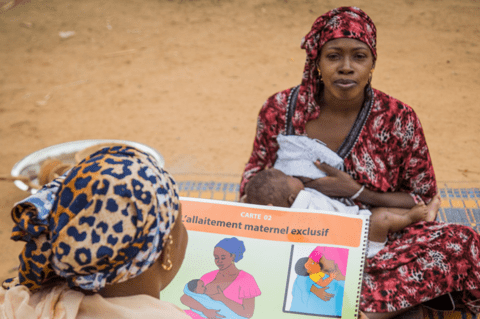
Launched regionally in November 2019, Stronger with Breastmilk Only is a multi-year advocacy and social behaviour change campaign aiming to protect, promote, and support exclusive breastfeeding in the 24 West and Central Africa countries. Its messaging focuses on stopping the practice of giving water to babies younger than 6 months as an entry point for shifting norms and behaviours and influencing the environmental, social, economic, and behavioural factors that influence a mother's decision to feed a child breastmilk only. The United Nations Children's Fund (UNICEF), the World Health Organization (WHO), and Alive & Thrive (A&T) are calling on governments, partners, businesses, communities, and families to ensure that mothers get the support they need to give their babies a healthy start in life, especially as the COVID-19 pandemic impacts the continent. The ultimate goal is to catalyse policy, social, institutional, community, and family dialogue and change towards action that positions breastfeeding as a public health priority to curb neonatal and infant mortality.
The initiative places families at the centre of its efforts while also engaging communities, health systems, the private sector, the public and policymakers to act to support and promote breastfeeding. Using a multi-channel approach, the communication and advocacy campaign highlights the virtues of breastfeeding on demand, day and night, and no supplementing with water, other liquids, or foods - even in hot and dry climates such as West Africa. Breastmilk contains all the water and nutrients a baby needs during the first 6 months of life. Based on scientific evidence, these recommendations stay the same during the COVID-19 pandemic.
Activities differ from country to country but have entailed, for example:
- Community engagement/education - In the village of Zengon-Bougage in the region of Maradi, in central Niger, community health volunteer Anifa has been offering educational sessions to instruct women's groups about the nutritional benefits of exclusive breastfeeding, using information, education, and communication (IEC) materials such as flipcharts. In addition, to normalise the activity, she breastfeeds her own baby in public. According to UNICEF, others have started to understand the importance of exclusive breastfeeding, either because they have witnessed Anifa's practice or heard about it through word of mouth, a powerful tool in rural areas.
- Edutainment - A community of celebrities joined forces and dedicated special songs to support the campaign and help spread messages. For example, Safiath, a popular artist in Niger, produced a song (see video below) whose chorus says (in Hausa) "nono uwa" - breastmilk; "Banda ruwa" - without water; "aba jariri nono tsantsa daga an ayhoshi zuwa wata shidda" - exclusive breastfeeding to 6 months. Safiath commented: "Music has the power to teach people, to reach people....Yes, music can change behavior. There is a proverb in Niger that says, 'Music soothes the soul.' When we are very musical, it's easier to receive a message. I'm not saying it will change the world but it will change the behavior of certain people. Of course, I want to see that with this song."
- Media efforts - These include public debates, promotional advertising, billboards, and bulk SMS (text messaging) blasts.
- Call to action [PDF] - The campaign delineates specific steps for stakeholders to take in this advocacy document.
- Learning - More than 100 stakeholders from across West Africa participated in a virtual learning and sharing café on August 19 2020. The goal was to communicate the strategies and objectives of the initiative, as well as the concrete ways countries are implementing and adapting the initiative in the context of COVID-19.
Children, Nutrition, COVID-19
According to studies in low- and middle-income countries (LMICs), babies who receive liquids and foods in addition to breastmilk before 6 months of age are at greater risk of diarrhoea and respiratory infections. They are almost 3 times more at risk of dying than those who are exclusively breastfed. However, in West and Central Africa, UNICEF estimates that 7 out of every 10 babies received liquids and foods in addition to breastmilk in 2019 during their first 6 months of life, contributing to child malnutrition, illnesses, and even death. Furthermore, it is estimated that the number of stunted children under 5 years of age in West and Central Africa increased from 23 to 29 million between 2000 and 2019. In addition, the region is home to an estimated 7.3 million children suffering from acute malnutrition. With COVID-19 and increasing levels of food insecurity along with other risk factors, the regional malnutrition caseload is projected to increase even more.
Click here to read a (translated) series of articles published in Le Monde Afrique in collaboration with the Fonds Français Muskoka that highlights the importance of exclusive breastfeeding across West Africa and discusses the obstacles to achieving the target of 50% exclusive breastfeeding by 2025. Among the reasons: lack of information for Burkinabé mothers, difficulties in combining work and full breastfeeding in Dakar, and fear of seeing their breasts sag for some Cameroonian mothers. In addition to this, you have the messages conveyed by the infant formula manufacturers.
The Stronger With Breastmilk Only campaign echoes the call of the Global Breastfeeding Collective, a global partnership to increase political commitment, investment, and policy change to support breastfeeding.
A&T, UNICEF, and WHO - along with the Bill & Melinda Gates Foundation, Le Fonds Français Muskoka, and AICS - the Italian Agency for Development Cooperation.
The MIYCN Update from Alive & Thrive, sent to The Communication Initiative on November 2 2020; "In Niger, Safiath brings her talent to support exclusive breastfeeding campaign", A&T website, November 2 2020; "Exclusive breastfeeding in West Africa: Series focuses on the realities for mothers, infants and communities in Burkina Faso, Cameroon, Nigeria and Senegal", A&T website, November 1 2020; 'Stronger with Breastmilk Only': A Learning and Sharing Café [PDF], August 19 2020; UNICEF Niger website, August 27 2020; and Stronger with Breastmilk Only website - all accessed on November 10 2020. Image credit: © UNICEF/UN0161679/HR/Mali
- Log in to post comments