










































Strengthening the Merci Mon Héros Campaign Through Adaptive Management: Application of Social Listening Methodology
Tulane University (Silva); M&C Saatchi (Walker); Johns Hopkins Center for Communication Programs (Portillo); Population Council (Dougherty)
"[F]or health communication campaigns that already engage populations who have a digital presence, social listening and social media monitoring can be powerful monitoring and evaluation tools."
Social media monitoring (quantitatively tracking mentions and comments on social media regarding a specific topic) and social listening (qualitatively tracking and analysing web-based interactions) are becoming increasingly relevant for public health research and evaluation - including in low- and middle-income country (LMIC) contexts. Between 2014 and 2018, the penetration of smartphones in sub-Saharan Africa increased from 10% to 30%, enabling increased access to the internet and social media. This paper describes the process used by Breakthrough RESEARCH to apply social media monitoring and social listening techniques in 4 francophone West African countries for the adaptive management of the Merci Mon Héros (MMH) campaign. It outlines how the lessons learned can be used to support future public health campaigns.
As detailed at Related Summaries, below, MMH is a multimedia campaign co-developed and implemented by youth activists and the United States Agency for International Development (USAID)-funded West Africa Breakthrough ACTION (WABA). This initiative aims to increase the coordination and effectiveness of social and behavioural change (SBC) interventions in Burkina Faso, Côte d'Ivoire, Niger, and Togo. MMH's youth-led campaign videos and other content such as quizzes, concerts, and recorded conversations are disseminated via Facebook, Instagram, Twitter, and YouTube, as well as through more traditional channels, such as television, radio, and community activities. Spreading MMH content through social media channels is meant to normalise the habit of talking about youth reproductive health (RH) and contraception needs, to empower young people to share their own stories and seek information to help them make informed, voluntary family planning (FP) choices for their future, and to promote a conducive environment for these decisions.
In brief, the MMH adaptive management process involved 6 steps:
- Ensure there is a sufficient volume of topic-specific web-based conversation in the priority countries.
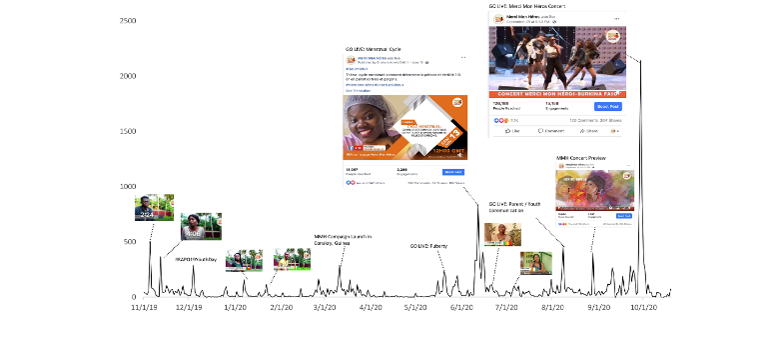
- Develop measures to monitor the campaign's social media strategy - e.g., by identifying conversation volume as a key indicator to track changes over time for topic-specific social media posts and comments and by selecting key indicators to help track social media users' interaction with the campaign through conversation volume, reach, engagement, and views.
- Identify search terms to assess campaign and related conversations - i.e., through a series of steps that began with co-development (with youth stakeholders) of a set of relevant keywords to capture conversations and that ended with use of machine learning technology.
- Quantitatively assess campaign audience demographics, campaign reach, and engagement through social media monitoring.
- Qualitatively assess audience attitudes, opinions, and behaviours to understand conversation context through social media listening - i.e., by using data visualisation and tools such as topic wheels, word clouds, topic clustering, and bigram analysis.
- Adapt campaign content and approach based on the analysis of social media data - e.g., by sharing reports with WABA to inform evidence-based adaptations to the MMH campaign.
The researchers analysed posts across social media platforms from November 2019 to October 2020 based on identified key search terms related to FP, RH, menstruation, sexual activity, and gender. Based on the quantitative and qualitative assessments in steps 4 and 5, there were several adaptive shifts in the campaign's content and approach, of which the following 3 shifts are highlighted:
- Social media monitoring identified that the Facebook campaign fans were primarily male, which prompted the campaign to direct calls to action to the male audience already following the campaign and to shift marketing approaches to increase the proportion of female followers.
- After learning that shorter videos had a higher chance of being viewed in their entirety, the campaign shortened video lengths and created screenshot teasers to promote videos.
- The most negative sentiment related to the campaign videos was associated with beliefs against premarital sex. In response to this finding, the campaign included videos and Facebook Live sessions with religious leaders, who promoted talking openly with young people to support intergenerational discussion about RH.
The following lessons learned from the application of social media monitoring and social listening to the MMH campaign suggest that future public health social media campaigns may wish to:
- Understand who uses social media in the implementation countries, and consider how the campaign's intended audience and content align with the audiences who are active on social media platforms;
- Assess which social media platforms are most active and relevant in the country of interest and the privacy limitations/administrative access requirements associated with these platforms;
- Pilot multiple engagement strategies adapted to the social media channel (e.g., Instagram) to test, through social monitoring and listening, which strategies are associated with higher engagement in adolescent-sexual-health-related posts; and
- Pair designated hashtags representing the goals of the campaign to facilitate the monitoring of conversations. The implementation of these hashtags should be consistent across social media channels.
In conclusion: "Inherent biases to internet and social media access are important challenges, and ethical considerations around data privacy must continue to guide the advances in this technology's use for research. However, social listening and social media monitoring can be powerful monitoring and evaluation tools that can be used to aid the adaptive management of health campaigns that engage populations who have a digital presence."
JMIR Public Health and Surveillance 2022;8(6):e35663. doi: 10.2196/35663.