










































Strengthening the Acute Flaccid Paralysis (AFP) Surveillance Component of the Polio Eradication Initiative through Short Message Service (SMS) Reminders; Experience from Sokoto State, Nigeria 2014
African Field Epidemiology Network (Adegoke, Nguku); World Health Organization, or WHO (Takane, Ota, Murele, Okayasu); Centers for Disease Control and Prevention, or CDC (Biya, Mahoney)
This article describes a pilot study in the state of Sokoto in Nigeria, one of the three remaining polio-endemic countries, to evaluate the impact of refresher training and weekly short message service (SMS)-based reminders and reporting on the acute flaccid paralysis (AFP) surveillance system. The specific objective is to assess: (i) the changes in knowledge, attitude, and practice (KAP) among surveillance focal points and clinicians and (ii) the progress in improving AFP surveillance indicators (e.g., reporting rate, timing).
Providing context, the researchers explain that Nigeria appeared to have interrupted wild poliovirus (WPV) transmission in July 2014. But two years later, continued WPV circulation was detected in Borno, a northern state with ongoing conflict. Polio cases are detected through surveillance for AFP, which entails rigorous, timely AFP identification and reporting, and confirmation of WPV in stool samples. Identification of AFP caused by polio is significant because, for every child affected by paralytic poliomyelitis, approximately 200-1,000 children may be infected with WPV without paralysis. Therefore, failure to detect cases early enough and to respond promptly through supplementary immunisation activities (SIAs) will hinder the ability to eradicate polio. In Nigeria, a focal point for AFP surveillance is assigned at each AFP reporting site, responsible to immediately report any suspected AFP cases to the Disease Surveillance Notification Officer (DSNO) at the district level and to conduct active AFP case search.
The experimental study has a one-group pretest-post-test design. It was conducted in three stages:
- A baseline assessment of the KAP of 223 clinicians, the majority of whom were community health extension workers (CHEW), and focal points from 112 health facilities. Only 48.9% of clinicians knew the proper case definition for AFP; even fewer (19.7%) were found to have knowledge of active case search. Less than half (47.5%) had been formally trained on AFP surveillance.
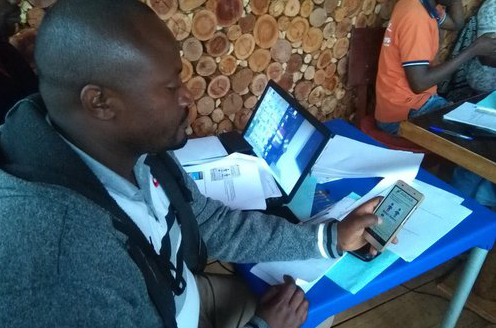
- The training of healthcare workers through a short course on AFP detection and the surveillance system, followed by training on the processes involved in the SMS reminders and reporting system. They were requested to continue the traditional AFP reporting system in addition to the SMS method for a period of 36 weeks (November 2013 - July 2014). The SMS reporting method is a semi-automated system using the (open source) RapidSMS platform, which automatically sends out reminders to healthcare workers at a designated time, receives reports, and aggregates the information on the system dashboard. During the implementation phase, SMS reminders were sent to the focal points and clinicians every Friday with messages tailored according to the profile of the health worker. Once a suspected AFP case was reported by SMS, an automated SMS reply was sent to the focal point requesting the case information (e.g., name, sex, date of onset, date reported).
- Follow-up assessment of healthcare worker awareness and knowledge of AFP and the surveillance process. After sending SMS reminders to all focal points for 36 weeks, the investigators visited the same facilities and administered the same standardised KAP questionnaire as in the pre-intervention phase. During the follow-up assessment, active case search through register review was conducted.
During the intervention period, a total of 176 AFP cases were reported through the SMS reporting system, as compared to 233 AFP cases reporting through the official reporting channel for the same reporting period in 2012/2013. Eighteen percent of confirmed AFP cases were reported through the SMS reporting system for the reporting period. The SMS reporting system picked up only one case not reported through the official reporting channel. Review of registers in surveillance sites did not find any missed AFP case during the SMS-based intervention. The average number of days between the date of AFP onset and that of notification during the study period was 5.6 days, as compared to 6.2 and 9.2 in the similar period one and two years previously. (The researchers indicate that this trend might be due to improvement in the reporting system over the years and may not solely be attributed to the SMS intervention.)
The post-implementation follow-up survey showed that 95.6% of focal points and 62.7% of clinicians knew the AFP case definition. This finding represents a 15.6% and 13.8% improvement for AFP focal points and clinicians, respectively. Approximately one-third (30.5%) of clinicians had knowledge of active case search, which showed a substantial increase when compared with the baseline survey. An increase of 10.3% of clinicians at the post-intervention survey knew whom to contact after a child with suspected AFP was diagnosed. Clinicians showed an improvement in practice that was statistically significant (p<0.05). However, no statistically significant difference was found in knowledge and attitude of clinicians or in attitude and practice of AFP focal points in pre- and post-intervention. Three-quarters (75%) of focal points in the follow-up assessment indicated they reported zero cases of AFP through the AFP SMS reminder system. Fifty-five percent of focal points indicated "I don't receive SMS credit" as a reason for not reporting through the SMS system.
According to the researchers, the SMS AFP surveillance project contributed to polio surveillance in multiple ways. First of all, the project contributed to identifying and addressing the knowledge gaps amongst healthcare workers. The improvement in the follow-up survey indicated that the study strengthened AFP awareness and training. More than 50% of focal points responded to SMS reminders, demonstrating the feasibility of this approach.
Concluding that the use SMS for AFP reporting improves reporting rate and timeliness, the researchers suggest that the study should be expanded to areas with low AFP reporting rate, where there is more opportunity to identify unreported cases, as well as to cover non-conventional healthcare providers and community informants, who are not part of the official surveillance system. The inclusion of these non-conventional informants amongst underserved and hard-to-reach populations could provide an opportunity to overcome access challenges.
Journal of Immunological Sciences (2018); S (010): 68-74. Image credit: eHealth Africa
- Log in to post comments