










































Social Marketing for Health and Family Planning: Building on Tradition and Popular Culture in Niger
German HIV Practice Collection - German Development Cooperation (GDC)
This German HIV Practice Collection study from Niger examines the social marketing methods used by the Association Nigerienne de Marketing Social (Animas-Sutura). Animas-Sutura is one of the main mechanisms through which Niger implements actions called for in its national strategic framework on sexually transmitted infections (STIs)/HIV/AIDS, its 2006 law on reproductive health, and its 2007 policy on population. The organisation was formed in 2006 through funding from the KfW Entwicklungsbank (German Development Bank, KfW) and is supported by a consortium of consultants on social marketing.
Social marketing, as stated here, "uses commercial marketing methods (consumer research, market segmentation, targeting of messages at particular segments of the market, providing financial and incentives to producers and consumers) to increase knowledge, change attitudes and promote practices, including the use of low-cost, high quality products to improve public health."
Historically, in Niger, social marketing of condoms was rejected as early as 1995 when "enraged marabouts (Muslim clerics) and their followers brought Niger’s first attempt at social marketing to an end when they methodically destroyed billboards with ads for condoms, saying they were an outrageous attack on the culture and mores of a society that prides itself on adherence to a conservative Muslim code of conduct." However, according to the study, there has been growing public recognition of the need to prevent the spread of HIV and reduce the rate of population growth, including the 2006 law on reproductive health that recognises women’s rights to choose whom to marry and couples’ rights to choose whether to have children and when, and the new 2007 policy calling for increased acceptance and use of modern family planning methods.
The goals of Animas-Sutura, as stated here, are more than making condoms and other family planning and health products (e.g., oral contraceptives, water purification tablets, and mosquito nets) available, affordable, and reliable through distribution to everyone who needs them whenever they need them across Niger. They recognise the need not only to market products but also to change behaviour: "This will mean providing all Nigerien youth and adults with the information, education, skills, constant reminders, and access to supplies and services they need in order to make intelligent choices and avoid unwanted sex, unwanted marriage, unwanted pregnancy, and easily prevented infection and disease."
Challenges to behaviour change messaging include a population that is primarily rural, has no electricity, and has low literacy levels. Therefore, television is not a useful tool for marketing, and radio is unlikely to reach women, since it is primarily accessed by men through battery powered radios.
Methods chosen include the following:
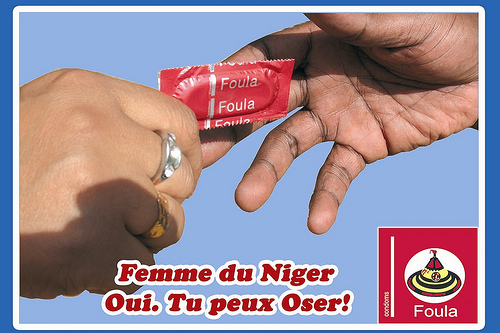
- Turning to tradition and popular culture to avoid historical rejections, the campaign chose for the name and symbol of its condoms the traditional foula hat, famous for the excellent protection it provides against the country’s intense sun. "Careful testing found it was a popular choice for a brand name and that people could easily make the connection that Foula condoms protect against unwanted pregnancy and disease. To introduce the new brand of condoms, it recruited Balla Harouna, Niger’s three-time wrestling champion and one of its all-time great national heroes. His photo on the first poster advertising Foula condoms helped ensure it was prominently displayed throughout the country and, since then, the project has continued to use major figures in sports and entertainment to deliver its behaviour change messages in songs, television spots and radio sketches."
- The campaign recognised that, though the health services needs among the economically poorest and least educated were greatest, the needs for HIV prevention tended to be greatest among the economically wealthier urban population. "They may be better informed about HIV and how to prevent it but, still, they engage in more high-risk sexual activity (e.g., with non-cohabiting partners including sex workers)..." Therefore, the project focused on sexually active youth, using television spots and songs featuring Mali Yaro, ZM, and other popular entertainers, because television spots were more likely to reach those in urban areas. Also, the songs could be played on radio and reach at least some young adults in rural areas. The project developed "Aventures de Foula", a series of 15 five-minute radio sketches in Niger’s three most widely spoken languages (French, Djerma, and Hausa). Each episode was a mini-drama designed to inform and provoke thought about: risky sexual activity that can result in unwanted pregnancy or disease, when to use condoms, how to get your partner to agree, early marriage, forced marriage, and the spacing of births. Forty-six radio stations broadcast episodes at the rate of one per week, 3 times daily every day of the week for a combined total of 8,000 broadcasts. Every week, each radio station also broadcast a radio debate in which guests focussed on the issues raised by that week’s episode, and, in some cases, listeners called in to participate. To enhance the episodes, "8100 discussions in young people’s fadas (informal groups of friends) [were] guided by trained animators who were, in turn, guided by discussion sheets. In addition, there were 1200 discussions in school classrooms. Altogether, more than 200,000 youth participated in discussions in fadas and classrooms."
"The project commissioned a post-broadcast assessment of the impacts of series one and also an extensive Knowledge Attitudes Practices (KAP) survey. Both concluded that it would be well worthwhile to develop a campaign around a second series. While targeting sexually active youth, the first series had also reached their parents and stimulated much discussion within families. However, the second series should make specific efforts to reach not only all youth but also all rural women, truck drivers, sex workers, and military recruits."
A 2008 pilot project tested a plan to "train respected women from rural villages as femmes relais responsible for organizing and animating weekly discussions to go with each episode plus a decision to provide the femmes relais with solar radios to overcome the problems that radios and batteries are expensive and mostly controlled by men. Another pilot project looked for the best ways to use selected episodes in a five-week course for military recruits....Launched in March 2009, Aventures de Foula series two had 24 five-minute episodes developed around these themes: women’s rights, female genital mutilation (FGM), sexual harassment and degradation, forced marriage and child marriage, sexual fidelity, early sexual relations, and stigma and discrimination against people living with HIV. Compared to the first series, the second series was broadcast on more radio stations and was accompanied by more radio debates and more organized and synchronized discussions. Also, Animas-Sutura had taken steps to improve the quality of each episode and its discussion guide and to improve the training and supervision of radio hosts, animators and teachers and the monitoring and evaluation of their activities."
Simultaneously, the project increased the availability of condoms with a distribution system including: 17 anti-AIDS kiosks run by truckers' syndicates at major truck stops in Niger; 44 wholesalers of the project’s Foula condoms and other products; and a salesperson associated with each wholesaler whose job is to recruit retailers, keep them supplied with products, and help them sell those products with the help of animators, clowns, and other performers provided by Animas-Sutura. There are more than 3,000 retailers: typically, small independent pharmacies and grocery stores, hair salons, bars, petrol stations, market stalls, and walking vendors and motorcycle-taxi drivers found throughout Niger’s cities and towns, making products available at any hour. "During 2009, Animas-Sutura is adding oral contraceptives and water purification tablets to its product line, extending its distribution network into an additional six rural regions, and training femmes relais to demonstrate and sell its products. It is also testing a mobile unit to provide small rural villages with services similar to those provided by Anti-AIDS Kiosks."
Publisher: German HIV Practice Collection - German Development Cooperation (GDC)
Writer: Stuart Adams
For information about the approach outlined in this study, please contact Katharina Anschütz at the address indicated below.
For information about the German HIV Practice Collection, please contact the GHPC Secretariat at the address indicated below.
Email from Dr. Dieter Neuvians to The Communication Initiative on August 1 2009.


- Log in to post comments