










































SADC HIV and AIDS Cross Border Initiative
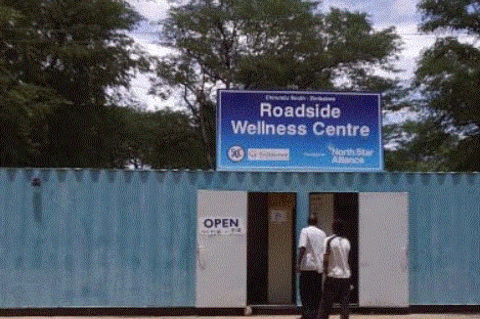
Launched in 2012, the SADC HIV and AIDS Cross Border Initiative is a five year programme established by the Southern African Development Community (SADC) to improve the regional response to HIV and AIDS among mobile populations. The Initiative’s goal is to reduce HIV infections in the SADC region and to mitigate the impacts of HIV and AIDS on mobile populations and affected communities across SADC Member States. Funded by the Global Fund, the initiative focuses on long distance truck drivers and commercial sex workers, as well as communities that live close to cross border sites, through mobile clinics offering health services, as well as behaviour change communication and HIV and tuberculosis (TB) information.
Through the project, SADC, in partnership with North Star Alliance and the Walvis Bay Corridor are establishing mobile clinics at 32 cross border sites, at least two in each of the 12 mainland Member States. Each of these cross border sites will provide the following clinical services to migrants at the mobile clinics: screening for HIV, TB and malaria, voluntary HIV counselling and testing and medical referrals, screening and treatment for sexually transmitted infections (STIs), condom distribution, behaviour change communication, HIV and TB information and education, and primary health care service. These mobile clinics or Roadside Wellness Centres are being created at transport hotspots and will travel across the established migrant corridors. It is intended that emphasis and implementation modalities will vary depending on the needs of each site, with an emphasis on learning what works in what circumstances.
The programme was initiated as it was found that increased cross-border movement in the region increases the risk of HIV infection - not just among high risk groups such as commercial sex workers and long-distance truck drivers, but also among migrant populations, communities close to border sites, and communities with high levels of in- and out-migration. Young working age adults are at particular risk, given that they make up the largest portion of mobile populations, as are young women involved in periodic transactional sex.
Part of the Cross Border Initiative and one of the conditions for the Global Fund grant was for SADC to sign Memoranda of Understanding (MoUs) with all 12 SADC Member States participating in the Cross Border Initiative. The MoUs describe the commitments between SADC, its sub-recipients, and Member States, and delineate the Member States' provision of pharmaceuticals, medical supplies, work permits, and exemption from customs duties. Signing of the MoUs entailed individual country visits to 12 Member States to introduce the project, agree on location of mobile wellness clinics at border posts, and negotiate and obtain commitments from each Member State to support the resourcing and effective functioning of these centres. In July 2012 all twelve MoUs were signed, including: Angola, Botswana, Democratic Republic of Congo, Lesotho, Malawi, Mozambique, Namibia, South Africa, Swaziland, Tanzania, Zambia and Zimbabwe.
HIV/AIDS, Migration
The Southern African Development Community (SADC) is a 15-country intergovernmental organisation established in 1992. Its purpose is to enhance the development and economic growth of Southern Africa, alleviate poverty, and improve the standard and quality of life of the region’s people through regional integration. SADC continues to experience the most severe HIV prevalence in the world. According to SADC, about one third (34%) of all people living with HIV globally in 2009 resided in 10 countries in the SADC region. In 2009, almost a third (31%) of all the people newly infected with HIV and 34% of all the people dying from AIDS-related causes resided in these 10 countries.
The SADC HIV and AIDS Cross Border Initiative forms part of the SADC's HIV and AIDS Programme. For more information about this programme and related resources, see this K4Health Toolkit.
Southern African Development Community (SADC), North Star Alliance, Walvis Bay Corridor,
PharmAccess International, and Population Services International (PSI).
SADC HIV and AIDS Cross Border Initiative [PDF] on July 5 2013.