










































Risk Communication and Community Engagement (RCCE) Considerations: Ebola Response in the Democratic Republic of the Congo
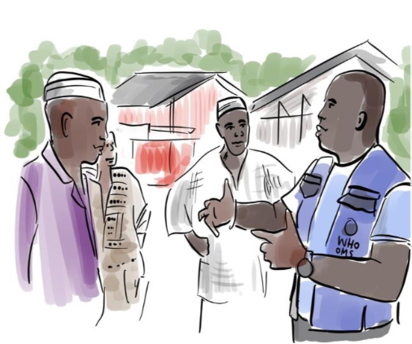
"In order for behaviour or practice change to be adopted, a specific and targeted change objective has to be articulated with a strategy developed together with the community to ensure its implementation."
This document was developed by the World Health Organization (WHO)'s Health Emergencies Programme as a resource for the response to the Ebola Virus Disease (Ebola) outbreak in the Democratic Republic of the Congo in May 2018. It is intended to be used to guide risk communication and community engagement (RCCE) work, which WHO deems central to stopping the outbreak and preventing its further amplification. Unlike other areas of response, RCCE draws heavily on volunteers, frontline personnel, and people without prior training in this area. As such, the document provides basic background information, scopes socio-economic and cultural aspects, and offers evidence-based advice and approaches based on WHO's Communicating Risk in Public Health Emergencies (see Related Summaries, below).
The document features several practical tools. For example, it provides a basic template for message maps (thought to be more useful in disease outbreaks and emergencies than just messages). Once filled in for each change objective (to change knowledge, attitudes, or practices), the map can be used for developing any communication and engagement product or process - from talking points for the media (e.g., "We now have a vaccine that has been used with good effects in the African context to protect from the deadly disease. Please take the vaccine if you are asked to do so."), to developing one or more information, education, and communication (IEC) materials, or for effective conversations in the community or with just one person or family.
The document also annexes a checklist for RCCE considerations in all pillars of the response, from surveillance and contact tracing to clinical care and safe and dignified burials.
English; French
35 (English); 37 (French)
Epidemic Response Anthropology Platform (ERAP), June 21 2018.