










































Responsible Data Management Training Pack
"Managing data properly may be the greatest challenge of the information age. We now have more ways to collect, store, share, transmit, analyse and publish data than ever before. As new legal frameworks emerge and increasing attention is paid to the ethics of data management, humanitarian organizations are adopting new policies on how to manage data responsibly."
From Oxfam, this training pack covers in detail responsible data management (RDM), which may include changing organisational culture, individual attitudes, and behaviour on handling data. "This training pack has been developed to help introduce the principles of RDM, the planning processes that can be used, and to examine how we might handle unexpected issues that arise in different contexts..." for humanitarian organisations.
The goals of the materials are:
- Treating data with respect, upholding the rights of respondents, and ensuring that organisations always act in their best interests.
- Managing data to strengthen and facilitate the contribution that data make to high-quality work.
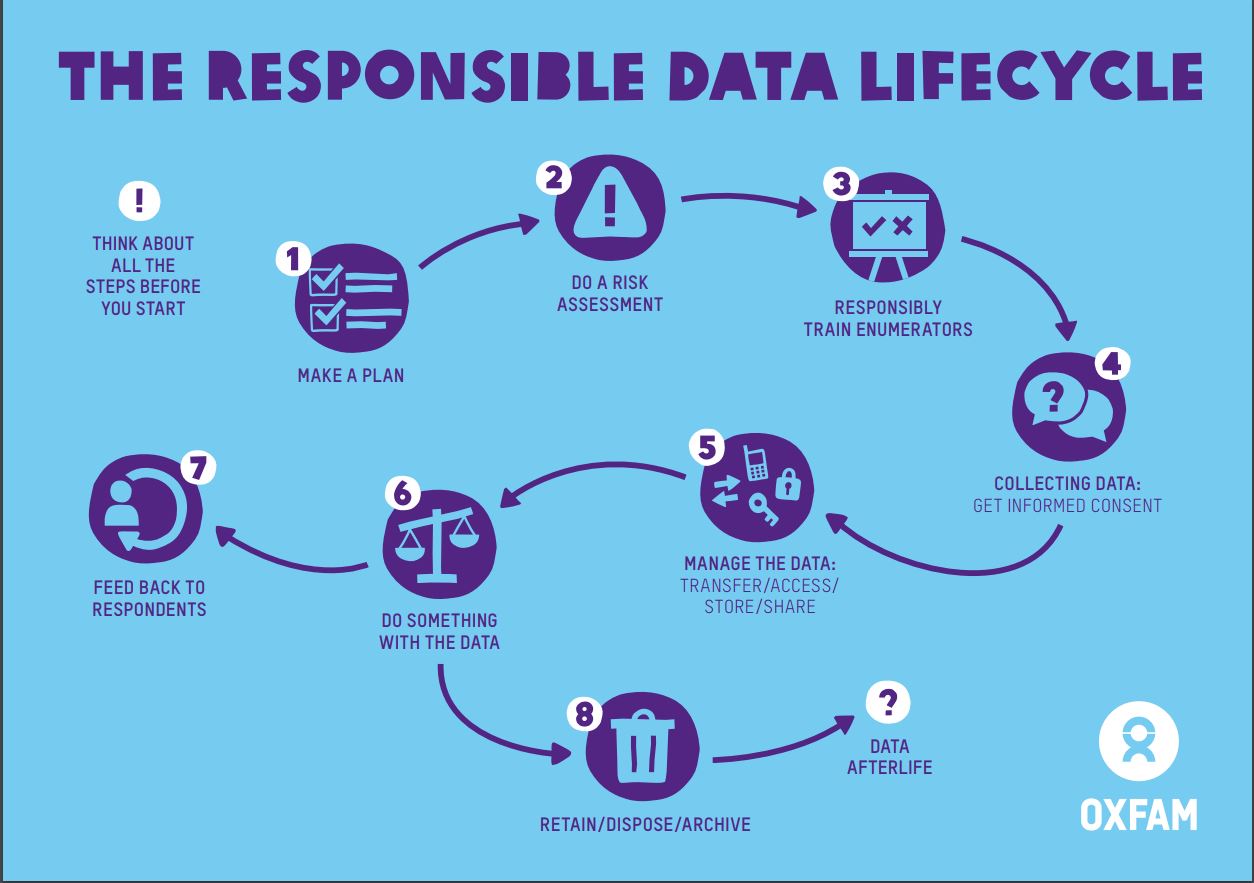
The instruction manual explains that materials are designed to encourage discussion and debate. It outlines how to plan a training session, introducing the topic, defining RDM, and how to proceed with activities, including formatting for the activities. Resources and references are included. Card games for stimulating discussion are downloadable. A leaflet provides tips for managing the data lifecycle responsibly, including a jargon buster and printable A3 poster. A leaflet provides tips for taking photos in humanitarian crises, including links to further information and printable A3 poster.
These titles are available in English, French, or Spanish at the weblink below:
- Instructions booklet (464kB)
- 'Agree or disagree?' cards (doubled-sided) (45kB)
- 'Agree or disagree?' cards (single-sided) (34kB)
- 'What would you do if...?' cards (double-sided) (46kB)
- 'What would you do if...?' cards (single-sided) (35kB)
- Responsible Data Lifecycle infographic poster/leaflet (96kB)
- Taking Photos in Humanitarian Crises infographic poster/leaflet (282kB)
- Making a Plan editable matrix (18kB) PowerPoint presentation (954kB)
English, French, Spanish
Oxfam website, September 6 2017.
- Log in to post comments