










































Relationships: Intimacy Without Risk
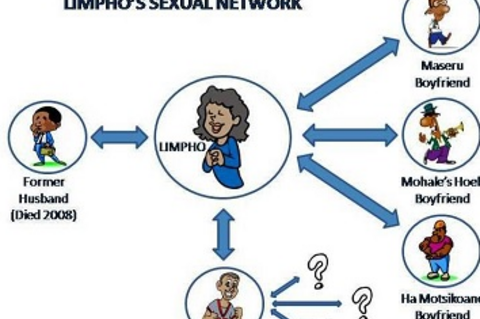
At the beginning of 2009, the Relationships: Intimacy Without Risk project worked with existing community groups in Lesotho to engage adult community members and couples in open dialogue to raise awareness of multiple concurrent partnerships as well as address key factors that perpetuate these relationships, such as alcohol, migration, intergenerational and gender inequality, and pervasive social norms. The goal of the project was to encourage positive and responsible sexual behaviour, by focusing on individual-level behaviour change and community-level normative change. The project was a collaboration between the National AIDS Commission (NAC), the Ministry of Health and Social Welfare (MoHSW), the President's Emergency Fund for AIDS Relief's C-Change Project, and Phela Health and Development Communication.
The main activity of Relationships: Intimacy Without Risk project were facilitator-led, informal, participatory group conversations that provided an open space for group members to become comfortable with discussing sexual issues, identify the drivers of HIV within their wider social and cultural contexts, and address their own attitudes and behaviours toward the virus in order to make positive individual and collective decisions and plans to further disease reduction.
To understand the context for new SBCC intervention design, C-Change conducted an inventory review of existing HIV prevention communication materials and ongoing prevention programmes in Lesotho. C-Change then designed a community manual to guide the dialogue intervention, which included a facilitator's guide, a training manual, and communications materials. The intervention consists of 11 sessions including: HIV basics, relationship between HIV and multiple concurrent partnerships (MCP), sex & sexuality, facts and myths around HIV and AIDS, problems and pleasures of MCP, couples communication around love and sex, gender and culture, real men and real women, stages of behaviour change, and Yes, I can change my behaviour.
The programme implementation included four phases of group and facilitator selection, training, and conducting community dialogue groups and community outreach. C-Change provided technical assistance to district health leadership and CBOs to engage with community councils and select community groups to participate in the planned community dialogues. Community members participated in the dialogue groups. Along with these groups, C-Change also engaged hard-to-reach groups including couples, correctional facility inmates and staff, garment factory workers, and police and security company staff, in day-long orientation workshops on concurrency and HIV. In addition, college students were engaged to carry out a compressed dialogue programme with their peers. Each group that participated in the dialogue programme was encouraged to organise at least two outreach events. These events were designed to engage members of the wider community who were not part of existing community groups. Some of the outreach activities conducted by groups included: screening of the MCP drama, 'Monna oa Motsamai', that was developed by Phela Health and Development Communication as part of the Onelove campaign, discussions at local bars, and health talks on concurrency and HIV with health care providers.
C-Change developed a three-pronged sustainability strategy for the community dialogue programme that included certificates of completion, follow-up training, and the community conversation toolkit:
- Certificates of completion - C-Change provided certificates of completion and ceremonies to recognise the groups that completed the 11-week dialogue programme and at least two outreach activities. C-Change encouraged groups to continue engaging around concurrency and HIV within their groups and the wider community after the 11 weeks. Programme staff continued to make themselves available to groups by phone and through the provision of questionnaires, risk and value forms, and monitoring and evaluation (M&E) forms that would allow groups to track individual and group change.
- Follow-up training - During the last year of the programme, C-Change provided further training of CGFs to upgrade their status to Community Mentors to enable them to liaise with community council members and provide guidance to new groups in getting started, organising outreach activities, and helping them problem solve around challenges.
- Community conversation toolkit: C-Change developed the Community Conversation Toolkit, an additional resource for community groups that completed the dialogue programme. The interactive materials in the toolkit responded to feedback from CGFs that it was challenging to initiate conversations on HIV in certain social situations (e.g., bars). Six distinct materials designed for the use of small groups in facilitated or social settings are grouped around a guide intended to mobilise communities for HIV prevention. Finalised materials are in Sesotho, with adapted artwork.
The community dialogues were complemented and reinforced by being part of a larger regional campaign to address concurrency. Entitled OneLove, and conducted by the Soul City Institute for Health and Development Communication and Phela in Lesotho, this larger mass media campaign allowed community members in the dialogues to discuss concurrency through additional communication channels. C-Change supplemented the booklets, flyers, and posters used by the OneLove campaign in Lesotho with billboards and radio talk shows, radio public service announcements (PSAs), and a concurrency pamphlet. Links between community dialogues and the larger mass media campaign were reinforced in several ways. For example, talk shows were designed for both male and female audiences and addressed such themes as gender norms and their influence on the way in which men and women behave and their risk of HIV.
Topics discussed in the talk shows were taken directly from the C-Change community dialogue manual, and community members from the targeted districts where dialogues were conducted were invited to participate in discussions. Community members from outside Maseru could also call into the show to ask questions and participate in the discussions. PSAs related to risk and reduction of concurrency were launched across four radio stations in Lesotho (Harvest FM, Moafrika, Radio Lesotho, PC FM). In addition, billboards on HIV drivers were developed and displayed in each of the five districts where the community dialogues were implemented. In addition to the stationary billboards, C-Change arranged for mobile billboards through a local bus company. Billboards were placed on the backs of buses which covered 10 long distance routes throughout all of the country's districts.
HIV/AIDS
The OneLove campaign worked to increase awareness of the risks related to concurrency among adults ages 18–50, which was linked with tools for groups to carry out community-level discussions. These two mutually supporting components of mass media and community mobilisation, effectively used different channels to communicate mutually reinforcing messages.
National AIDS Commission (NAC), Ministry of Health and Social Welfare (MoHSW), President’s Emergency Fund for AIDS Relief ‘s C-Change Project, Phela Health and Development Communication.
C-Change website on June 6 2013
- Log in to post comments