










































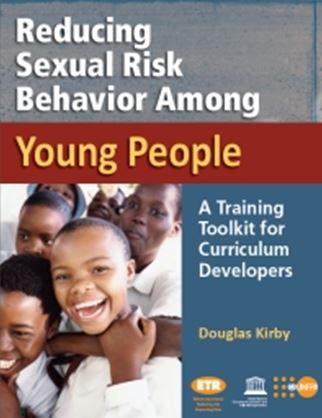
Reducing Sexual Risk Behavior Among Young People: A Training Toolkit for Curriculum Developers
Image
SummaryText
This is a training toolkit intended for training sessions with curriculum developers wanting to develop a country- or context-appropriate curriculum on sexuality and sexually transmitted infections (STI), including HIV, for education in schools or other learning environments.
As stated in the toolkit, the training has two primary objectives: "1. To increase participants' knowledge and skills to design and adapt sex and STI/HIV education curricula for young people so that those curricula are more likely to change young people's sexual behaviors that affect HIV transmission, other STI transmission, unintended pregnancy and coerced sex. 2. To develop a partial blueprint for an effective sex and STI/HIV education curriculum for each country (or group of participants)."
By the end of the workshop, the participants should have a clear idea of how to develop a curriculum, and should leave the training with a partial blueprint, as well as a plan for completing their curricula. If appropriate, the groups also develop a plan for getting the curriculum adopted and then disseminated.
The training is organised as follows:
Editor's note, May 24 2016: This toolkit is no longer available online. Please contact ETR Associates to inquire about how to access it.
As stated in the toolkit, the training has two primary objectives: "1. To increase participants' knowledge and skills to design and adapt sex and STI/HIV education curricula for young people so that those curricula are more likely to change young people's sexual behaviors that affect HIV transmission, other STI transmission, unintended pregnancy and coerced sex. 2. To develop a partial blueprint for an effective sex and STI/HIV education curriculum for each country (or group of participants)."
By the end of the workshop, the participants should have a clear idea of how to develop a curriculum, and should leave the training with a partial blueprint, as well as a plan for completing their curricula. If appropriate, the groups also develop a plan for getting the curriculum adopted and then disseminated.
The training is organised as follows:
- Presentation of evidence on the prevalence of HIV, other STIs and pregnancy in the host country.
- Presentation of evidence from Africa on declines in HIV prevalence and changes in behaviour among young people.
- Global evidence on the impact of sex and STI/HIV education programmess.
- Use of a logic model: As stated in the toolkit, "An overarching characteristic of the effective programs is that they were based on a logic model. It stipulates that first the public health goals (e.g., reducing unintended pregnancy, HIV or other STIs) are specified; second, the behaviors affecting those health goals are specified; third, the risk and protective factors affecting each behavior are specified; and finally, the specific curriculum activities designed to change each selected risk and protective factors are specified." The logic model then becomes the basis for most of the remainder of the training.
- Selecting health goals.
- Selecting behaviors that directly affect these health goals.
- Selecting risk and protective factors that affect each behaviour. Once factors are identified, those factors that curriculum-based programmes can actually change are selected. These are mostly psychosocial factors.
- Selecting activities to change these psychosocial factors e.g., short lectures, small group discussions, role playing, simulations.
Editor's note, May 24 2016: This toolkit is no longer available online. Please contact ETR Associates to inquire about how to access it.
Publication Date
Number of Pages
306
Source
United Nations Population Fund website on July 23 2014.
- Log in to post comments