RedChatZone
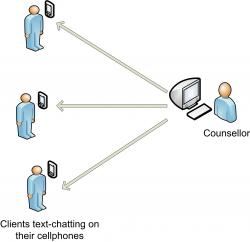
The service was set up as follows: a contact that MXit users could add - RedChatZone - was created; a web-based system was created to enable counsellors to provide text-based counselling from their PC to MXit users; a small amount of "splash screen" advertising was done on MXit to inform users about RedChatZone; users then added RedChatZone as a contact, allowing them to chat with a counsellor for as little as $0.01 in data costs for a conversation.
Counsellors were trained to understand "chat" language, allowing them to communicate on the same level as the users. Once they were used to text-based counselling, they were able to handle up to ten or more conversations at the same time. Also, due to the less personal nature of chat, counsellors found that users would get to the point far quicker.
According to the organisers, mobile text-chat is an ideal way of providing HIV counselling as: it is cheap for users; people can get counselling from anywhere (like their bedroom); it is efficient for providers (as counsellors can counsel many people at the same time); and it is an appropriate way of getting youth to talk about HIV.
Other features of the system include the fact that counsellors can view the chat history of clients, removing the need for the client to repeat ground already covered in previous counselling sessions; usage statistics can be obtained as and when needed, making staff and service management easier; the conversation text can be made available for analysis (though privacy also needs to be taken into consideration); and counselling can be provided from any computer connected to the internet, saving on call-centre infrastructure costs.
HIV/AIDS
According to the organisers, research has shown that users sometimes struggle to call the National AIDS Helpline from a landline because it is difficult to talk about certain things for fear of someone overhearing. They felt more comfortable using the service on a cell phone as it would seem like they were just chatting with a friend on MXit.
In addition, hoax calls are a big problem for South African helplines. The National AIDS Helpline has found that up to 80% of calls are hoax, which wastes a lot of counsellor time. On MXit, this decreased dramatically, and the few hoax calls received are easy to deal with as the counsellor can ignore them and carry on with their other conversations. A possible reason for the decrease in hoax calls is that this costs the user a small amount of airtime that could rather have been spent on chatting with friends.
To find out more about the free technology used to run this service, go to the JamiiX website.
Cell-Life and LifeLine
MobileActive website on January 3 2011.
Comments

thanks
thank you for the commendable job ,when are you coming to uganda