










































Red Card
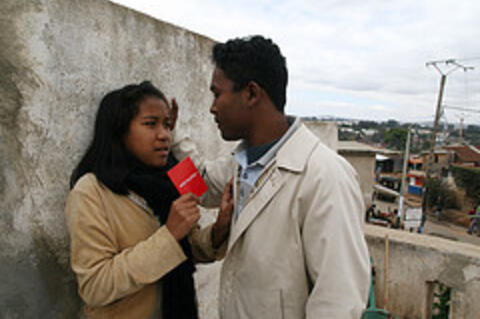
To kick off the initiative, AED ran a series of 4 television spots showing teenage girls in common, but difficult, situations. For example, one spot features a boyfriend who won't listen to a girl's polite, but insistent, refusals to drink alcohol at a party. Not knowing what else to say, she draws a Red Card from her pocket, shakes her head with confident disapproval, says, "I told you three times I just want a soda; why won't you listen to me?" and leaves.
As the initial series of spots was airing, dozens of two-hour training sessions were held in schools and clubs and with sports teams so that girls could practice using Red Cards. According to AED, the demand to attend these sessions exceeded expectation. Trainers asked the girls to explain Red Card to their parents once they got home. The intention was that this conversation might open the door to discussing sexual harassment, alcohol use, and other risky behaviours.
During the project's second phase, trainings took place throughout the country, directly reaching 30,000 teenage girls and sparking what AED describes as an exponential increase in the number of phone calls made to the national HIV/AIDS hotline - most of them asking for packs of 100 Red Cards. In addition, more than 2,000 Red Card clubs were formed, providing an opportunity for girls to talk about their experiences using the tool. They might, for example, be able to relate to what happened to Fanja, a 15-year-old girl facing a difficult interpersonal conflict: her boyfriend's pressuring her to be intimate with him in a way that makes her uncomfortable. In the past, she didn't know how to get him to stop. Flashing the Red Card was a way to communicate "NO!" or "STOP!" without saying a word. In the words of organisers, "Red Cards...clearly give young women a way to be heard, even if they can't find the right words."
Youth, HIV/AIDS, Gender.
Project staff claim that "most training participants, who normally might be seen as quiet or even a bit passive, have said they used Red Card within a week of the workshop." AED's Peter Gottert explains, "Red Card has become a symbol of coolness among young women. It's not unusual to hear someone say, 'That's a Red Card,' when a friend is off base. The program has tapped into emotions that were just below the surface. Plus, it's so simple and scaleable." As of June 2009, 50 national-level organisations and a multitude of local non-governmental organisations (NGOs) had purchased packs of 10,000 Red Cards for US$160. There is also evidence that parents are making their own Red Cards, which their daughters can take with them to parties or on dates.
Please note: currently all USAID funding, including through C-Change, for programmes in Madagascar has been suspended. [October 2009]
"Red Card Equips Girls to Sideline Risky Behavior", by Fano Randriamanantsoa, in the June 2009 issue of AED Connections, sent from Mary Maguire to The Communication Initiative on June 23 2009; and email from C-Change, October 27 2009.
Comments

How did the PSAs do?
I would like to know how successful the PSA campaign was judged to be and what it cost to produce and run it. The PSA I watched didn't seem like it would have played well in a developed country. For me, it raised questions about what works where and whether producers are either able to communicate effectively to an audience far from their home country or not.
red cards, men, education
This is fantastic! Great initiative to use leading up to the World Cup - get some powerful role model soccer players around it, get it into schools and education structure curriculum, etc.
A few questions:
1. How do men respond when they get a red card? I imagine some could take it very hard, and potentially get violent, especially within an established relationship.
2. I can imagine only a few red cards would not catch on, but with many red cards all over, it becomes cool and trendy? What were the key factors in making this initiative viral?
2. Is there any grassroots education that uses the red card? Can you share materials with me?
Taylor Ahlgren - taylor@grassrootsoccer.org
Curriculum & Training Manager
Grassroot Soccer
Cape Town, South Africa

- Log in to post comments