










































Protecting Girls from Undergoing Female Genital Mutilation: The Experience of Working With the Maasai Communities in Kenya and Tanzania
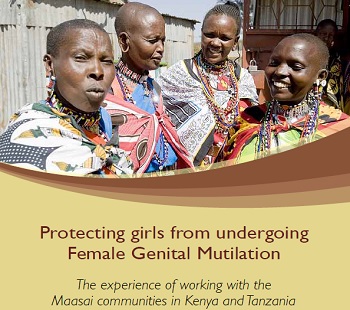
Published by Equality Now, this 36-page booklet discusses the experiences of the Tasaru Ntomonok Initiative (TNI) in Kenya and the Network Against Female Genital Mutilation (NAFGEM) in Tanzania - organisations that both take a gender and rights based approach to the prevention of female genital mutilation (FGM), mostly in Maasai communities. The two case studies show that despite "difficulties in changing tradition, TNI and NAFGEM are making systematic inroads into tackling FGM in indigenous communities, by combining social mobilisation efforts with a rights and legal framework approach to the prevention of FGM." Both organisations receive support from Equality Now's Fund for Grassroots Activism to End Female Genital Mutilation.
The Tasaru Ntomonok Initiative is a Kenyan community-based organisation working to promote awareness on women’s rights issues and fighting for the elimination of social and cultural practices harmful to girls and women. In terms of its work on FGM, TNI applies a strategy that involves various stakeholders, mobilises and educates the community, offers protection for girls fleeing from FGM, promotes alternative rites of passage, and encourages girls’ education. Community-based monitors trained by TNI are a key part of the strategy. They help to raise awareness about FGM through workshops and seminars, advise affected girls, and protect those at risk of FGM and early marriage.
TNI continues to face many challenges in eliminating FGM, particularly due to deep-rooted cultural traditions and the lower socio-economic status of girls. There is significant pressure from peers, family, and the community for girls to undergo FGM before child or early marriage. At the same time, girls have few economic opportunities and families often view girl children as an economic asset, due to the bride price given to the family at the time of marriage. In order to counter these challenges, TNI is continuing to sensitise the community, engage both government chiefs and traditional elders, and use role models who have refused FGM to help educate other girls and serve as role models. The campaign is also collaborating with traditional birth attendants and those who perform FGM.
Achievements include:
- "TNI has engaged religious leaders in the campaign to end FGM, and pastors have taken their own initiatives to spread anti-FGM messages during Sunday services and other church functions."
- "TNI trains the police on FGM, including information about the Children’s Act and international and regional instruments that protect and promote human rights of women and children. Today, the Narok police are also engaged in the prevention of the practice. Police conduct patrols within practicing communities during FGM season to warn about the risk of being arrested if caught carrying out the practice."
- "As a result of the workshops, some 'circumcisers' have denounced the practice and are now actively engaged in the campaign against FGM."
- "The number of girls undergoing the Alternative Rite of Passage (ARP) trainings and staying in schools is increasing. For example in 2009, the number of girls who underwent ARP was 204 - an increase from 137 in the previous year. More parents from the Maasai community understand the consequences of FGM, have realised the importance of girl-child education, and are requesting that TNI holds more ARP trainings."
- "In the Maasai community, FGM had long been considered a taboo subject. Today, thanks to the many awareness workshops, many community members are talking about the issue and its consequences in families and communities."
- "TNI’s campaigns - along with other initiatives in the area - have made great contributions in the wider campaign to end FGM in the Rift Valley provinces. According to the KDHS survey 2008/2009 prevalence in the region has reduced from 42% in 2005 to 35% in 2009."
NAFGEM was founded in 1999 to provide a comprehensive information dissemination and sensitisation campaign against the practice of FGM. Its strategies focus on information dissemination through workshops; information, education, and communication (IEC) materials; and mass education through a partnership with the local radio station, Moshi FM. "Targeted communities are given information on the dangers of FGM, on anti-FGM laws, and on the relationship between FGM, religion and the rights of women and children." This is supported by community advocacy and discussions both at family and community levels, usually hosted by community animators chosen by the community. NAFGEM has a particular focus on youth, and also conducts school-based activities.
NAFGEM also faces many challenges, including deeply rooted cultural beliefs and a legal context that protects the rights of the child in general, but does not specifically reference FGM. NAFGEM plans to identify and train more animators, in order to increase the reach of the campaign to neighbouring villages as well as across the border into Kenya, in order to harmonise strategies. Continued sensitisation is also needed to challenge common myths around circumcision.
Achievements have included:
- "Some Maasai traditional leaders have publicly denounced the practice and are now fully engaged in the campaign against FGM. One Maasai Elder (Laigwanan, Musa Paulo of Same), reported that after being sensitised about FGM by NAFGEM, he realized that the practice added no value to the family and community."
- "Media campaigns have successfully raised awareness about FGM, especially among people from communities that do not practice FGM."
- "Successful sensitisation campaigns have empowered girls to say no to the practice, with many running away or threatening to report their parents to court."
- "In some villages, the law has been used as a deterrent to the practice."
Equality Now website on September 16 2014 and email received from Ruth Njeng'ere from Equality Now on September 22 2014.
- Log in to post comments