










































A Passion for Video - 25 Stories About Making, Translating, Sharing and Using Videos on Farmer Innovation
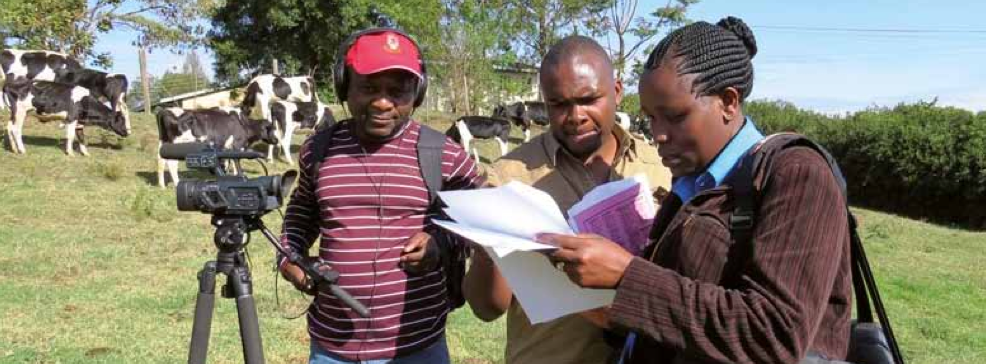
This publication shares stories about the production and distribution of farmer-to-farmer videos. These are videos that have been produced for farmers to inform them about the agricultural practices and innovations used by other farmers in an effort to support sustainable agriculture in developing countries. Many of the videos are produced by young professionals from agricultural organisations who have been trained by Access Agriculture, an international non-governmental organisation (NGO) that showcases agricultural training videos in local languages, to make farmer-to-farmer videos.
The stories were gathered as part of a Writeshop held in November 2015, where 40 people from eight countries in Africa and Asia (consisting mainly of university students and development professionals involved in farmer-to-farmer video productions) met near Nairobi, Kenya. At the writeshop, each person told a story and wrote a draft edited by the facilitators. The authors then swapped stories and peer-reviewed each other, incorporating further comments before a final edit by the facilitators.
The stories that emerged highlight the experiences of the many organisations involved in making, translating, distributing, and screening videos, as well as those that do follow-up studies, such as the MSc and PhD students who are supported by Access Agriculture. They offer insight into the creativity of this field, as well as project successes and challenges. As explained in the Foreword of the publication, “We learn what it feels like to be involved in one of the more creative efforts in international development and communication. We read, for example, about the radio producer who began to make videos because his father, a Kenyan farmer, said that farmers wanted to see the images, as well as the words. We learn why farmers in Malawi find videos from West Africa more convincing than learning from lead farmers in their own villages. We read about the journalist in Benin who is so inspired by the videos that he has become a farmer himself. We learn what it’s like to translate a video script into an African language, and other personal experiences of getting videos and DVDs into the hands of farmers. Two people wrote about Bangladesh, which is where our style of farmer-to-farmer videos started.”
The following is a list of the stories contained in this publication:
- In our own language - Eric Babatoundé Allagbe, Benin
- Farmers pay for learning videos - Gérard C. Zoundji, Benin
- You can’t include everything: deleting scenes without losing your colleagues - Irene Tamubula, Uganda
- Willing to pay to watch videos - Renaud K. Itoo, Benin
- Ready, set, bureaucracy! Kick-starting farmer training videos in Egypt - Laura Tabet, Egypt
- Finding the words -Mark Maiga, Uganda
- My father taught me to open my eyes - Musdalafa Lyaga, Kenya
- The video tricycle - Raymond Vuol, Ghana
- I bought it - it’s mine Romuald Ulrich Assogba, Benin
- When students make farmer training videos - Simon N. Mutonga, Kenya
- It will take time before Eletina watches her video - Tamanda Chabvuta, Malawi
- No laughing matter: videos that blend humour, drama and machinery in Bangladesh - Timothy J.Krupnik, Bangladesh
- Learning more from videos than from lead farmers - Vinjeru Nyirenda, Malawi
- Showing videos without electricity - Donald Tchaou, Benin
- Deejaying on the farm - Ronald Kondwani Udedi, Malawi
- You want to film me? Give me money! - Gilbert Dembélé, Mali
- Earning money from weeds - Samuel Guindo, Mali
- Giving birth is the easy part - Ahmad Salahuddin, Bangladesh
- Making farming sexy - Léonce Sessou, Benin
- Crazy about the new cheese - Bio Ganni Kirabe Allou and Mori Gouroubera, Benin
- Becoming a journalist farmer - Alcide Agbangla, Benin
- Farmers get organised to watch videos - Souradjou Fayçal Adenidji and Charlot Eriola Marius, Benin
- Time and place - Gabriel Karubanga, Uganda
- Videos on the radio - Philip Chinkhokwe, Malawi
- Smallholders organised nationwide, using videos - Fatuma A. Nyanjong, Kenya
All of the videos written about in this book are available in English, French and other languages for viewing and free download from the Access Agriculture website.
Publishers
English
60
Technical Centre for Agricultural and Rural Cooperation (CTA) website on December 13 2016.