










































I am PrEPPED: using behaviour-centred design to create demand for oral PrEP among young women in Cape Town, South Africa
Summary:
We used a behaviour-centered design approach to develop a PrEP demand creation strategy ('I am PrEPPED') for young women in Cape Town, South Africa. In phase one (Assess), we gathered existing knowledge and developed a working hypothesis of behaviour change. In phase two (Build) we conducted ethnographic formative research with the target audience and other community members to gather additional information and explore hypotheses about likely drivers of change. Phase three (Create) involved iteratively designing and testing communication materials. In phase four (Deliver) and five (Evaluate), we delivered and assessed the intervention through household surveys of 320 young women (16-25 years) and in-depth interviews with 20 young women enrolled in the 3Ps for Prevention Study, a year-long PrEP demonstration study.
Background/Objectives:
South Africa has the highest HIV incidence among adolescents, worldwide. There is a critical need to address young women's vulnerability to HIV through combination prevention strategies, including pre-exposure prophylaxis (PrEP). PrEP is highly effective when taken consistently, offering a prevention method that isn't dependent on partner agreement, yet little is known about how to effectively stimulate interest and demand for this novel prevention method among young South African women.
Description of Intervention and/or Methods/Design:
The 3Ps for Prevention Study sought to better understand young women's choices whether to use PrEP and how those decisions are made. A behaviour-centred design (BCD) framework with five steps (Assess, Build, Create, Deliver, Evaluate) was used to develop a PrEP demand creation strategy targeting young women in a Cape Town township. Ethnographic research with young women (n=17, 16-25 years), in-depth interviews with PrEP-experienced young women (n=10, 16-29 years), HIV-positive women (n=5, 26-32 years), men (n=15, 25-35 years), and key informants (n=7), and pre-testing focus groups with young women (n=38, 17-24 years) informed the content and design of a short video and two brochures. 320 women (16-25 years) completed a household survey that elicited feedback about the video and their interest in trying PrEP; IDIs with women enrolled in a PrEP demonstration study (n=20) provided additional campaign feedback.
Results/Lessons Learned:
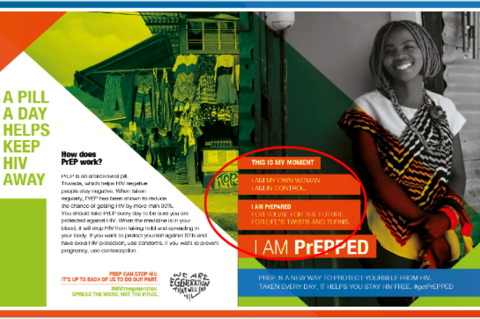
We uncovered several challenges that may hinder young women's demand for PrEP guided message development, including: low concern about HIV, low sense of personal HIV risk, cultural norms that are unaccustomed to preventative pill-taking, concerns about side effects, and socio-economic stressors that limit personal agency and future-oriented thinking. The video was well-received: 71% (n=227) of young women reported liking or really liking it and 68% (n=217) reported they were 'definitely interested' in learning more about PrEP after viewing it. Qualitative participants reported appreciating the invitation to join 'the generation to end HIV', found the characters relatable, liked the focus on peer support and the positive angle on PrEP (ease of pill-taking and low burden), and many indicated they wouldn't have been as motivated to try PrEP if they hadn't seen the video. Printed materials legitimised PrEP to family members that were sceptical of a pill that prevents HIV.
Discussion/Implications for the Field:
Our initial research found healthy young women had low motivation to take a daily pill (with possible side effects) to prevent HIV, for which they didn't necessarily feel at risk. However, young women liked a video and printed materials that leveraged an empowerment theme. Effective future PrEP demand creation strategies should use multiple communication channels that raise community awareness, encourage engagement by healthcare providers and community workers, and convey powerfully motivating gain-framed messages that focus on the benefits and opportunities of using PrEP rather than loss-framed messaging that focus on risk avoidance.
Abstract submitted by:
Laura Myers
We used a behaviour-centered design approach to develop a PrEP demand creation strategy ('I am PrEPPED') for young women in Cape Town, South Africa. In phase one (Assess), we gathered existing knowledge and developed a working hypothesis of behaviour change. In phase two (Build) we conducted ethnographic formative research with the target audience and other community members to gather additional information and explore hypotheses about likely drivers of change. Phase three (Create) involved iteratively designing and testing communication materials. In phase four (Deliver) and five (Evaluate), we delivered and assessed the intervention through household surveys of 320 young women (16-25 years) and in-depth interviews with 20 young women enrolled in the 3Ps for Prevention Study, a year-long PrEP demonstration study.
Background/Objectives:
South Africa has the highest HIV incidence among adolescents, worldwide. There is a critical need to address young women's vulnerability to HIV through combination prevention strategies, including pre-exposure prophylaxis (PrEP). PrEP is highly effective when taken consistently, offering a prevention method that isn't dependent on partner agreement, yet little is known about how to effectively stimulate interest and demand for this novel prevention method among young South African women.
Description of Intervention and/or Methods/Design:
The 3Ps for Prevention Study sought to better understand young women's choices whether to use PrEP and how those decisions are made. A behaviour-centred design (BCD) framework with five steps (Assess, Build, Create, Deliver, Evaluate) was used to develop a PrEP demand creation strategy targeting young women in a Cape Town township. Ethnographic research with young women (n=17, 16-25 years), in-depth interviews with PrEP-experienced young women (n=10, 16-29 years), HIV-positive women (n=5, 26-32 years), men (n=15, 25-35 years), and key informants (n=7), and pre-testing focus groups with young women (n=38, 17-24 years) informed the content and design of a short video and two brochures. 320 women (16-25 years) completed a household survey that elicited feedback about the video and their interest in trying PrEP; IDIs with women enrolled in a PrEP demonstration study (n=20) provided additional campaign feedback.
Results/Lessons Learned:
We uncovered several challenges that may hinder young women's demand for PrEP guided message development, including: low concern about HIV, low sense of personal HIV risk, cultural norms that are unaccustomed to preventative pill-taking, concerns about side effects, and socio-economic stressors that limit personal agency and future-oriented thinking. The video was well-received: 71% (n=227) of young women reported liking or really liking it and 68% (n=217) reported they were 'definitely interested' in learning more about PrEP after viewing it. Qualitative participants reported appreciating the invitation to join 'the generation to end HIV', found the characters relatable, liked the focus on peer support and the positive angle on PrEP (ease of pill-taking and low burden), and many indicated they wouldn't have been as motivated to try PrEP if they hadn't seen the video. Printed materials legitimised PrEP to family members that were sceptical of a pill that prevents HIV.
Discussion/Implications for the Field:
Our initial research found healthy young women had low motivation to take a daily pill (with possible side effects) to prevent HIV, for which they didn't necessarily feel at risk. However, young women liked a video and printed materials that leveraged an empowerment theme. Effective future PrEP demand creation strategies should use multiple communication channels that raise community awareness, encourage engagement by healthcare providers and community workers, and convey powerfully motivating gain-framed messages that focus on the benefits and opportunities of using PrEP rather than loss-framed messaging that focus on risk avoidance.
Abstract submitted by:
Laura Myers
Source
Approved abstract for the postponed 2020 SBCC Summit in Marrakech, Morocco. Provided by the International Steering Committee for the Summit. Image credit: Dr. Kimberly Green