











































Non-uptake of Dual Protective Polio Vaccine and Its Determinants among Children in Ethiopia Using Ethiopian Demographic Health Survey 2019: A Mixed-effect Model
University of Gondar (Agimas, Belew, Muhammad, Tesfie); Woldia University (Bizuayehu, Abate); Debre Tabor University (Kassaw)
"[T]he findings of this study have implications and provide input for designing different strategies and policies to expand the vaccination practice in Ethiopia. It is also an important input to the global polio eradication initiative."
Administering both oral polio vaccine (OPV) and inactivated polio vaccine (IPV) can protect the poliovirus more than a single vaccine. Because of low access to health services and low socioeconomic and health-seeking behaviour, vaccination practices vary across Ethiopia. In general, however, the coverage of polio vaccination is low compared with the global target (85%). The objective of this study was to assess the non-uptake of the dual protective polio vaccine (OPV + IPV) and its determinants among children in Ethiopia.
Secondary data analysis of a community-based cross-sectional study was conducted using Ethiopian Demographic Health Survey 2019 data among 3,094 women who had a child aged 12-35 months in the enumeration area. Mixed-effects binary logistic regression was used for descriptive analysis and identification of predictors, using a p value of <0.05. Intraclass correlation was used to assess the clustering effect.
The prevalence of non-uptake of the dual protective polio vaccine in Ethiopia was 44% (95% confidence interval (CI) 42.2% to 45.8%). Possible reasons for the high non-uptake of the dual protective polio vaccine in Ethiopia might be the high level of insecurity, internal instability, and displacement in some parts of the country, which makes it difficult to access health services, including the vaccination programme.
The study found that women from low proportions of community media exposure were 2.3 (adjusted OR (AOR)=2.3, 95% confidence interval (CI) 1.8-2.8) times more likely to have non-uptake of the dual protective polio vaccine than those from high proportions of community media exposure. As the researchers explain, media exposure is very important to promoting knowledge, health seeking, and preventive behaviour for women. In developing countries like Ethiopia, the health system is very weak, and because of this, the media is the most important source of health-related information.
In addition, women who had no history of antenatal care (ANC) visits were 5.12 (AOR=5.12, 95% CI 3.89-6.35) times more likely to have non-uptake the dual protective polio vaccine than their counterparts. The ANC visit is a conventional platform for counselling and educating women about the advantages and preparedness of child vaccination. Such visits provide a good opportunity for exposure to vital information and subsequent healthcare utilisation, including vaccination. However, many women do not access the ANC service.
In conclusion, this study found the burden of non-uptake of the dual protective polio vaccine in Ethiopia to be high. The researchers recommend improving access to both community media and ANC services to expand polio vaccination in this setting.
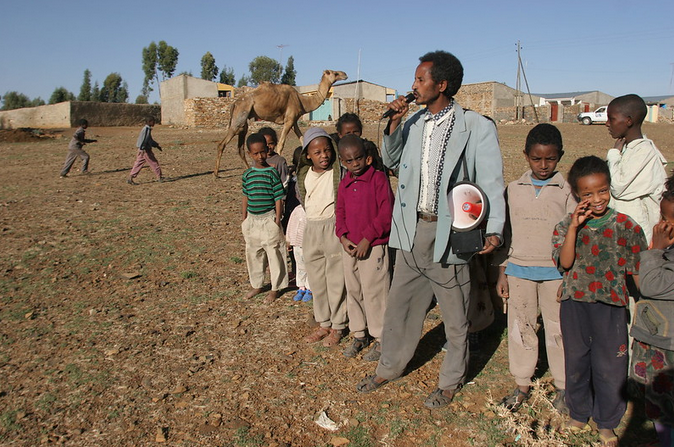
BMJ Open 2024;14:e083648. doi:10.1136/bmjopen-2023-083648. Image caption/credit: Man speaking on a megaphone about polio vaccination during Ethiopia's national polio vaccination campaign. ©UNICEF Ethiopia/2005/Heger via Flickr (CC BY-NC-ND 2.0)
- Log in to post comments