










































My Rights, My Voice (MRMV)
This programme aims to engage marginalised children and youth in their rights to health and education services in 8 countries: Afghanistan, Georgia, Mali, Nepal, Niger, Pakistan, Tanzania, and Viet Nam. Activities in each country are tailored to the specific contexts and conditions children and young people experience, but all come together in a wider global programme that is designed to inspire learning, innovation, and sharing of experience. Working with children and young people and those who influence their lives, MRMV is an effort on the part of Oxfam to achieve changes in policies, practices, and beliefs so as to ensure that health and education needs are met.
Sample activities in each of the 8 countries:
- Afghanistan activity example: Youth representatives (at least 35% of whom are women) are receiving media and communications training so they can campaign for their health and education rights. The project helps them develop campaign materials, including radio slots and booklets on rights, legal frameworks, and support bodies - all emphasising the particular challenges facing girls and young women. Young people are using these to lobby decision-makers, generate media coverage, and underpin events such as a nationwide letter-writing campaign for schoolgirls to voice their needs to the national government.
- Georgia overview: "Working with children and young people, parents, doctors and Georgia's Public Defender's Office (the country’s health ombudsman), My Rights, My Voice is promoting child and youth health-rights among IDPs [internally displaced persons] in the two post-conflict regions of Samegrelo and Shida Khartli (each with a quarter of its population aged from 0-16). Together with our local partners..., we are using the experiences and views of young people from these two regions to inform wider debates and national policy-making..."
- The project in Mali teaches young people about sexual and reproductive health (SRH) rights and advocates for improved national education policies and their implementation. For example, Learning about Living (Info Ado Mali) is an e-learning programme about SRH rights, delivered via computers, radio, and mobile phone. Available online, on CD, and in hard copy (for remote areas), the programme is delivered by teachers in schools, as well as in training sessions for young people out of school. It is backed by a confidential free-to-user text messaging service, Youth Call (Weleli Ado Mali). Children and young people send questions about SRH rights and receive an answer from trained counsellors within 24 hours. A monthly prize of free airtime encourages adolescents to use the service.
- In Nepal, 3 advocacy films around health rights were planned, filmed, and edited by 12 Nepali MRMV youth campaigners in February 2014: (i) Health For Life (about the need for health-post laboratories in Banke District); (ii) A Journey Towards Light (about the lack of solar power in health posts in Surkhet District; and (iii) Searching For Medicine (about the availability of essential medicines in Dailekh District). Click here to view a comic strip in PDF format which tells the story of the 2-week participatory video workshop during which the 12 youth campaigners learned the skills and planned, filmed, and edited these 3 advocacy films.
- Example from Niger: "In schools and youth-led groups known as fadas, we are training young people aged 11-25 on their right to SRH and on concrete aspects such as the prevention of sexually transmitted diseases and unwanted pregnancies, early and forced marriages of girls, obstetric injuries and genital mutilation. They will also be trained in how to spread the word among their peers through child-to-child techniques. We will develop an existing 'school parliament' scheme to build pupils' experience in governance issues, participation and decision-making. The fadas will organise community discussions, drama and radio programmes on young people's rights to education and SRH, emphasising the needs and involvement of girls and young women and mothers. Dedicated phone-in discussions enable youth leaders to discuss issues with each other. Questions raised through these conversations will inform national advocacy to press the government to improve the school curriculum on SRH and gender equity."
- Through a mass edutainment campaign, the project in Pakistan is working to change social attitudes to young people's SRH rights and to drive reform of the curriculum, aiming to reach out to young people with information and education through formal mechanisms.
- Sample story from Tanzania: "We are helping create and strengthen student councils, providing mentoring and coaching before elections, both for candidates and their supporters. With a particular focus on girls, we are training students in leadership skills, on their right to education, and how to hold teachers and the authorities accountable for its delivery by accessing information and developing monitoring tools. Student champions from each council gather information on key issues, build joint policy positions and develop campaign materials such as letters and artwork to lobby decision-makers for educational improvements. The student body is becoming aware of its right to a quality education and how to hold schools and community leaders to account, while student leaders are learning to represent their peers effectively in community meetings and regional and national forums. In this way, we are also building leaders for the future with a good grounding in democracy and accountability."
- In Viet Nam, one of the focal points is education: "We are building awareness among children - especially girls - of their right to education and their ability to communicate their needs. Through capacity-building events in schools and communities on gender equality and children's rights, we are raising awareness among children and parents of the challenges facing them, and particularly those facing girls. Children also learn life skills such as teamwork, communication, presentation, leadership and negotiation, so they can express their needs and claim their rights with teachers and the authorities. To make it fun, we hold summer camps and fairs where children can deliver their messages to teachers, education managers and policy-makers creatively through festivals, art, poetry, theatre, song, photography, mobile exhibitions, dialogue forums and social networking. We also run contests for children, parents and teachers to develop innovative ways of promoting children's rights in schools and communities. At inter-school workshops, they can share learning with each other and decision-makers at different level."
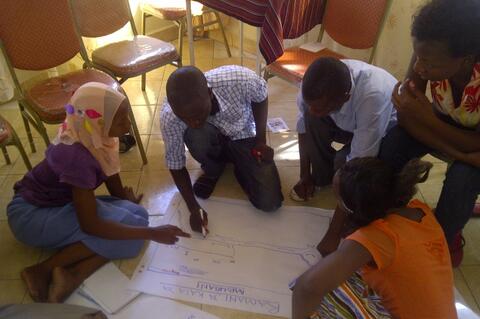
At times, MRMV participants from various countries come together. In December 2013, a Global Advocacy Workshop in Nairobi, Kenya, brought together 16 MRMV youth campaigners with Oxfam and partner staff to network, share, and strengthen their skills around advocating for child and youth rights to health and education services - as documented in this comic strip story [PDF]. The film that emerged from the session can be seen below or by clicking here.
More details and interactive functions are offered on the MRMV website.
Children, Youth, Education, Gender, Health, Sexual and Reproductive Health, Rights
Funded by the Swedish International Development Cooperation Agency (Sida).
My Rights, My Voice page on the Oxfam website; My Rights, My Voice Global Programme Overview; and MRMV website - all accessed August 5 2014.
- Log in to post comments