










































Mpilonhle Mobile Health and Education Project

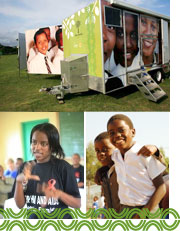
Each mobile unit includes a computer laboratory equipped with 24 individual computers which are available to students during the day, after hours, on weekends, and during school holidays. The students receive structured computer training, which includes guidance about how to use the computer, as well as basic software, email, and internet skills. Students can also access educational health material, including information on HIV/AIDS and self-tests for knowledge of HIV and other health issues.
In response to students' request to involve their parents in the programme, the mobile units were made available to parents and other members of the community on weekends and during school holidays. Parents and community members are provided with services similar to those given to students.
The project uses a participatory learning and skills-building approach. Through interactive group health education sessions, learners become actively involved in the learning process rather than mainly listening to lectures. These sessions are led by a trained health educator and are adapted to the age of the students. They focus on strategies for preventing HIV, such as delaying sexual debut, and, if sexually active, being faithful to a single partner, practicing safer sex and using condoms, and HIV testing. The sessions also cover topics such as substance abuse, healthy eating, reducing stigma, and living with HIV.
Students are also offered a one-hour health screening. During screening, services include voluntary counselling and testing for HIV; screening and care for other sexually transmitted infections; and screening, counselling and referral for tuberculosis, pregnancy, hypertension, asthma, substance abuse, and mental health problems. Students also receive counselling on family planning, nutrition and exercise, and mental health. In addition, Mpilonhle has added a food security component to the project that includes food parcels, school food gardens, and nutrition education.
The Mpilonhle programme uses an electronic client record to record all of its services. Health counsellors, who also conduct the HIV testing, use an Apple Ipod connected to a server through a local area network (LAN) to record all information collected from students they see in the one-hour counselling session. The screening follows a standard format that is prompted by the electronic record, which also includes decision support. Nurses and social workers use netbooks to connect through the LAN to record information on client visits. Information from all encounters is kept in a single database that is synchronised daily from the mobile sites using a mobile phone.
The educational curriculum [PDF] used in the programme was developed in collaboration with the Education Development Centre and focuses on participatory learning and skills building. Methods include class discussions, brainstorming, demonstration and guided practice, role plays, small group work, educational games and simulations, case studies, storytelling, debates, audio and visual activities, and decision-mapping. Materials are geared toward health promotion and wellness rather than just disease prevention. This includes the physical, emotional, social, and spiritual areas of life. The project seeks to address factors that can affect health as a whole, rather than as isolated issues.
Youth, Health, HIV/AIDS.
The programme is serving 32 schools and communities throughout northern KwaZulu-Natal through 3 mobile units. The schools have a total enrolment of 24,000 students.
Mpilonhle, Health and Human Development (HHD) Division of the Education Development Centre (EDC), KZN Department of Health, KZN Department of Education, KZN Department of Social Development, South Africa Catholic Bishops Conference, Star Schools, and Grassroot Soccer.
Mpilonhle website; Mpilonphle Mobile Health and Education Project: HIV and AIDS Activities 1-8 (Year 1) for Youth in KwaZulu Natal, South Africa [PDF] on January 18 2010; and emails from Michael Bennish, MD to The Communication Initiative on September 24 2012 and September 25 2012.
- Log in to post comments