










































Mobile for Reproductive Health (m4RH)
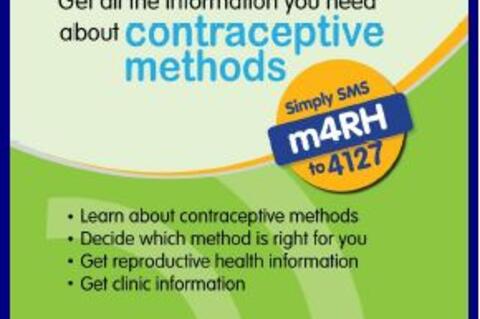
Results from the pilot indicate that women, men, young people and couples use m4RH to learn about the range of FP methods. Users find m4RH easy to use and understand and report increased FP knowledge as well as some behaviour change. The success of the pilot has lead to an expansion of the project in both pilot countries and the addition of a m4RH project to Rwanda. The initiative is funded by the United States Agency for International Development (USAID).
How it works
Users access the m4RH programme by sending a text message containing the keyword "m4RH" to a short code. After sending the initial SMS, the user receives a menu of choices for accessing contraceptive information and family planning clinic locations operated by partner organisations. To access these different options, the user replies with another SMS message to the service using a keyword or code from the menu provided. Interaction with the system follows a "ping-pong" approach, meaning that users only receive messages as they request them.
Messages
m4RH includes messages on contraceptive methods, HIV and STI prevention, sex and pregnancy, and puberty. These messages have been systematically developed, adapting evidence-based global guidelines to the 160 character limit of short message service (SMS) or text messages, and tested with users. The original m4RH messages tested in the pilot focused on family planning methods and were developed for the general population. They have since been expanded to include additional information about method-specific side-effects and to address persistent misconceptions and rumours.
In Rwanda, m4RH was adapted to focus on sexual and reproductive health (SRH) aimed at young people, aged 10-24. New content related to HIV, STIs, sex and pregnancy, and puberty was developed to accompany the basic family planning messages.
In addition to the fact-based, method-specific messages, m4RH also provides supportive messages in the form of role model stories to communicate the benefits of contraceptive use and to model effective reproductive health behaviour.
Promotion
m4RH is an "opt-in" service which means that users initiate communication with the system by requesting information. (Unsolicited messages are not pushed out to individual mobile phone users who have not accessed m4RH). As an opt-in service, people must know about m4RH in order to use it. Promotion is therefore critical to reach high numbers of potential users. m4RH has been promoted in a variety ways:
- In clinics through posters, flyers, and palm cards;
- Through outreach workers affiliated with clinics;
- By community/peer- educators (CHWs);
- Via mass media (radio and newspaper); and
- As a part of other community activities like fashion shows, fairs, festivals, etc.
Partners such as Marie Stopes in Tanzania and Kenya and Family Health Options of Kenya displayed m4RH posters in their facilities, offered flyers in their waiting rooms, and asked their providers to notify clients of the service and distribute palm cards with the short-code. Over time, more partners began promoting m4RH in increasingly diverse ways. Partners including Pathfinder and the ROADS Project in Tanzania oriented their community health workers and peer educators to the service and provided them with the palm cards for distribution to their target audiences.
Both Population Services International (PSI) in Kenya and Johns Hopkins University Center for Communication Programs (JHU-CCP) in Tanzania featured m4RH within larger mass media campaigns promoting family planning. According to the project, while all promotional strategies have been effective, mass media has resulted in the largest subsequent increase in use of m4RH; the JHU-CCP promotion resulted in a ten-fold increase in hits to the m4RH service.
For more information about the project see the m4RH booklet or the m4RH website which also contains the messages and tools used by the programme.
Reproductive Health, Mobile Technology
FHI 360, Text to Change, Progress in Family Planning, USAID, JHU-CCP, PSI, Marie Stopes, Family Health Options, Pathfinder, and the ROADS Project.
m4RH booklet and the m4RH website on February 20 2013.
- Log in to post comments