










































Mobile Innovation for Local Governance
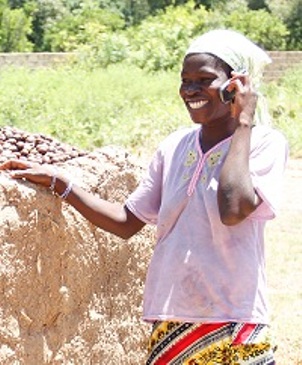
The proliferation of mobile phones and mobile service worldwide makes possible the use of mobile phone applications for local governance. This paper proposes the website Mobile Innovation for Local Governance (MoGo) for the centralisation of resources and case studies on mobile applications for local government.
As stated here: "Worldwide, the explosion of communication tools and technologies has been reshaping the way people organize themselves to demand actions and to participate in social and political institutions. This has challenged democracies, totalitarian governments and religious hierarchies across the world. Accessible, affordable and innovative communication tools push the role and boundaries of citizenship which is going through a tremendous redefinition.
Acknowledging the development of mobile phone applications for banking, health, agriculture, the Royal Tropical Institute (KIT) wants to investigate the potential and impact of mobile phone innovations for local governance. Mobile innovation for local governance is defined as 'a novel solution using mobile phone applications to tackle local governance problems, which provides added value to existing solutions in terms of effectiveness, efficiency and sustainability and which benefits to society as a whole rather than to private individuals'. The concept of innovation used in this paper is closely aligned to social innovation emphasizing not only technological progress, but also the way technologies are used in various social contexts and how these interactions lead to social change."
Because existing mobile application usage (e.g., for denouncing corruption, informing policy-makers, or entering into a debate with local institutions via radio, etc.) has not been analysed and is thus far limited to local usage, KIT aims to set up a ‘knowledge in action’ programme with the following objectives:
"Main Objective:
Develop critical knowledge on mobile innovations for local governance in Africa and set up an action-research programme in East/West Africa to test the potential of mobile communication and internet for citizen empowerment and inclusive local governance.
Operational Objectives and Components of the Programme:
Set up a multi-country community of practice (CoP) to identify, assess and learn from mobile innovation initiatives in local governance, with the specific purpose of linking East and West Africa.
Component 1: Analysis, Case Documentation of Existing Projects
Within this component, several case studies will be conducted in various African countries with the common objectives of assessing:
• How existing mobile innovations are used to strengthen citizen voice and accountability relations?
• How these mobile innovations impact local governance processes, citizen voice and (local) public authorities’ responsiveness/accountability towards citizens?
• How these innovations perform in terms of inclusion/exclusion of some citizens groups (gender, class, age…)?
• What contextual factors are preponderant for mobile innovations to have a significant impact on local governance processes?
• Which domains of influence and impact are more suitable for mobile innovations for local governance than others?
• How these mobile innovations are financed and what are opportunities and challenges for scaling up?
Case studies will be developed in an interactive way, involving users, developers and other stakeholders. After having identified a number of case studies and groups of authors, a writeshop could be organised to enhance the quality of the cases. Cases will be translated and shared on a Community of Practice (CoP) platform. Based on these case studies, a regular synthesis and some lessons learnt could be gathered in a publication, emphasising some core conditions of mobile innovations that are essential for citizen empowerment and inclusive local governance.
Component 2: Development Support, Monitoring and Analysis of New Mobile Applications
Beyond analysing and documenting existing applications, the aim of this programme is to support local partners to develop simple mobile applications (in collaboration with local developers and/or phone operators), tailored to fulfil the needs that citizens have identified and which could lead to citizen empowerment and more inclusive local governance.
The role for KIT can be two-fold. Firstly, to work as a financial broker between these local initiatives and various donors. Secondly, to work as a knowledge broker between the different initiative holders to help them exchange their experiences but also to provide an assessment framework for the monitoring and analysis (case study analysis) of their project.
Case studies and new initiatives could come from/emerge in any sub Saharan African country, but we expect to find more advanced cases in East and southern Africa. However, we aim to have a mix of countries represented, with different technological, social and political backgrounds, including post conflict countries."
MoGo website, November 23 2011.