










































Media Development Indicators
Image
Subtitle
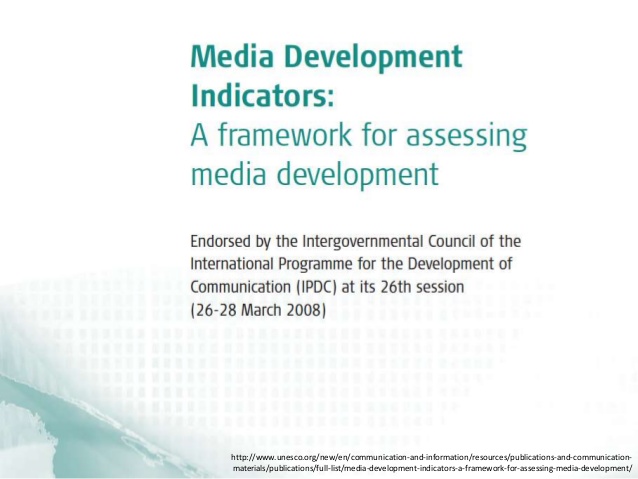
A Framework for Assessing Media Development
SummaryText
This paper has been prepared in order to define indicators of media development in line with the priority areas of UNESCO's International Programme for the Development of Communication (IPDC): promotion of freedom of expression and media pluralism; development of community media; and human resource development (capacity building of media professionals and institutional capacity building). This set of indicators is designed for analysing the main aspects of the media ecology. It defines a framework within which media can best contribute to, and benefit from, good governance and democratic participation. The indicators are intended to enable stakeholders concerned with media development, and in particular local actors, to assess the state of the media within a given national context and identify the main gaps. They can thus serve as an instrument to guide the formulation of media-related policies and target development assistance efforts in this area.
This paper builds upon a previous analysis of existing initiatives to measure media development, which employed a diverse range of methodologies. It does not prescribe a fixed methodological approach, but, rather, offers a ‘toolkit’ approach in which indicators can be tailored to the particularities of the national context. Some generic considerations in selecting media development indicators have been adopted in this paper including: quantitative measurements whenever possible; indicators where measurement data is sufficiently reliable in quality to permit confident decision-making; disaggregating indicators by gender or other population characteristics; ensuring that indicators are separated out to address one key issue at a time; and considering the practical implications of cost and time for collecting measurement data.
This paper is structured around five principal media development categories:
1) a system of regulation conducive to freedom of expression, pluralism, and diversity of the media; 2) plurality and diversity of media, a level economic playing field and transparency of ownership; 3) media as a platform for democratic discourse; 4) professional capacity building and supporting institutions, which underpin freedom of expression, pluralism, and diversity; and 5) infrastructural capacity is sufficient to support independent and pluralistic media.
Under each category, a range of key indicators are given. For each indicator, various means of verification are suggested.
This paper builds upon a previous analysis of existing initiatives to measure media development, which employed a diverse range of methodologies. It does not prescribe a fixed methodological approach, but, rather, offers a ‘toolkit’ approach in which indicators can be tailored to the particularities of the national context. Some generic considerations in selecting media development indicators have been adopted in this paper including: quantitative measurements whenever possible; indicators where measurement data is sufficiently reliable in quality to permit confident decision-making; disaggregating indicators by gender or other population characteristics; ensuring that indicators are separated out to address one key issue at a time; and considering the practical implications of cost and time for collecting measurement data.
This paper is structured around five principal media development categories:
1) a system of regulation conducive to freedom of expression, pluralism, and diversity of the media; 2) plurality and diversity of media, a level economic playing field and transparency of ownership; 3) media as a platform for democratic discourse; 4) professional capacity building and supporting institutions, which underpin freedom of expression, pluralism, and diversity; and 5) infrastructural capacity is sufficient to support independent and pluralistic media.
Under each category, a range of key indicators are given. For each indicator, various means of verification are suggested.
Publication Date
Languages
English, French, Spanish, Arabic, Russian, Chinese, Portuguese, Nepali, Thai
Number of Pages
102 (English)
Source
World Association of Community Radio Broadcasters website and RFPA News, Radio for Peacebuilding, Africa (RFPA) Issue 009, October 23 2008.
- Log in to post comments