










































Media and Information Literacy Curriculum for Teachers
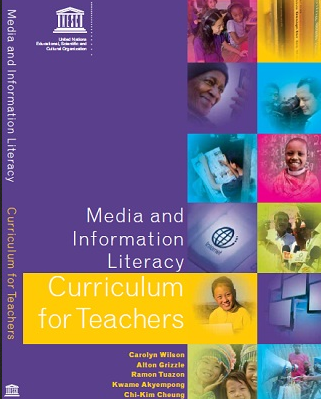
Published by the United Nations Educational, Scientific and Cultural Organisation (UNESCO) in 2011, this model Media and Information Literacy (MIL) Curriculum and Competency framework for teachers is intended to provide teacher education systems in developed and developing countries with a framework to construct a programme for turning out teachers who are media and information literate. UNESCO also envisions that educators will review the framework and take up the challenge of participating in the collective process of shaping and enriching the curriculum as a living document. For this reason, the curriculum focuses only on required core competencies and skills which can be integrated into existing teacher education.
This publication is divided into two parts. Part 1 provides the MIL Curriculum and Competency Framework, which gives an overview of the curriculum rationale, design, and main themes. It is complementary to the UNESCO ICTs Competency Framework for Teachers (2008). Part 2 includes the detailed Core and Non-Core Modules of the curriculum.
According to UNESCO, the publication is pioneering for two reasons. First, it is forward looking, drawing on present trends toward the convergence of radio, television, internet, newspapers, books, digital archives, and libraries into one platform – thereby presenting MIL in a holistic manner. Second, it is specifically designed with teachers in mind and for integration into the formal teacher education system.
The publication includes the following chapters:
- Introduction
- Unifying notions of media and information literacy
- Benefits and requirements of MIL
- Main topics of the MIL curriculum for teachers
- The Curriculum framework
- Policy and vision
- Knowledge of media and information for democratic discourse and social participation
- Evaluation of media and information
- Media and information production and use
- Core teacher competencies
- Pedagogies in the teaching and learning of MIL using the curriculum
UNESCO promotes Media and Information Literacy (MIL) as a composite concept, a combined set of interrelated competencies (knowledge, skills and attitudes) necessary for the media and technology mediated world of today. MIL empowers citizens with competencies (knowledge, skills and attitudes) related to media, information, ICT and other competencies which are needed for 21st century. These competencies include the ability to: find, evaluate, use the information they need in ethical and effective ways, understand the role and functions of media and other information providers such as libraries, Internet, museums and archives, in democratic societies; understand the conditions under which media and information providers can fulfill their functions; critically evaluate information and media content; engage with media and information providers for self-expression, life-long learning, intercultural dialogue and democratic participation; and updated skills (including ICTs skills) needed to produce content, including user-generated.
To find out more about UNESCO's MIL work and to access further documents as well as videos, click here.
English, Arabic, Chinese, French, Greek, Japanese, Mongolian, Montenegrin, Portuguese, Russian, and Spanish. Translation into other languages such as German and Swedish is underway.
191 (English)
UNESCO website on December 17 2012; and email from Neelima Mathur to The Communication Initiative on June 25 2020.