










































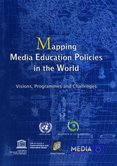
Mapping Media Education Policies in the World: Visions, Programmes and Challenges
Sorbonne Nouvelle University (Frau-Meigs); Alliance of Civilizations (Torrent)
"Mapping Media Education Policies in the World" discusses a policy-based approach to media education, considering it from three inter-related dimensions: its national, regional, and global contexts; its value to citizens and civic participation; and the importance of the role of collaboration among governments, civil society, and the private sector in the process of elaborating education for media literacy. It is published by: the United Nations - Alliance of Civilizations; the United Nations Educational, Scientific and Cultural Organization (UNESCO); European Commission; and Grupo Comunicar.
The foreword to this document provides this definition of media literacy: "'Media literacy' may be defined as the ability to access the media, to understand and evaluate critically their contents and to create communications in a variety of contexts."
According to the document, "Media education provides the critical knowledge and the analytical tools that empower media audiences to function as autonomous and rational citizens, enabling them to make informed use of the media.... [M]edia literacy is one of the principal new tools that provide citizens with the skills they need to make sense of the sometimes overwhelming flow of daily media and in particular, new media and information disseminated through new communication technologies. These forces are reshaping traditional values while transforming them into contemporary new ways of understanding life, society, and culture." The foreword emphasises the opportunity for the empowerment of everyone through information if policy-makers "overcome the perceived risks that media education might threaten governmental power, national sovereignty and even the cultural identity of a country....Using media and ICTs [information and communication technologies] with cohesion and inclusion can foster trust and respect among all members in a society and benefit all stakeholders involved. Developing a coherent rationale is key, especially if governments show any readiness in pursuing their rights and responsibilities, that can be summed up in the 3 P’s of sound Public Policy: Provision of media education for all their citizens; Participation of all their citizens in social, cultural and economic activities; and Protection of all citizens in need (either because of their age, their disabilities or their income)."
The document urges a global, shared rationale that can be summarised "as revolving around the 6 C’s of the Competences for media education: Comprehension, Critical Capacity, Creativity, Consumption, Citizenship and Cross-Cultural Communication. The overarching structure of such a rationale needs to be buttressed against the human-rights framework, with dignity and the construction of identity and solidarity at the core."
The contents include the following:
- Defining Media Education and its Stakes in a Cross-cultural Perspective
- Information Skills: Conceptual Convergence between Information and Communication Sciences
- Curricular Contribution for Media Education: A Process in Construction
- Media Education Issues for Professionals and Citizens: Bridging the Divides in Countries of the South
- Media Education as a Development Project: Connecting
Emancipatory Interests and Governance in India - Nurturing Freedom of Expression through Teaching Global Media Literacy
2. Media Education and its Enabling Environment: Reforms beyond Capacity Building
- Education Reform as an Agent of Change: The Development of Media Literacy in Hong Kong During the Last Decade
- History, Policy and Practices of Media Education in South Korea
- Implementing Mandates in Media Education: the Ontario Experience
- Making the Introduction of Multi-Media Technologies Count in Education Reform in Africa: the Case of Ghana
- Media Literacy in MENA [Middle East and North Africa]: Moving beyond the Vicious Cycle of Oxymora
3. Media Education Actors Outside the Educational Framework: Toward Civic Agency
- When Media Education is State Policy
- Media Education beyond School
- The Role of Broadcasting Regulation in Media Literacy
- Media Education in Turkey: Toward a Multi-Stakeholder Framework
- Exploring Media Education as Civic Praxis in Africa
- Promoting Youth Civic Participation with Media Production: The Case of Youth Voice Editorial Board
ICT in Education e-newsletter on May 12 2009, and emails from Jordi Torrent and José Ignacio Aguaded Gómez to The Communication Initiative on September 16 2009 and January 13 2010, respectively.

Comments

Excellent Publication
Thank for this new publication and I would like to know if it is possible to have a hard copy in Community Library.
From
Balaba Peter
Nakaseke Telecentre
- Log in to post comments