










































Linkages Across the Continuum of HIV Services for Key Populations Affected by HIV (LINKAGES) Project
The LINKAGES project (Linkages Across the Continuum of HIV Services for Key Populations Affected by HIV) aims to accelerate the ability of partner governments, key population (KP)-led civil-society organisations, and private-sector providers to plan, deliver, and optimise comprehensive HIV prevention, care, and treatment services at scale that reduce HIV transmission among KPs (people who inject drugs, men who have sex with men (MSM), transgender persons, sex workers, and prisoners) and extend life for those who are HIV positive. LINKAGES is partnering with more than 30 countries in Africa, Asia, and the Caribbean to ensure that KPs are accessing HIV prevention, care, and treatment services in an environment that is free of stigma and discrimination and that respects their rights. Besides engaging in partnerships and building capacity to ensure adequate service provision, the LINKAGES project involves a wide range of communication activities that include peer education and outreach, community mobilisation, and advocacy.
The project is being implemented by FHI 360 and supported by the US President’s Plan for AIDS Relief (PEPFAR) and the U.S. Agency for International Development (USAID).
LINKAGES enhances HIV prevention and care by: improving the outreach to KPs most at risk of acquiring or transmitting HIV; promoting routine HIV testing and counseling; actively enrolling those with HIV into care and support interventions; and enabling them to remain in care. The project also helps countries use and scale up evidence-based approaches to service provision; helps KPs mobilise and advocate for changes in laws and the conduct of police, healthcare workers, and policymakers; and works with governments to make programmes sustainable for the long term.
High-quality, accessible services and sustained responses are driven through community networks to ensure that the rights of KPs, including those living with HIV and AIDS, are respected and that the most impact is achieved.
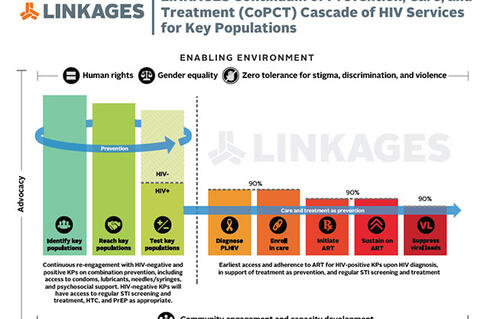
The LINKAGES approach is based on the cascade of services for HIV prevention, diagnosis, care, and treatment, which requires strong linkages among programme elements to ensure the seamless integration of interventions so that HIV transmission is reduced and so that people diagnosed with HIV obtain early access to services. As KPs face multiple challenges accessing HIV services - including stigma and discrimination, violence, human rights abuses, and a lack of community and social supports - the linkages between interventions for KPs are frequently inadequate at every stage of the HIV continuum of prevention, care, and treatment. The LINKAGES project therefore seeks to address these weak links and facilitate the HIV cascade flow by creating a supportive environment and empowered KP communities. Click here [PDF] to find out more about the LINKAGES HIV Cascade Framework for Key Populations.
Overall, LINKAGES activities seek to improve the following:
- Access to better quality, more integrated HIV prevention, care, and treatment services in welcoming settings that protect the privacy of KPs
- Support from trained peers who can help KPs access HIV testing and counseling and other HIV services, legal aid, mental health and nutrition support, and economic opportunities
- Healthcare workers who understand and address their needs in a non-stigmatising way
- Safer communities with stronger crisis response systems and reduced gender-based and other forms of violence
- Meaningful opportunities to have KPs community members' input in how services are delivered, improved, and evaluated
- Evidence-based information that empowers KPs to make decisions that lead to better health
- Reduced threat of criminal prosecution under discriminatory laws.
To date, LINKAGES has issued sub-awards to more than 200 partners throughout multiple regions and countries around the world. Currently, direct service programming and/or technical assistance activities are being implemented with KP-led organisations, other non-governmental organisations (NGOs), public health facilities, and ministries of health.
The following are some examples of communication-focused activities undertaken under the LINKAGES project:
In Thailand, a web series called Gay OK Bangkok was developed and launched by the Asia-Pacific Coalition on Male Sexual Health (APCOM), a LINKAGES Thailand implementing partner, as part of their ongoing TestBKK campaign, which seeks to generate demand for MSM-friendly HIV testing services in Bangkok and around Thailand. The five-part web series focuses on the relationship trials and tribulations of a group of young, gay men living in Bangkok. It weaves a number of health issues into its storylines, including HIV testing, treatment, and pre-exposure prophylaxis (PrEP). Between March and April 2016, the Gay OK Bangkok videos received more than 600,000 views, and in the period since the web series was launched, there were more than 12,000 instances of active engagement (likes, shares, and comments) via YouTube and Facebook. Click here [PDF] for more information.
Also in Thailand, the LINKAGES programme partnered with local community-based organisations Mplus Foundation and Caremat to introduce an enhanced peer mobiliser model (EPM) to increase HIV testing and counselling (HTC) and improve enrolment and retention of those who test positive in the HIV continuum of care. The key components of this model are: increased focus on targeted, one-on-one interpersonal communications between clients and trained, salaried community-based supporters (CBSs) and a shift of responsibility for client recruitment to an informal network of incentivised peer mobilisers (PMs) who recruit clients from within their social and sexual networks. Click here [PDF] for more information.
In Angola, LINKAGES partnered with a local association of HIV-positive women, called Mwenho, to bring in champions of positive living to reach sex workers who had tested positive and were lost to follow up (previous methods using counsellors had limited success). The champions were all trained on issues such as stigma and discrimination, gender identity, sexual orientation, and helping patients accept their positive status and manage their own treatment. The approach was successful, as champions had the shared experience of being HIV positive and thus could demonstrate first hand that life after an HIV-positive result is possible. Through this initiative, most of the HIV-positive sex workers who were initially lost to follow-up were located, had their CD4 counts taken, and proceeded to be placed on antiretroviral therapy (ART). Click here [PDF] for more information.
In Kenya, LINKAGES is working with Keeping Alive Societies Hope (KASH), an organisation working to improve relations between the police and sex workers. KASH trains violence response teams to address a critical barrier to the use of HIV prevention, care, and treatment services: the violence experienced by sex workers and MSM at the hands of the police. When a violation occurs, community members or KASH peer educators call on this violence response team. The work of the violence response team is supported by other activities aimed at reducing stigma and discrimination toward sex workers and MSM. For example, LINKAGES supports sensitisation forums to help police officers understand and protect the rights of sex workers and other marginalised populations. Click here [PDF]for more information.
In South Sudan, LINKAGES is helping to generate demand for services, improve access to KP-friendly services, and create a policy environment that is more conducive to the health rights of KPs. For example, to create demand for services, the project conducted a mapping exercise to identify hotspots (or key locations) where sex work takes place. From these locations, 65 female sex workers (FSWs) were identified and trained as peer educators to lead participatory education sessions among their peers. Between October 2015 and March 2016, the trained peer educators reached 4,356 FSWs. Click here [PDF] for more information.
HIV/AIDS
Over the past 15 years, the world has made remarkable strides in halting and reversing the HIV epidemic: annual new infections have declined 35% since 2000, and 15 million people living with HIV (PLHIV) are now on ART. However, the KPs of sex workers, MSM, transgender people, and people who inject drugs remain disproportionately affected; 40-50% of all new HIV infections among adults worldwide occur among these populations and their sex partners. At the same time, the stigma, discrimination, and threat of criminal prosecution faced by KPs around the world pose serious barriers to their ability to access quality, rights-based health care.
The project is being implemented by FHI 360 and supported by the US President’s Plan for AIDS Relief (PEPFAR) and the U.S. Agency for International Development (USAID).
FHI 360 website and HIV Cascade Framework for Key Populations [PDF] on May 17 2017, and email from Natasha Mack, FHI 360, to Soul Beat Africa on June 13 2017.
- Log in to post comments