










































Lessons from a Training Needs Assessment to Strengthen the Capacity of Routine Immunization Service Providers in Nigeria
Direct Consulting & Logistics, or DCL (Arogundade, Akinwumi, Molemodile, Nwaononiwu, Ezika, Wonodi); National Primary Health Care Development Agency (Yau); Johns Hopkins Bloomberg School of Public Health (Wonodi)
"Improved RI coverage requires a multipronged approach that incorporates major drivers of enhanced service delivery...and having a highly skilled workforce to carry out community mobilization and deliver vaccines efficiently..."
Health workers (HWs) providing routine immunisation (RI) services play a crucial role in influencing vaccine uptake. In the Nigerian healthcare system, there is a major human resource shortfall, in both quantity and quality of personnel, and they are overburdened. In 2016, the National Immunization Coverage Survey and Multi-Indicator Custer Survey (NICS/MICS) showed that only 23% of all eligible children in Nigeria received all the antigens in the national immunisation schedule. Over the years, Training Needs Assessments (TNAs) have not been routinely utilised in Nigeria to determine unmet needs of HWs offering immunisation services and what approaches should be adopted to meet their training needs. The objective of this study was to assess the level of Expanded Program on Immunization (EPI) knowledge among RI service providers and tutors in pre-service institutions in 3 Nigerian states in order to identify unfulfilled training needs and their implications. The present summary focuses on communication skills.
A total of 11 local government areas (LGAs) were selected: 3 each in Niger and Rivers states and 5 in Bauchi state. Twelve pre-service training institutions in the 3 states were also engaged to identify and train tutors, who were drawn tertiary institutions to support EPI manager training. (This training approach proposes a shift from the norm of cascade training, whereby training is cascaded across 3 levels before it gets to the frontline health worker, to an institutionalised system of training preceded by TNAs.) TNA survey tools were designed to obtain knowledge-based information on the fundamental EPI concepts through key informant interviews and focus group discussions with 27 pre-service tutors and 90 HWs, mainly Community Health Officers (CHOs), Community Health Extension Workers (CHEWs), and Environmental Health Assistant/Technicians (EHA/EHTs). Quantitative data were also obtained.
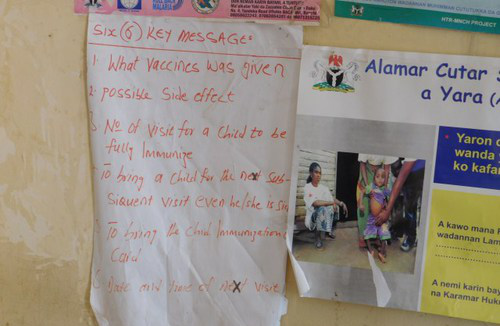
Structured data collection tools in survey format were specifically developed for the TNA and administered to respondents. The HW tool was designed to obtain knowledge-based information about EPI with regard to the Reaching Every Ward (REW) strategy domains, general immunisation concepts, and EPI trainings HWs had attended in the last 5 years. The World Health Organization (WHO) REW strategy is aimed at improving immunisation coverage in every ward (district) through the provision of quality and sustainable RI services. The tool was also used to obtain key information on HW communication skills, particularly their ability to effectively communicate 6 key RI messages to caregivers during immunisation sessions. These messages enlighten caregivers about the vaccines, the number of visits needed to be fully immunised, and the importance of keeping the immunisation card safe.
In general, in spite of several previous trainings, HWs' knowledge on basic immunisation concepts, including the REW strategy, was found to be varied and suboptimal. Pre-service tutors' knowledge of fundamental EPI concepts, as well as HW perception of the new training approach, also varied across the states. The researchers say: "The sub-optimal performance observed" among HWs and tutors with regard to basic knowledge and understanding of some core immunisation concepts "points to major gaps in training structure and curriculum",
With regard to communication, over half of all the respondents in the 3 states were moderately effective at communicating the key RI messages - meaning that they could only communicate between 3 and 4 messages out of 6. Respondents from Bauchi state had the highest (36%) proportion of those who were very effective at communicating the 6 key RI messages, while Rivers state had the lowest (7%).
In exploring these findings further, the researchers "found that critical elements of demand creation strategies for routine immunization uptake, such as community mobilization by health workers, were not well conducted because service providers were demotivated to carry out this activity. This was largely due to lack of funds for transportation and necessary logistics to mobilize caregivers and link RI services with the community. It has been established that when health workers develop a strong partnership with the community, immunization coverage tends to improve as a result of some level of trust developed that will allow the community to be more willing to accept and utilize services..."
The researchers suggest that future efforts incorporate a competency-based learning approach and consider core principles of adult learning so as to ensure that a significant portion of the time allocated for the trainings focuses on engaging HWs to do case demonstrations and other practical on-site activities as well as strengthen their capacity to use data to independently make decisions to improve the EPI programme.
Furthermore, they point to the importance of a safe, comfortable environment for training sessions. This means ensuring that motivating factors are in place such as: an appropriate tutor-trainee ratio (30:1); an adequate supply of training materials; availability of information, education, and communication (IEC) materials; light refreshments and decent, safe accommodation; and provision of stipends to cover travel expenses. Early and adequate preparations need to be made to ensure that necessary training materials are available and sufficient and that service providers have time to make travel and other arrangements. Also: "Evaluations of all trainings ought to be conducted using standard and nationally recognized tools to ascertain their immediate outcome and long-term impact."
"Finally, this assessment highlights that conducting TNAs has potential value for policy makers and program managers to guide planning and determining human resource needs."
BMC Health Services Research, vol 19, no 664 (2019). https://doi.org/10.1186/s12913-019-4514-2. Image credit: DCL
- Log in to post comments