










































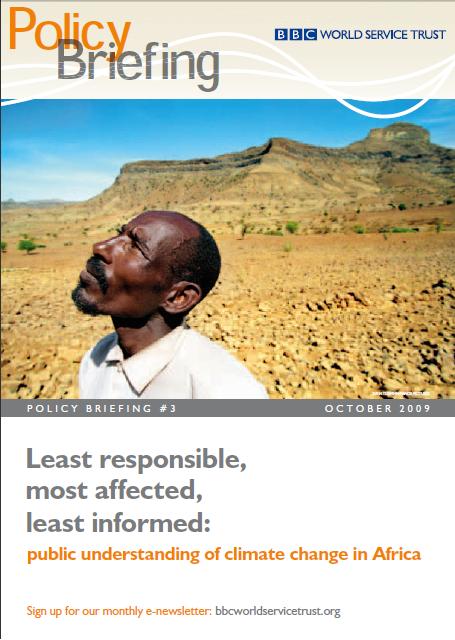
Least Responsible, Most Affected, Least Informed: Public Understanding of Climate Change in Africa
BBC World Service Trust
"There appears to be a clear demand for information that enables people to adapt to environmental change, particularly if it gives people realistic options of how to do so."
This 12-page Policy Briefing highlights research findings from six African countries that suggest that the information and communication needs of those most affected by climate change should be a priority in the international climate change response. The briefing is based on insights from the research and communication initiative, Africa Talks Climate, undertaken by the Research & Learning (R&L) Group of the BBC World Service Trust (BBC WST) in partnership with the British Council. This research has systematically gathered the views of more than 1,000 people - farmers and fishermen, pastoralists and business people, women and men (from rural and urban settings) - in focus group discussions and nearly 200 interviews with opinion formers across ten countries in sub-Saharan Africa. Insights from six of these - Ethiopia, Ghana, Kenya, Nigeria, Senegal, and Uganda - informed the briefing.
Data analysis is currently being completed on additional research in the Democratic Republic of the Congo (DR Congo), South Africa, Sudan, and Tanzania. An Executive Summary and 10 country reports from Africa Talks Climate are published separately, and available on the Africa Talks Climate website. Full findings from the Africa Talks Climate series were launched in March 2010 in Nairobi at an event with the Right Honourable Raila Odinga, Prime Minister of Kenya and Nobel Laureate Professor Wangari Maathai.
Selected findings and communication-related policy conclusions, from research carried out from October 2009. (All quotations taken directly from the briefing.):
- African public awareness of the environment - and particularly of environmental degradation - is strong, principally because environmental issues impact so immediately on the daily lives of African citizens and have done so for many years.
- There is a near-universal sense across all the people interviewed that the "weather" is changing (the term "climate" is rarely used, or is used interchangeably with "weather").
- Africans believe that changes in the weather are caused by local environmental degradation, for which they hold themselves individually and collectively responsible.
- There is little awareness that the climatic problems facing Africa - now or in the future - are likely to have causes that extend beyond their own continent.
- Lack of information about human-induced global climate change, its causes, and its consequences is severely inhibiting the capacity of African citizens both to adapt to climate change and to exert influence both internationally and on their own governments to ensure an appropriate and urgent response to the scale of the threat they face.
- There is a trend for some African citizens to attribute weather changes (in part or in full) to God, gods, or fate. "The potential role of religious and faith leaders in informing and catalysing responses to climate change would appear to be substantial."
- The media in Africa, together with schools, are critical sources of information on climate change. But "Nearly all the measures proposed to address international climate change are devised and debated at international fora which - at least until very recently - have barely been reported in Africa, and are conducted in language unlikely to resonate with the vast majority of people on the continent..."
- "Providing African citizens with the information they need to respond and adapt to climate change is just one component of probable forthcoming debates around climate change in Africa. A central issue is one of environmental justice. African citizens will be among the most affected by climate change but are least responsible for the greenhouse gases that have caused it. They cannot make just demands on the rest of the world, or determine properly their own political and other responses to this emerging crisis, without being informed about its causes and its consequences. African citizens need better information on climate change, but they also need far better ways of communicating their reality and perceptions on the issue to those principally responsible for causing it."
- Civil society in Africa is increasingly strong and focused on the issue, but climate change is being debated more on Africa's behalf rather than by and within Africa itself. An important repercussion of this is that a problem that will affect Africa more than any other continent is being framed in language and terms that are largely divorced from African reality. Quoted in this policy briefing, Saleemul Huq of the International Institute for Environment and Development (IIED) comments: "Climate change is an esoteric and initially confusing concept to many. Communication about it must use a community's own language and terms they can understand. This means not only translating scientific texts into local languages but also giving up on the written word altogether and using traditional means of communication such as art and theatre, or modern methods such as video."
- A window of opportunity exists for the international community to persuade African citizens that the rest of the world is serious about mitigating the worst of the devastating potential impacts of climate change on the continent. The policy briefing suggests that, "if that window is closed, blame, recrimination - and possibly despair - may become major additional factors complicating meaningful action on environmental degradation and climate change in Africa."
The concluding section of the policy briefing considers these Africa-specific findings in the broader, international, context in light of the United Nations Framework Convention on Climate Change (UNFCCC) conference (known as the Conference of Parties, or COP 15) in Copenhagen, Denmark, in December 2009. In short, "The intense environmental awareness affirmed by the research suggests there is a reservoir of public demand for more serious efforts to tackle the environmental crises and problems facing Africa....Meaningful action on climate change will require unprecedented international cooperation and political will. It will require profound behavioural, economic and social change across nearly all sections of society in nearly all societies."
Emails from Emily LeRoux-Rutledge, Anna Godfrey, and Grace Davies to The Communication Initiative on October 29 2009 and November 3 2009.
Comments

Stratification fo Respondents
This document is very useful and criticaly presented. However I would like to add some comments on how more understanding of the climate change by africans can be elaborated. For policy makers it is better for them to know what type of community were your respondents..you could classify them and then comment on the major group of people in which the effort should be stricted. Howévre the report stongly covers the real situation in Africa. Bravo!