










































A Kenyan Newspaper Analysis of the Limitations of Voluntary Medical Male Circumcision and the Importance of Sustained Condom Use
Department of Community Health Sciences, University of Manitoba, (Muzyka, Bombak, Driedger, Lorway), Centre for Global Public Health, University of Manitoba (Muzyka, Thompson, Bombak, Lorway)
"Media messages shape popular understandings of the benefits and limitations of male circumcision"
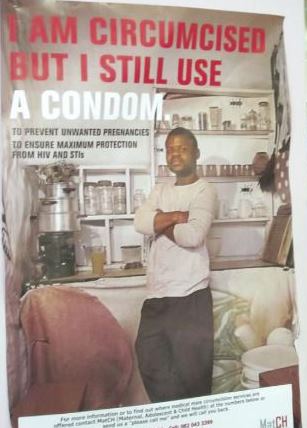
This analysis of Kenyan media treatment of condom use has the objectives of: (1) investigating promotion messages in a popular online newspaper to determine how the limitations of male circumcision are represented, and whether condom use is still being promoted; and (2) gaining insight into popular understandings of the limitations of this new procedure through newspaper reader comments.
Because the results of three clinical trials in sub-Saharan Africa indicate that male circumcision may provide a protective effect of approximately 60% against the acquisition of HIV in heterosexual males, voluntary medical male circumcision (VMMC), has been promoted in Kenya. Yet, as stated here, "[i]t is critical that messaging about VMMC be informative, accurate, and culturally sensitive [5] and emphasize that VMMC does not afford full protection against HIV infection....Mass media (e.g. radio, television, cinema, newspapers, pamphlets, and posters) provide an opportunity to communicate to the general public. For many people, their knowledge, attitudes, and beliefs about a topic or event are shaped, in part, by media framing." Additionally: "The Kenyan Ministry of Public Health & Sanitation has developed a VMMC Communication Guide, which includes the utilization of the media to promote 'frequent and accurate coverage of VMMC in Kenya'."[Footnotes removed throughout.]
This study searched the independent East and Central African newspaper the Daily Nation, using as a qualitative thematic analysis. "Following this sampling framework, a total of 34 online media articles published during a two-year period between January 1, 2008 and December 31, 2010 were selected for final coding and analysis. This period coincided with the launch and expansion of the Kenyan VMMC programme." The study utilised the newspaper's website for both news and Op/Ed articles and included reader comments in the analysis. Researchers included a placement analysis on the assumption that more readers scan the beginning of articles than finish them.
Results showed that there was partial or incomplete presentation of the degree of protection against HIV infection of VMMC. "The few times that the limitations and potential consequences of VMMC were explicitly communicated, newspaper articles seemed to present information about the limitations of VMMC by camouflaging limitations by portraying them as benefits to identify potential drawbacks of VMMC. The limitations of VMMC as an HIV prevention method were camouflaged in positive language, which highlighted risk reduction and not the fact that VMMC does not afford full protection. Even if a procedure reduces the risk of infection, it does not mean that the risk of becoming infected with HIV is eliminated." Comments suggested that using numerical odds may not work to make meaning clear to all readers. Researchers cited a lack of accurate descriptions of the limitations of VMMC, as well as a need to describe the necessity of another method of protection. VMMC and condom use were not mentioned in the same news articles, though that information was in evidence in the Op/Ed articles. "Similarly to the Op/Ed articles, many individuals wrote comments referring to the benefits and limitations of VMMC, the need for sustained condom promotion, and expressed concern that the media and government should provide better and more comprehensive risk communication."
Researchers recognised the need to use "gain" framing language to encourage participation in VMMC but recommended clarity about limitations both of its extent of protection for the individual and the way in which that affects the spread of new HIV infections. They emphasise the need for including information about additional protection, especially condom use.
Among the recommendations:
- "[T]he government could provide regular news releases or information sessions to the media, which communicate the procedures’ partial protection."
- "[C]ontinued monitoring is needed to ensure media messaging concerning VMMC includes discussion of limitations and encourages condom use following circumcision. "
- "[F]urther research should be conducted to investigate whether the general public understands that VMMC does not completely protect them from HIV infection and the importance of sustained condom use whether or not they are circumcised. This research could involve surveys of people’s attitudes or employ more qualitative methods of focus group discussions and interviews. "
HC3 evidence database, accessed April 21 2015.