










































Ka Bobebe Theatre Production

The Ka Bobebe play was part of a day-long event held in Lesotho's capital, Maseru. The event included a soccer tournament, educational and life-skills sessions, football-related HIV/AIDS awareness activities, voluntary counselling and testing, and an awards ceremony and gift exchange. The programme began with a march of 150 children who made up the 10 teams participating in a knock-out soccer tournament. According to the organisers, close to 600 people had gathered at the Maseru Sport Club, many in support of their teammates.
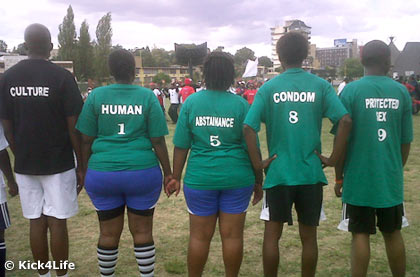
Drawn from applied drama and theatre processes, the play was devised and performed in the context of the YDF tour and built on the momentum created by the Fédération Internationale de Football Association (FIFA) 2010 World Cup, which was held in South Africa. The performance embraced the notion of spectActors, where the audience can watch as well as participate in the performance to change the outcome of the storyline. Ka Bobele was staged as a football match between two teams: Risky FC [football club] and Safety FC. Players represented various factors that contribute to or prevent the spread of HIV/AIDS, including unprotected sex, alcohol, peer pressure, condoms, protected sex, and abstinence. Goals scored represented the choices that people can make.
The game was played with an imaginary ball, and players received yellow cards for unfair play. According to the organisers, although Risky FC dominated the play in the first half, with "peer pressure", "unprotected sex," and "alcohol" giving the goalkeeper a tough time, they were not able to score. When the teams went for halftime, Safety FC had already proved their resilience by scoring two goals: one by "condom" and the other by "protected sex."
Former Banyana Banyana captain Desiree Ellis was involved in the play and was interviewed as a character during halftime. Audiences were encouraged to participate by cheering and blowing vuvuzelas (plastic horns about 2 feet long that produce a loud monotone note). At the end of the game - which Safety FC won 3-nil - players and spectators joined hands to form a giant AIDS ribbon and placed red cards on the ground.
HIV/AIDS, Youth
According to the organisers, the play's name was inspired by young people's observations of how applied drama and theatre processes make learning easy. "Ka Bobebe rea ithlabolla" means "we learn with ease" in Sesotho. YDF Project Coordinator Phumlile Dlamini said the "soccer match was brilliant, as it visualised what we try to teach all the time. Life is like a game, and the choices that had to be made were real."
The YDF project uses football as a vehicle to address critical health and development issues in Africa and to empower youth to manage their challenges and develop life skills. YDF has partnered with Kick4Life, a non-governmental organisation (NGO) established by brothers who realised that football can change and enrich people's lives. Kick4Life engages youth through football, imparting social skills and encouraging them to live HIV-free lives. The organisation also sets up networks that work to sustain youth.
Youth Development through Football, Kick4Life, and Drama For Life.
Email from Selloane Mokuku to Soul Beat Africa on July 6 2010; and YDF website on July 15 2010.
- Log in to post comments