










































Intersexions Television Drama
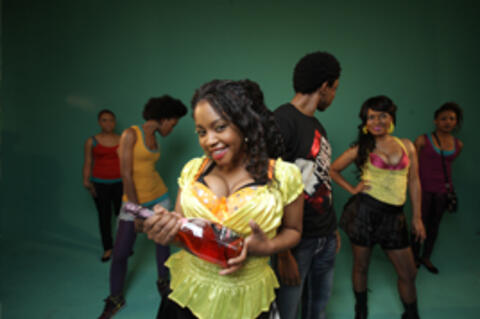
According to the producers, the entertainment-education programme does not present itself overtly as an HIV/AIDS drama series, but looks at the lives and loves of those infected and affected by HIV, as well as the circumstances in which characters contract the virus and the relationships in their lives. The interconnected but independent stories start and end with episode one, bringing the series-arc full-circle.
The first series starts with a wedding in a well-to-do suburb North of Johannesburg. The bride, Mandisa, dressing for her wedding, hears on the radio that a well-known DJ is dying of an AIDS-related illness. She is shocked as the DJ had been her lover five years before. With this story, the programme begins its journey through the chain of transmission of the HIV virus. Episode two is the story of Mandisa and the DJ five years before, and episode three is the story of the DJ and his other lover, Boitumelo.
In another episode, social climber Boitumelo, stung by the negative publicity around her affair with DJ Mo, meets Thami, a famous actor - and is seduced by his apparent sincerity, his offer of a movie role, and his fancy home. But his lifestyle is bankrolled by his sugar mama, Ruth, who is incensed to discover his infidelity and cuts his line of credit. Thami, who has taken Boitumelo on a joyride to meet his best friend Tshepo, has run up a large hotel bill that he cannot pay - leading him and Tshepo to make a critical error of judgment. For Boitumelo, who has equated status with self-worth and has given herself to Thami because of his perceived material wealth, the consequences are devastating.
In the next episode, Thami and his friend Tshepo are arrested after their serious lapse in judgment over an unpaid hotel bill and thrown into the notorious Polokwane Prison. The friends find themselves in a world where they are no longer hip and trendy homeboys, but the weak targets of violent and sexually predatory convicts. Locked up with a hardened criminal like Tizozo, they don’t stand a chance - and Thami's well-meaning but misguided effort to protect them by using his celebrity status backfires horribly. The fateful decision that landed them there has consequences they could never have imagined: one of the two will never leave the prison alive, and the other is a broken man.
Each stand-alone episode takes viewers closer and closer to understanding the interconnectedness of their sexual networks. Viewers begin the story thinking that Mandisa, the wife, has infected her husband. But by the end of the series, audiences are supposed to see how everyone is part of a complex network of transmission. The final episode breaks form and reveals, quite explicitly, in a documentary format, the network that viewers have been exploring throughout the series. Told with a mixture of live-action and animation, as well as referring to the characters in the story, it starts by taking audiences back to the wedding they encountered at the beginning of the series. It carefully shows who is related to whom - not only by blood, but through the virus. It then pulls out and takes a wider and wider picture of the sexual networks in society.
The second series maintains the same format of interlinked episodes but differs from series one as it shows how that which remains unsaid in our personal and sexual relationships places us at risk of HIV infection. According to the producers, the second series has a more daring script than the first series. Producers consulted widely via community dialogues with over 2000 people, inputs from the Intersexions facebook page, focus groups, and reviewed studies and media reports on issues relating to love, sex and HIV/AIDS to come up with storylines that are gripping yet real in bringing to the fore society's unspoken issues on relationships.
Intersexions is supported through SABC Education by educational programming on 15 SABC radio stations and is represented online with a blog, and Facebook, and Twitter groups. As of May 2013, the show has 14,783 "likes" on Facebook and is followed by thousands of people on Twitter. There is also an Intersexions website, which offers news and information about the show and the characters, as well as an advice section. The "Where to Get Help" section provides contact information (e.g., a helpline) for organisations such as People Opposed to Woman Abuse (POWA), which offers shelter, counselling, and legal support to women in abusive relationships, rape survivors, and survivors of incest. Similarly, the phone number of Stop Gender Abuse is offered. This organisation offers crisis counselling for women who have been raped or abused, advice and support for people wanting to support women in need of help, and legal and other options available for abused women and rape survivors.
HIV/AIDS, Multiple Concurrent Partnerships
According to the producers, for the week of 1-7 November 2010, in which Intersexions episode four was screened, the show garnered 4,072,000 viewers. Besides popular soap opera "Generations", Intersexions was the only show to have broken the 4-million viewer mark.
A 2012 survey revealed that Intersexions was watched by 9 million South Africans - 28% of men and 38% of women. Of those who watched the series, almost 50% (or 4.5 million South Africans) watched at least 13 episodes. According to the survey, Intersexions decreased favourable attitudes towards multiple concurrent partnerships (MCP) and increased audience self-efficacy to resist MCP. The series increased positive attitudes towards condom use and self-efficacy to use them. It also reinforced the perceived norm that more people are getting an HIV test and increased discussion about testing. It has received a Peabody award and 11 South African Film and Television Awards (SAFTAs), including honours for Best TV Drama, Best Director, Best Actor, and Best Actress.
Johns Hopkins Health and Education in South Africa (JHHESA), Curious Pictures, Ants Multimedia, SABC Education, USAID, and PEPFAR.
Johns Hopkins Health and Education in South Africa website, Intersexions website and Johns Hopkins University Center for Communication Programs (JHUCCP) website - all accessed on January 4 2010; and Intersexions website and JHUCCP website, both accessed on May 8 2013, and JHUCCP website on July 23 2013.
- Log in to post comments