










































Integrated Communication Campaigns to Support Citizen Behaviour Change
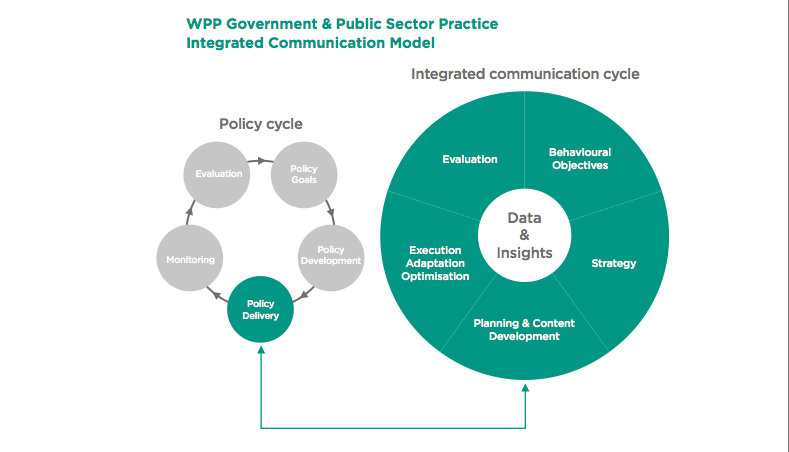
This guide is designed to help communication programme managers in the public sector develop and manage integrated communications programmes that “use communication as a new lever to educate and inspire citizens to change their behaviour, and to mobilise social movements for change.” Published by WPP, a British multinational advertising and public relations company, the guide is organised around the model for integrated communication used by WPP's Government & Public Sector Practice. This group works to help policy makers and public sector communicators to address key challenges governments face today through creative, research-based communications programmes designed to have measurable impact.
WPP describes integrated communications as a structured approach to communications that is integrated across policy interventions; audiences; communication, marketing and research disciplines; and paid, owned, and earned media channels. Based on the premise that an integrated communications approach offers benefits in supporting behaviour change, the guide describes:
- the importance of integrated communication
- the four dimensions of integration
- the five stages of the WPP Government & Public Sector Practice model
- ways to put the model into practice.
The five stages of the integrated communication model are:
- Behavioural objectives
- Strategy
- Planning and content development
- Execution, adaptation, and optimisation
- Evaluation
“Data and insights” are central to all five stages; the guide identifies the approaches to research and other data gathering methods as appropriate for each stage, as well as stage-specific uses of data and insights.
For each stage of the model, the guide includes: questions to ask, tasks to be performed, and expected outputs, and explains how to set behavioural objectives and measure progress against them. The model itself is based on WPP experience, industry best practices, and academic literature on behaviour change science.
The guide is also intended to help communications managers structure and manage an effective multidisciplinary team of experts and work effectively with behavioural scientists and other experts. The concepts are illustrated with practical examples and case studies (from countries like Australia and Kenya), as well as recommendations for other written and broadcast sources of relevant information.
English
35
WPP website, Nov 9 2016.