










































Integrated Approaches for the Delivery of Maternal and Child Health Services with Childhood Immunization Programs in Low- and Middle-Income Countries: Systematic Review Update 2011-2020
Centers for Disease Control and Prevention (Shah, Wallace); Jhpiego, a Johns Hopkins University Affiliate (Morgan); University of Melbourne (Morgan, Beeson, McPake); Burnet Institute (Morgan, Beeson, Peach, Davis); Monash University (Beeson); University of New South Wales Medicine and Health (Peach)
"Integrated services continue to play an important role in achieving more client-centered services in primary healthcare and progress towards IA2030 [Immunization Agenda 2030]."
Immunisation visits during the first two years of life may provide a platform for increasing the coverage of other maternal and child health (MCH) interventions, particularly in low- and middle-income countries (LMICs). However, integrating services could lead to overburdened health workers and a decreased quality of service, with potential impacts on service coverage and acceptability. To inform global, regional, and country-level strategies with new evidence on the integrated delivery of MCH interventions with immunisation services in LMICs, this group of researchers undertook an update from the last systematic review on this topic, synthesising published and gray literature from 2011 to 2020.
Among the 16,578 articles screened, 44 met the criteria for inclusion, representing 34 studies, of which 29 were from Africa. The commonly linked MCH services were family planning (24%), HIV diagnosis or care (21%), and malaria prevention or control (21%). Multiple integration strategies were typically used; the most frequently described strategies were the co-location of services (68%), the provision of extra services by immunisation staff (41%), the provision of extra information and/or counseling by immunisation staff (41%), and the provision of extra information and/or counseling by non-immunisation staff (12%).
In general, integration improved MCH service outcomes (76%) and was either beneficial (55%) or neutral for immunisation (35%). For example, among studies that integrated service delivery during immunisation campaigns (n = 3), groups receiving integrated services had significantly higher vaccination coverage for measles and oral polio vaccine (OPV) and significantly higher long-lasting insecticide-treated (ITN) bednet coverage, compared to non-integrated service delivery groups. Integration was sometimes viewed as an opportunity to provide services, especially with the help of community health workers, to areas or communities that are hard to reach, thus expanding the reach of services. These findings support previous observations that the coverage of other health services could be expanded through integrated service delivery with immunisation programmes.
The processes, enablers, and barriers affecting service integration, as described by the included studies, are shown in Table 3 in the paper. Important implementation considerations included: the careful matching of priority populations in service re-design (e.g., the need for co-location); efforts to ensure support from policy, logistics, and information systems; the provision of adequate training and support of staff to avoid overload and to improve motivation and empowerment; clear client communication through multiple channels to improve community understanding and the uptake of integrated activities; and the need to address community concerns (e.g., in scenarios where linked services were potentially sensitive and might involve stigma, such as for HIV diagnosis or care).
The considerations summarised in Table 3 of the paper provide a framework that can be drawn on by planners wishing to promote greater service integration. The synthesis suggests that three key areas determine how easy it is to integrate services, and thus contribute to improved service delivery: (i) whether there is a good alignment of the new linked services' intended population and the need for skills and supplies with the capacities of the service platform already in use for immunisation; (ii) whether investments are in place to adequately support staff in terms of the guidance, training, time, supplies, and workforce needed to deliver the expanded package of care; and (iii) whether clients' expectations (e.g., privacy or timely care) are met and community perceptions are well understood, which can be achieved through formative assessment if necessary.
In conclusion: "Integrating MCH services with routine immunization can expand linked services and improve immunization coverage. This study has identified key implementation considerations relevant to both childhood and adult vaccination programs. More research is needed regarding costs and client preferences."
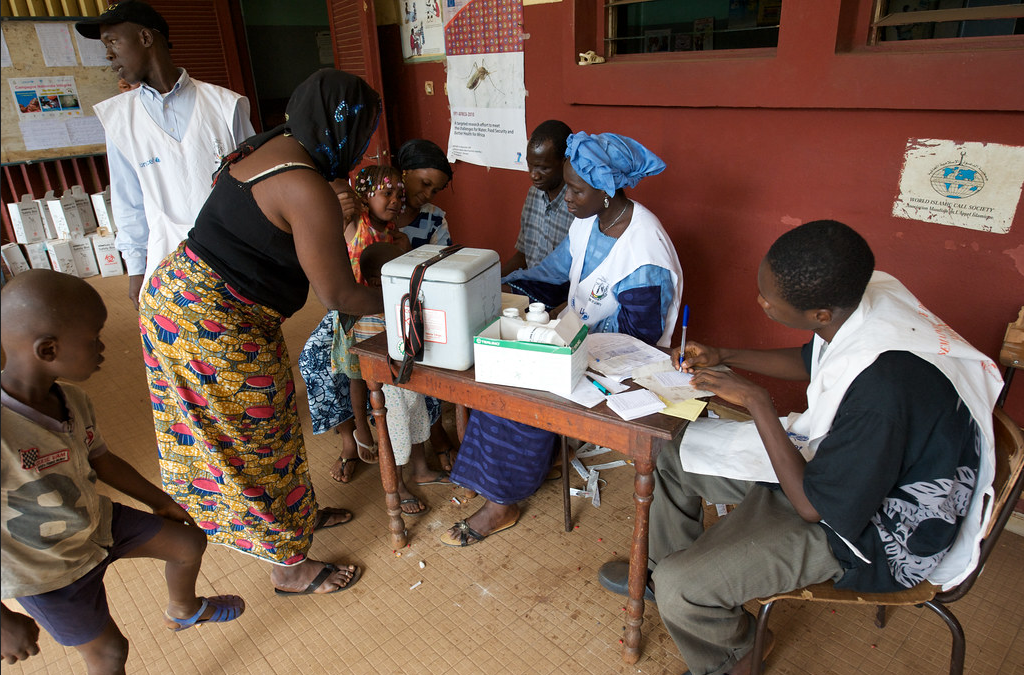
Vaccines 2024, 12, 1313. https://doi.org/10.3390/vaccines12121313. Image credit: Julien Harneis via Flickr (CC BY-SA 2.0)
- Log in to post comments