










































Increasing Support for Reproductive Health Activities Among Religious Leaders in Niger (Accroître le Soutien aux Activités de Santé Reproductive parmi les Leaders Religieux au Niger) - Volumes 1, 2 and 3
These three dual language reports offer a summary of the human-centred design (HCD) process used by Population Services International (PSI) to engage religious leaders in reproductive health activities in the Zinder region of Niger. Each of the three volumes looks at a different part of the HCD process: inspiration (the formative research stage), ideation (making sense of what is learned and the development and testing of prototypes), and implementation of the most promising ideas that emerged.
The background to the project is explained briefly in Volume 3 as follows: “In 2016, [the United States Agency for International Development, or] USAID’s Sahel Regional Office conducted an assessment of family planning needs within the region. This assessment found that significant socio-cultural and structural barriers to family planning use persist in Niger. For instance, it was found that men generally do not play a supportive role in women’s reproductive health and couples do not openly discuss these issues. In addition, many existing demand creation efforts are not sufficiently segmented and tailored to the needs of targeted audiences or grounded in the local cultural context. Lastly, while Islam is supportive of birth spacing, family planning is often seen by communities as a Western imposition and religious leaders in Niger have divergent views on the topic. In response, the Transform/PHARE project, led by Population Services International (PSI), partnered with YLabs to design an intervention in the Zinder region of Niger using a participatory human-centered design approach to engage religious leaders and other influential community members in the design of solutions that would increase support for reproductive health activities. Given the nature of the topic and target audience, such an approach was essential to ensure that careful research, design, and testing of solutions was done in a way that both resonated with the Islamic beliefs of the community and also served the reproductive needs of youth of family planning age. As a result, the final solutions build on religious principles for birth spacing and family well-being, address myths and misconceptions of family planning, and encourage responsible parenting.”
The first volume [PDF] focusing on the inspiration phase highlights the results of the HCD research conducted by YLabs and PSI to uncover youths' and religious leaders' perspectives on and knowledge of reproductive health products and services, particularly birth spacing practices, in three districts and nine villages. The research also sought to better understand the health, social, and economic contexts that influence their attitudes and decision making. Through interviews, observation, participatory research activities, and co-design workshops, PSI explored how social norms, peers, family, aspirations, religion, and financial constraints affect their decisions. The team also conducted a range of expert interviews in Niamey and Zinder with religious associations, governmental actors, USAID (which funded the programme), and other non-governmental organisations. The findings showed, for example, that there were several religious leaders within each village who were supportive of birth spacing, but perceived a significant amount of risk assuming a publicly supportive stance on their own. Insights from the design research also revealed that men routinely exercise dominion over every household decision, including household expenses, the number and timing of children, and what, if any, contraceptive method wives will use. Despite this immense control over household decision-making, it found that men had insufficient knowledge of the financial implications of raising children. In addition, both religious leaders and youth shared a desire to improve their knowledge (and relatedly, an ability to dispel myths) about reproductive health in a public forum so that the larger community could additionally benefit from this candid discourse.
Volume 2 [PDF] discusses the ideation phase, which is based on insights gathered during the inspiration phase. As explained in this second report, the team sought to develop solutions that tested the following central hypotheses:
- What resources, tools, religious arguments, or other incentives would motivate and inspire religious leaders to assume a more publicly supportive stance on birth spacing?
- Would improving the dynamics between religious leaders and youth foster more empathy, understanding, and support for positive reproductive health activities?
- Would a better understanding of the financial implications of having and raising children framed in the context of responsible parenthood encourage men to consider practicing birth spacing?
- How might we go about designing high-impact solutions for low-literacy populations in low-tech contexts?
The report explains how, based on these hypothesis, the team designed ten rapid, low-fidelity prototypes that were subsequently field-tested (using a variety of testing methods, such as mystery shopping, pictorial elicitation, role playing, and card sorting), with a combination of 72 religious leaders, youth, and healthcare workers across target districts. The team then evaluated which prototypes demonstrated the most promising potential with respect to a number of indicators, including sustainability, financial viability, and low risk to communities. The outcome of this evaluation yielded three refined concepts that were selected for live prototyping.
These three concepts were:
- Leaders Engagés - an activity that consists in identifying religious leaders who are champions of the practice of birth spacing in their communities, connecting them through a collective, and providing them with religious justifications to support their position during their preaches and sermons or other forms of public advocacy.
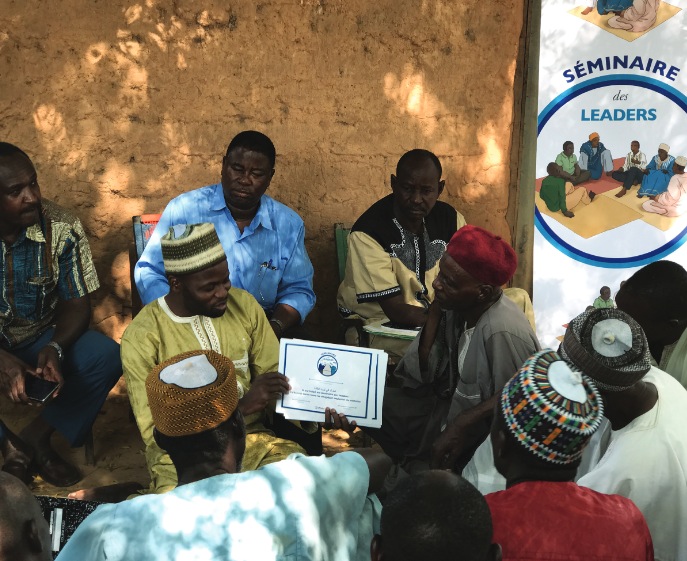
- Séminaires des Leaders - an activity that builds knowledge and connection between religious and youth leaders through a series of discussions and debates in different communities. These debates are comprised of six to ten participants, split between the two groups. Based on community preference, a third party can also take part in the debate to moderate the discussion between the different stakeholders. This moderator can be the village chief, a health worker, or other. These debates can either take place publicly, with the community in attendance, or take place privately at first, followed by a form of public dissemination of their choosing at a later stage (e.g., public meeting).
- Dede Ruwa Dede Tsaki - a communications and financial capacity-building activity administered in fadas. Fadas are existing structures in communities where men usually meet. This activity combines two elements aimed at enhancing the understanding among young married men of the importance of balancing family size to their means - these include communication materials and a budgeting exercise.
The report highlights some of the lessons and implications that emerged out of this live prototyping that would be useful for implementing these activities.
Volume 3 [PDF] is basically a detailed guide on how to implement the three different components - Leaders Engagés, Séminaires des Leaders, and Dede Ruwa Dede Tsaki. This includes guidance on how to introduce the activity to the community, recruit participants, screen religious and youth leaders, plan the launch, and develop the materials. Finally, it offers guidance on monitoring and evaluation, with a list of indicators for each activity.
PSI website on January 10 2018.
- Log in to post comments