










































How Listening Groups Are Adding Value to the Ethiopian Health Development Army and Impacting the Wider Community
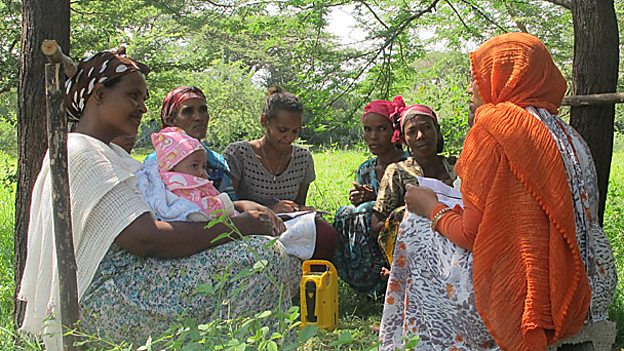
"Listening groups, based on BBC Media Action’s health programmes, are adding value to the Ethiopian government’s Health Development Army, a network of volunteers tasked with learning about key health behaviours and leading others in their communities. Volunteers report gaining new and valuable knowledge on maternal and child health practices and growing in confidence to better support others in the community through one-to-five networks."
This BBC Media Action qualitative study in Ethiopia was designed to understand the added value of listening to BBC Media Action’s programmes in a group setting. Conducted in February and March 2016, the project used a case study approach to measure engagement of focus group members who were in listening groups discussing two radio magazine programmes, Biiftuu Jireenyaa (Dawn of Life) and Jember (Maternal Light) that focus on women of reproductive age (aged 15-45) and their husbands. Both have been produced by BBC Media Action since 2013 with the aim of improving the health of mothers and babies.
"In addition to being aired on three regional broadcasters: Oromia Radio and Television Organisation (ORTO), Ethiopia Broadcasting Corporation (EBC) and Amhara Radio Network, a number of two year-long listening groups have been run to extend the reach and impact of the programmes to the community through the Health Development Army (HDA) and the one-to-five network.
The HDA comprises of male and female volunteers who learn about healthy behaviours (such as: vaccinating children, sleeping under mosquito bed nets and using family planning) and promote these in their communities by acting as role models and giving advice.
Part of the national Health Extension Programme, they are embedded within a one-to-five network in which one individual learns new information and then passes this on to five others in their community. They operate across almost all kebeles (neighbourhoods) in Ethiopia, while BBC Media Action’s listening groups work within only a small fraction of these. As of August 2016, 162 listening groups were operating across 96 kebeles."
The study results from 13 focus group discussions (FGDs) of listening group members and 38 in-depth interviews (IDIs) of listening group members, health extension workers (HEWs) who facilitate the groups, and households visited by group members as part of the one-to-five network in six different communities showed the following key findings:
- "Situating the listening groups within the one-to-five network is the key to success:
- Listening groups are filling knowledge gaps in the one-to-five network. Members told us that being part of the group helped them correct basic misconceptions around reproductive, maternal, newborn and child health (RMNCH). Despite being expected to lead others in the community, many reported having limited knowledge on healthy RMNCH practices, prior to being involved in a listening group.
- HEWs running listening groups recognise that these groups help extend the reach of vital health information within the community, creating further demand for services.
- Discussion and repetition is beneficial:
- Listening groups add value by providing a space in which group members can discuss and seek clarification on themes from the broadcast. Discussion time helps members consolidate learning through repetition.
- Members come to form strong bonds through sharing together in a group. In several cases members have gone on to create a community co-operative or ‘ekub’ to help support pregnant women in their community.
- Direct benefits to members:
- Listening groups provide access to uniform learning on reproductive and maternal health (in many cases, this is the first time members have access to such information).
- Members, particularly women, said they have grown in confidence and feel more empowered to support others in the community across RMNCH issues and contribute in other community meetings.
- Both HEWs and members report changes in gender dynamics within households. Some men report having learned to support their wives better during pregnancy, and HEWs have observed some women beginning to address their husbands more directly.
- Community impact:
- Information learned from the listening groups is being disseminated to the community via the one-to-five model, and HEWs are largely satisfied that information passed is accurate and of high quality.
- Households visited by group members say that information is delivered in a more detailed and attentive manner compared with other information available to them.
- Many group members spoke of people in their wider networks who they were able to support into practising healthier behaviours, such as contraception or birth spacing, antenatal care attendance, delivery in a facility, and caring for a newborn."
The study concludes that listening group and programming are compatible with the government ambitions for HDA groups and help them gain new knowledge and leadership ability. It recommends scaling up the BBC Media Action listening groups embedded within the HDA.
Click here to read the 2-page document in PDF format.
Click here to read the full 50-page study, "Listening Groups in Ethiopia: What Value Is Added to the Listener Experience by Taking Part in Listening Groups?" [PDF], published in December 2016.
BBC Media Action website, September 1 2016, and email from Emebet Wuhib-Mutungi to The Communication Initiative on April 18 2017.
- Log in to post comments