










































Holding Government Accountable to Gender-based Violence in the Republic of Congo Project
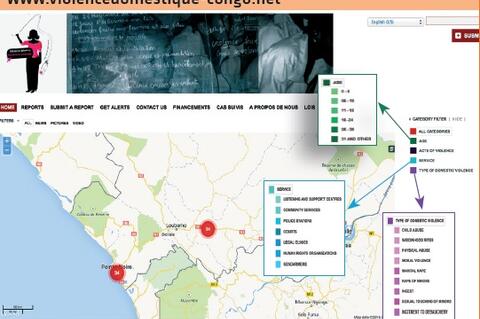
The project was developed to demonstrate the high number of incidences of violence against women and to identify recurring types of violence. Implemented in collaboration with local partners in two locations, Pointe-Noire and Nkayi, it was also designed to improve the documentation of violence cases and monitor responses by enforcement, health services, and law and legal support agencies to develop evidence that could be used to "convince the government and other authorities of the size and seriousness of the problem and to make decisions to ensure that violence against women and girls is one of the government’s action priorities." In order to do this, project partners identified cases and tracked progress as the survivor went through the process of reporting, opening a case, seeking counselling, etc.
A key component of the project was an interactive domestic violence map, which was launched in November 2012. A total of 174 cases of domestic and sexual violence were reported as part of the project and the map showed where violations occurred, categorised them by different types, age of the victim, and the role of the perpetrator, and indicated the status of cases. According to project reports, "the development of this online mapping platform made it easier to keep track of cases and to produce visual information around the commitments and services of the government, police, health facilities and courts of law, in order to hold them accountable for working to prevent violence against women and girls."
Data was collected from each of the partner organisations using harmonised data collection sheets developed as part of the project. These were then fed into the central platform. The process of developing the online mapping helped CSOs to collate their information and better understand ways of working together, and to make the problem of GBV more visible. The development of the map also generated interest by the media, who "found it a source of factual data and personal testimonies." Four workshops were also organised with journalists to improve their reporting on the issue of violence against women and to disseminate information about women’s rights and support services.
Along with the mapping process, the project also provided counselling and referral services for women and children who had been abused, and their relatives. People received support, comfort, and information about their rights and the legal and medical options available to them. This included helping file complaints at the police station and following cases through to court. As well, the project mapped and identified the places in each district where victims of violence might go for help - health centres, police stations, community leaders, schools, churches and district chiefs – and talked to people who would then send the victims or family members to the partner organisation's offices. With support from the government and the French Embassy, the project team was able to set up one-stop centres in each of the cities where the project was implemented to provide advice and support to women and girls who face violence, as well as their families.
In order to ensure that all organisations could effectively undertake this role, guidelines were developed and training conducted on the different stages when dealing with cases of violence - from reporting to the police to the court trials. Power Point presentations and training modules were created to build the legal capacities of the local organisations to identify, recognise and analyse malfunctioning in the judicial system. In addition, some partners required capacity building in the area of ICT technical skills.
Along with the online platform, the case information was presented in periodic meetings with local authorities, community members, the police and medical personnel, with the goal of improving understanding and prompting actions. Information was also used to inform advocacy workshops in the districts, which were organised with the support of local governments.
The formative research and reflections on the project are shared through several publications.
Online mapping to end sexual and domestic violence: A Research Report on the implementation of the ATTI Project in the Republic of Congo [PDF]
Use of ICTs to improve access to justice and health for women and children victims of sexual and domestic violence in the Republic of Congo A Survey Report – English [PDF]
Use of ICTs to improve access to justice and health for women and children victims of sexual and domestic violence in the Republic of Congo: A Survey Report – French [PDF]
Gender-based Violence, Information and Communication Technologies
"Republic of Congo (Congo) has one of the most serious incidence of gender-based violence and human rights violations in the world. It is a country emerging from years of armed conflict, which has perpetuated rape and sexual violence as a weapon of war. In Congo, a small country with a population of about 3.6 million, over 15,000 cases of sexual violence were reported in 2009. In the first six months of 2010, 7,685 cases were reported. More than half of the victims were under 18 years of age. Many cases of sexual violence continue to be reported particularly in post-conflict areas in both countries. In addition, domestic violence, sexual harassment and incest are common."
Women’s Rights Programme of the Association for Progressive Communications (APC), AZUR Développement, Africa Technology and Transparency Initiative (ATTI), Agence Régionale d’Information et de Prévention sur le SIDA (Regional AIDS Information and Prevention Agency - ARIPS), Réseau des Associations de Solidarité Positive (Network of Positive Solidarity Associations - RASPC), Association des Femmes pour le Développement de la Bouenza (Association of Women for the Development of Bouenza - AFDB)
- Log in to post comments