










































HC3 Research Primers
This series of research briefs explains a variety of theories, models, and approaches and is designed to help professionals design, implement, and evaluate their social and behaviour change communication (SBCC) programmes. Each Research Primer describes the behaviour change theory or model and provides guidance on when it should be used. They also include important information for implementers to consider, as well as a case study of a communication initiative that demonstrates how the theory has been used in practice.
The Research Primers in this series are:
Social Learning Theory
Social (or Observational) Learning Theory stipulates that people can learn new behaviours by observing others. Earlier learning theories emphasised how people behave in response to environmental stimuli, such as physical rewards or punishment. In contrast, social learning emphasises the reciprocal relationship between social characteristics of the environment, how they are perceived by individuals, and how motivated and able a person is to reproduce behaviours they see happening around them. People both influence and are influenced by the world around them.
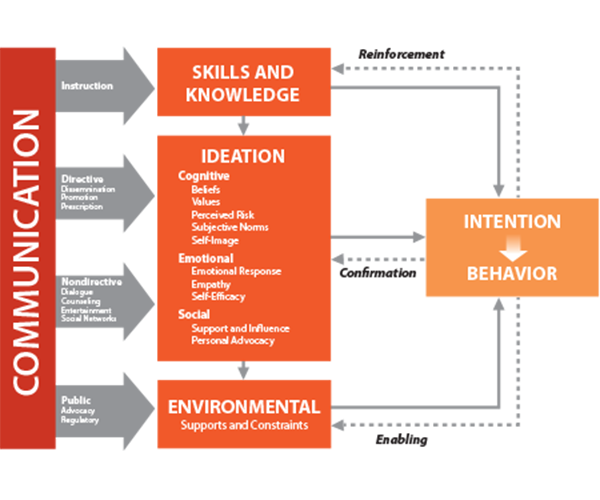
Ideation
Ideation refers to how new ways of thinking (or new behaviours) are diffused through a community by means of communication and social interaction among individuals and groups. Behaviour is influenced by multiple social and psychological factors, as well as skills and environmental conditions that facilitate behaviour. SBCC can affect all of these factors.
Propensity Score Matching
Propensity Score Matching (PSM) is a statistical technique that allows researchers to more accurately measure SBCC programme impact and to make a strong case for causal attribution. It helps researchers determine whether the programme was actually responsible for the changes in knowledge, attitudes, and behaviours that occurred.
Extended Parallel Processing Model
The Extended Parallel Processing Model (also widely known as Threat Management or Fear Management) describes how rational considerations (efficacy beliefs) and emotional reactions (fear of a health threat) combine to determine behavioural decisions. The degree to which a person feels threatened by a health issue determines his or her motivation to act, while one's confidence to effectively reduce or prevent the threat determines the action itself.
Integrated Model of Communication for Social Change
The Integrated Model of Communication for Social Change (IMCFSC) describes an iterative process where a community engages in dialogue and collective action to produce social change and support improvements in the health and welfare of its members.
Gender Transformative Approaches
Gender Transformative Approaches (GTA) are programmes and interventions that create opportunities for individuals to actively challenge gender norms, promote positions of social and political influence for women in communities, and address power inequities between persons of different genders.
Diffusion of Innovations
The Diffusion of Innovations model describes how a new idea, product, or positive health behaviour spreads through a community or social structure. The model identifies several factors that influence how quickly an idea or behaviour is adopted.
Theory of Planned Behavior
The Theory of Planned Behavior helps programme implementers design interventions that effectively address a particular behaviour. When using this theory, implementers consider three types of beliefs that tend to guide human behaviour: behavioural, normative, and control. When combined, attitudes towards the behaviour, subjective norm, and the perceived behavioural control result in the formation of an intention. Understanding these beliefs and the intentions they produce can provide clues on how to impact behaviour change.
English
HC3 website on July 19 2017.