










































Guidebook Internet Governance
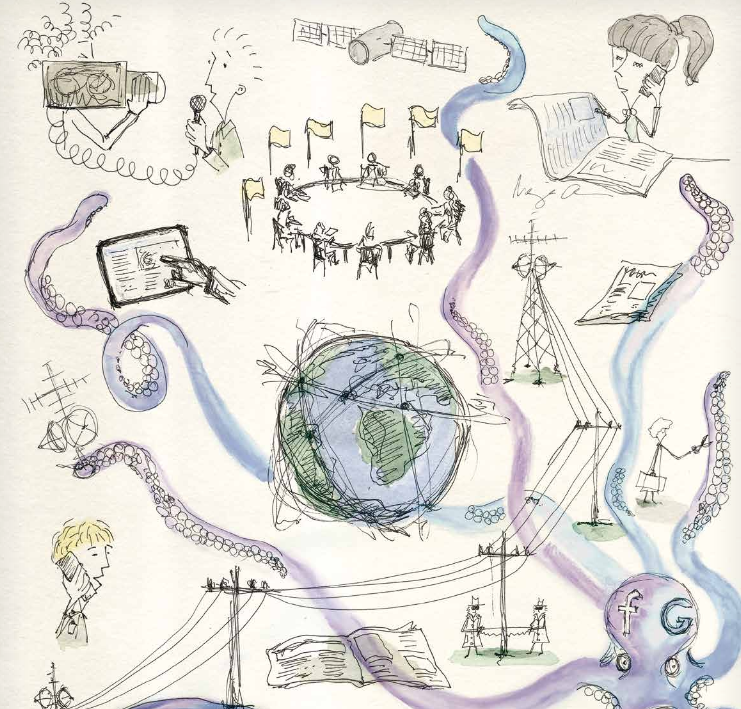
Written for, and by, stakeholders in the Global South, this guidebook from the international media development organisation DW Akademie, together with iRights, seeks to contribute to a greater understanding of internet governance - an issue that "will shape global communications, development and human rights." Considering the unevenness of access and use of the internet between the Global South and the Global North, the guidebook is designed to ensure that stakeholders in the Global South help shape the internet governance debate.
As explained here, governing the internet is a complex process with many entities involved. Media are more affected by internet governance then by any other kind of regulatory framework, because distribution of traditional media - television, radio, and newspapers - is migrating to the internet. So if someone publishes a controversial comment on Facebook or Twitter, is the company responsible for determining whether it is libellous or in line with the law of the respective country? If not, how can people in Chile or Bangladesh enforce their rights vis-à-vis a company that operates under the laws of a foreign country but makes the content available globally? Questions like these are amplified in a situation where the legality or decency of content is regarded very differently around the world but the content is accessible everywhere via the internet, as was seen in the case of the publication of depictions of Mohammed - completely legal as free speech in most countries and yet an illegal act in many Muslim countries.
According to the guidebook, a free and open internet is increasingly under attack. Online censorship is a growth industry, and internet and social network shutdowns in response to civil unrest are on the rise. Online surveillance is increasing, as is intimidation and/or detainment of people because of their online activities. At the same time, internet providers such as telecommunications companies are seeking to monetise parts of the internet to maximise profits.
After a foreword and introduction, the guidebook examines what activists say in Africa, Latin America, and Asia. The section "Many voices count" includes contributed chapters titled "Access for all - or the end of the Internet as we know it?", "Don't shoot the messenger", and "Undermining privacy and freedom of expression in guise of cybersecurity". The latter chapter is a case Study from South Africa. The section "Think globally, act locally" begins with "No balancing exercises!", in which David Kaye, United Nations (UN) Special Rapporteur on the freedom of opinion and expression, talks about how codes of conduct for online behaviour can be governed and about decision-making in cases where rights such as privacy and liberty of speech seem to be at odds with one another. This section then proceeds to address central topics under the umbrella of internet governance in the Global South: How can freedom of expression be fostered? What is zero rating about and how is it related to freedom of expression and information (It is a practice where internet service providers do not charge customers on data for select applications and content.)? How does the multi-stakeholder model of internet governance work? Why does privacy matter?
Editor's note: Click here to read "Internet governance - why you should care", the interview with Matthias Spielkamp, co-founder of iRights and one of the Editors of the the guidebook. The interview was conducted for DW Akademie's #mediadev site, which is dedicated to media development issues.
40
DW website, August 29 2016; and email from Barbara Gruber to The Communication Initiative on November 2 2016. Image credit: Manja Ehemann
- Log in to post comments