










































Grassroots Girls Book Club
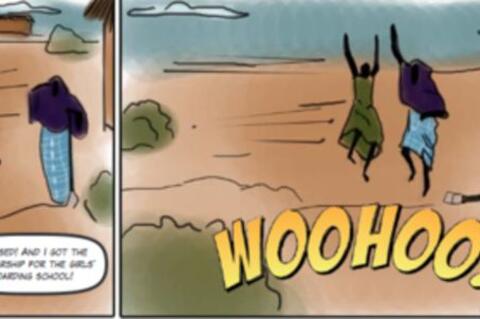
"We told our stories to show change is happening. It's amazing how a girl can transform her life with the right support. And it was fun seeing our lives illustrated by some incredible female artists! Read our graphic novellas, discuss with your friends and then take action to make our world better for girls everywhere." - Finka, one of six girls telling their stories of change for the Grassroots Girls Book Club graphic novella series
This initiative revolves around a series of 6 autobiographical stories, all authored by girls participating in social change and empowerment programmes offered by local grassroots organisations in countries around the world. The girls' stories appear in graphic novella format, each one illustrated with colourful images from emerging women artists and buttressed by a girls' book group discussion guide in the back. Grassroots Girls Book Club was created by Grassroots Girls Initiative (GGI), a partnership of 6 funders that believe that grassroots organisations are qualified to design and implement organic solutions for underserved girls in the communities in which they work.
"Six girls facing real challenges, six grassroots organizations offering real solutions, six unforgettable graphic novellas." The 30-page graphic novellas - sharing stories from Malawi, India, Poland, the Dominican Republic, Colombia, and Kenya - demonstrate what is possible when girls are given a voice and an opportunity to use it. Each girl co-authored her own story, choosing the story arc, crafting the dialogue, and selecting photos to later be illustrated by a diverse group of emerging female artists. The first draft of each of the 6 stories was told using a comic book app. According to organisers, having the girls closely involved in the development of their stories was paramount in this project. In the end, the stories are narratives of hope and advocacy, with the protagonists empowered to volunteer to extend their help and experiences to other girls.
The stories depict tough, real-life obstacles with candor. In one novella, Khadija, a Malawian girl struggling to get an education despite living in poverty, tells the story of how she won a coveted scholarship to secondary school only to get pregnant in her first year due to her lack of sex education. Luckily, the Nkhotakota AIDS Support Organisation (NASO) had a plan for young drop-out mothers like Khadija: In exchange for tuition at the secondary school, NASO asked Khadija and others like her to train to become peer educators for their Girls' Corner Program (or "Tsogolo Langa", which means "my future"). As a peer educator, Khadija shares her "cautionary tale" and teaches other girls about reproductive health, assertiveness, sexually transmitted infections (STIs), and the importance of staying in school.
Violence against women and sexual empowerment are primary themes in many of the stories. In Meenu's narrative, for instance, the shy high school-age girl is afraid to leave her home, which lies in a Delhi slum, for fear of assault or "eve-teasing", sexual harassment, which is both dangerous to her personal health and potentially damaging to her reputation and marriage prospects, according to traditional Indian custom. However, after a training course on computers at Feminist Approach to Technology, Meenu begins critiquing the system of patriarchal power: "Males are just worried that if girls are educated, we will become self-assured and vocal and then it will be difficult to control us and marry us off", she says. Finka, a Polish girl, becomes a sex educator and feminist with Ponton, an organisation devoted to providing young adults with information about sex in a country whose Catholicism severely limits upfront discussion of such topics. Her work fulfills a need: on average, just 23% of Polish women have access to modern contraceptive methods, and schools teach a strictly abstinence-only sex education curriculum.
Visit the Grassroots Girls Book Club website to read all 6 stories, as well as the artists' bios. Click here to read one of the 6 stories in PDF format. For any questions about the Grassroots Girls Book Club, please email info@kahanicommunications.com
Girls, Rights
GGI members are: Global Fund for Women, Firelight Foundation, The Global Fund for Children, Mama Cash, American Jewish World Service, and EMpower.
Email from Robin Dixon to The Communication Initiative on March 12 2015; and Grassroots Girls Book Club website, "Grassroots Girls Book Club", by Robin Dixon, Firelight, GGI website, and "True Stories of Girl Power Around the World", by Margaret Barthel, The Culturist, March 10 2014 - all accessed on June 2 2016.
- Log in to post comments