











































Grandmothers - A Neglected Family Resource for Saving Newborn Lives
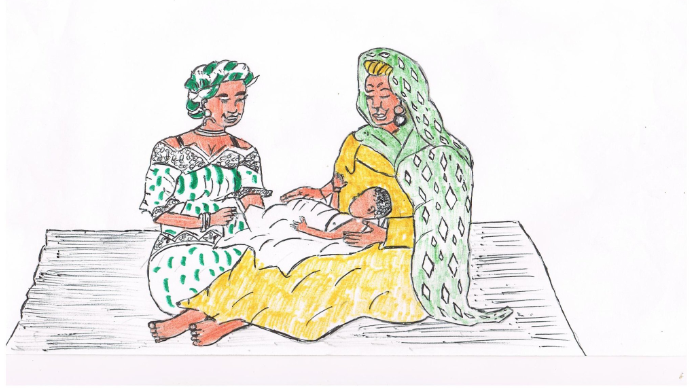
Grandmother Project (GMP) - Change through Culture
"In collectivist cultures, the roles of men and women are gender specific and as both advance in age and experience, their authority in their respective domains of expertise and responsibility increases."
In non-western cultures, where the extended family has a strong influence, different family members, including grandmothers, play advisory and caregiving roles with new mothers and newborns. The evidence presented in this paper suggests, however, that ageism, sexism, and Western ideals of the nuclear family have excluded grandmothers from national and international policies and programmes to save newborn lives in the Global South. The paper provides numerous examples from research in Africa, Asia, and Latin America that reveal the role and influence of senior women, or grandmothers, in newborn care.
As author Judi Aubel explains, fundamental features of the structure and dynamics of families in non-western collectivist cultures have received limited attention - this, despite the fact that approximately 88% of all societies are fundamentally collectivist. Aubel identifies the characteristics of collectivist cultures that should orient newborn programmes, including: hierarchy based on age and experience; elders as teachers of younger generations; gender-specific roles; multi-generational families and childrearing; collective decision making; and interdependency valued over autonomy. The "onion model" depicts the individual as nested within family, community, and cultural systems. Based on such a model, as well as the household production of health (HPH) framework, Aubel endorses the need for a conceptual shift from a narrow focus on women and children - the mother-child dyad - to an inclusive family systems perspective.
Aubel's review of 70 relevant published studies from 29 countries reveals seven themes related to grandmothers' role in family-level newborn care:
- Grandmothers' role as authoritative advisors and caregivers: Collectivist cultures are hierarchically structured, and authority is associated with gender, age, and experience. For this reason, there is consistent recognition of grandmothers' expertise and authority in the context of newborn care across Africa, Asia, and Latin America.
- Inculcation of cultural norms and practices: While certain traditional practices conveyed by grandmothers are beneficial, others are not, such as giving prelacteals and withholding colostrum. Many studies document mothers' adherence to grandmothers' traditional advice on infant care, given their trust and respect for them, even when it conflicts with health workers' advice.
- Seclusion of mothers and newborns: Studies in many cultural contexts describe an initial period of isolation for babies and mothers during which grandmothers provide education on newborn care and support to new mothers.
- Grandmothers' role in breastfeeding: There is extensive evidence of grandmothers' influence on whether and how long young mothers breastfeed.
- Care of sick newborns: Evidence from numerous non-western contexts reveals that families recognise grandmothers' expertise to diagnose neonatal illnesses, to provide home treatment, and to determine if extrafamilial support is necessary.
- Indigenous newborn social support systems: In collectivist non-western cultures, solidarity and reciprocity are central values, with social networks, composed mainly of older, experienced women, conveying to younger women prescribed practices but also providing them with crucial emotional support.
- Men's role in newborn care: Evidence indicates that men in non-western cultures are very rarely directly involved in newborn care. However, a trend that reflects nuclear family structure in the Global North is the promotion of men's involvement in all aspects of maternal and child health (MCH). Some researchers have questioned this trend and concluded that men's involvement and authority in the newborn space can inadvertently disempower women and disrupt women-to-women support systems.
Per Aubel, where initiatives have recognised the value of grandmothers and included them in programmes, such as in Nepal, India, Malawi, Burkina Faso, and Senegal, a grandmother-inclusive approach has been beneficial, and these experiences offer evidence that grandmothers may not be as resistant to change as is often assumed. "Evaluations of these innovative programmes have shown positive results strengthening grandmothers' knowledge, caregiving competencies and advice to other family members and increasing programme outcomes."
Despite such evidence, "at the global level, newborn research, policies and interventions continue to focus primarily on medical technologies and services,... to a lesser extent on mothers while giving little attention to intrahousehold newborn strategies in which grandmothers are key components of families' sociocultural operating systems..."
Two recommendations emerge from this review of research on the role of grandmothers in newborn care, supporting the need to:
- Refocus newborn research and interventions toward "a more systemic and culturally grounded frame for MCH research on intra-household dynamics indicating their greater cognizance of both the structure of collectivist cultures and of the critical role played by elders within those systems."
- Involve grandmothers in newborn interventions, recognising that while some of their knowledge and practices may be out of date or even harmful, they are powerful family actors: "Most studies strongly advocate for their inclusion in future newborn interventions based on their power and influence within their respective cultures and on the notion that their involvement may strengthen their knowledge and practices."
In conclusion: "Policy and programme planners should realise that the failure to explicitly include these cultural authorities can be perceived by grandmothers themselves and by their communities as an affront to their culture and engender resistance to well-intentioned programmes, thereby limiting their effectiveness."
BMJ Global Health 2021;6:e003808. doi:10.1136/bmjgh-2020-003808 - sent from Judi Aubel to The Communication Initiative on May 24 2021; and BMJ media release, February 16 2021 - accessed on May 25 2021; and email from Judi Aubel to The Communication Initiative on May 29 2021. Image credit: © The Grandmother Project via Facebook
- Log in to post comments