Forum 08 in Review: AWID's 11th International Forum on Women's Rights and Development
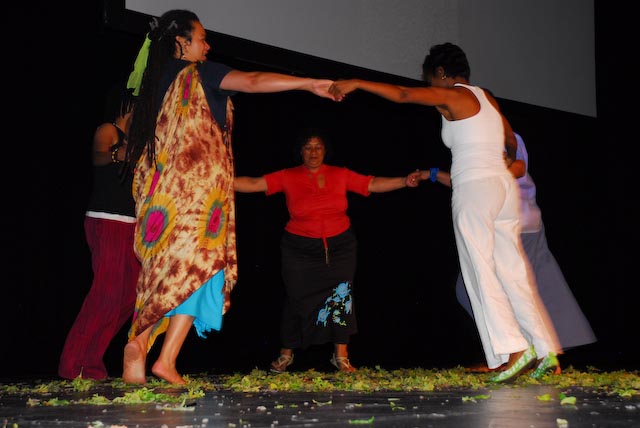
From November 14-17 2008, close to 2,000 women's rights activists from 144 countries came together in Cape Town, South Africa, to discuss "the power of movements". This 124-page compilation examines the 11th international forum held by the non-governmental organisation Association for Women's Rights in Development (AWID), presenting a snapshot of some of the discussions and activities that took place, transcripts from each of the daily plenaries, and excerpts and reports from some of the breakout sessions. Personal testimonials and other reflections and writings on the forum itself are included, as are photos and images intended to capture some of the energy, debate, and solidarity that AWID feels characterised this dialogue on the power of women's movements, all around the world. The report also includes reflections on areas for improvement in advance of the next AWID forum (Istanbul, Turkey, 2012).
As introductory sections of the report indicate, AWID selected the "power of movements" based on the belief that building collective power is key to advancing feminist agendas. AWID's aim was to engage a broad diversity of activists so that participants would be pushed to look to the varied array of experiences and expressions of women's organising, and, through that, recognise the broader possibilities for alliance-building. AWID "also wanted to firmly resist the increasing pressure on women's organizations to move away from movement building to project-oriented approaches that focus on delivering so-called 'concrete' or easily quantifiable outputs and services. We wanted to create a space for women to re-focus on strategies that build collective power to challenge the roots of gender discrimination and other forms of social exclusion and oppression....We aimed to build the Forum as a feminist space, valuing the relevance of individual women's stories and experience as part of the broader collective process of constructing knowledge."
Email communication preceding and following the forum is described here as an enhancement to the debate and as an element that increased understanding of the debate's impact on participants. AWID's Building Feminist Movements and Organizations (BFEMO) strategic initiative developed some core content as a foundation for the forum discussions. "Changing Their World - Concepts and Practices of Women's Movements" proposed definitions of a movement, and particularly what constitutes a feminist movement, and analysed core elements of movement strategies. "Changing Their World" was sent to all forum registrants via email prior to the forum, and printed copies were made available on-site in English, Spanish, and French. Post-forum, an online evaluation survey was conducted (591 responses were received); along with those results, the forum report draws on interviews and many informal conversations with participants.
Plenary and breakout sessions are outlined in the report; in brief, session themes covered economic and social rights, education and culture, sustainable development, multigenerational organising, overcoming fragmentation and alliance-building, constituency-building, organisational strengthening, sexual rights and reproductive rights, HIV and AIDS, communications and technology, violence against women, and conflict and post-conflict/peace-building.
"After analyzing a range of information collected about the Forum and participant experiences, it is clear that the AWID Forum created an inclusive space for diverse expressions of women's organizing and also contributed to opening up or advancing several sensitive internal debates - on NGO-ization, competition, power dynamics within women's movements - that are critical for our organizations to address head-on. Also, the 2008 AWID Forum is remembered as a space that contributed to positioning multi-generational movement-building on the agenda of many women's organizations, their allies, and donors." These selected comments from forum participants reinforce this assertion and illustrate the strategy of bringing people together in a large gathering to build strategic alliances:
- "At the Forum, many of the plenaries and sessions dealt with movement building, and how to build allies and collaborations that will help strengthen our movements. As I spoke with women from around the world and observed the sheer diversity of Forum participants, I thought of how many of the groups [my organisation] works with in East Africa do not collaborate effectively, or are not necessarily inclusive of a diversity of people. Thus seeing so many different women working together inspired the idea of strengthening collaboration and inclusiveness amongst Indigenous women and their organizations in Nomadic areas of Kenya."
- "It was a pleasant surprise to see my digital story being shown at the main plenary of the AWID Forum. I then realised that digital story telling was an effective and powerful tool that can be used to tell the audience what we know, who we are and what we believe in - as an individual from a
marginalised community and as a Movement."
Critical lessons and insights AWID learned through the experience of this forum are outlined in the report, particularly with a view to planning the 2012 forum. For example,
- Engagement with local women's organisations: "[W]e came to see that an event of this magnitude requires much more pro-active outreach on the part of AWID....This means more proactive local ambassadors, more focused local communication efforts with women's movements, as well as regular open interaction with an array of relevant actors in the host country."
- Responsiveness to shifts in context: "The financial crisis exploded about 6 weeks prior to the 2008 Forum....[T]he majority [of participants] felt that the absence of more debate around the crisis was a significant weakness and a lost opportunity to strategically use such a diverse space in a very particular political moment - for example to launch common actions, or give greater visibility to related joint statements."
- Openness and safety: "[W]e were both in a position where we had to turn away interested participants because we were over-capacity and we saw some participants in the space who did not embrace core feminist principles of respect for diversity and equality....The nature of participation by some men in attendance was also perceived as threatening, particularly in sessions on sexuality....What is clear...is that by making the forum such an inclusive and diverse space, we need to be better prepared...to manage the diversity in a way that it enriches us all and contributes to building a space where participants can raise their differences in respectful ways, protecting the integrity of all people present there."
- More opportunities for in-depth debate, strategising, and substantive interaction among participants: "...AWID faces difficult trade-offs between the diversity of voices and experiences and time for more in-depth analysis....For the 2008 Forum we tried to strengthen accompaniment of session organizers and provided methodological guidelines and tips from past experience. In future AWID Forums, we will be exploring other formats that we hope might provide greater opportunities for depth and interaction as well as strategizing."
- More diversity among participants as well as speakers: "...[W]e had hoped to attract as participants more women from other social movements and grassroots organizations who might not normally attend an international feminist event....In practice, we were reminded that...the time demands to facilitate this participation are extensive.....Although professional interpretation was provided...we heard that...the participation of Arabic, French and Spanish-speaking delegates was hindered....We have also received requests to expand accessibility by providing sign language interpretation and making key materials available in Braille. We will continue to explore possibilities for expanding the accessibility of the Forum..."
- Breadth and balance of the forum: "...AWID [aims]... to ensure that there is 'something for everyone'. But we will also be exploring the value of unstructured space in the agenda, as well as looking at the strong interest in more creative, cultural events as part of the forum program....[W]e [also] need to invest significant effort and outreach to more organizations working on economic justice to ensure they have appropriate space within the Forum."
- More effective multigenerational reflection and engagement: There was "...an ongoing tension whereby advocacy to overcome the exclusion and isolation experienced by young women activists leaves women from other generations feeling excluded or unappreciated. This tension needs to be addressed directly in future strategies built around generations as an identity."
Posting to the Women's United Nations Report Network (WUNRN) listserv, April 15 2010; and AWID website, April 27 2010.