











































Exploring the Impact of a Community Participatory Intervention on Women's Capability: A Qualitative Study in Gulu Northern Uganda
McGill University (Belaid); St. Mary's Lacor Hospital (Ochola, Bayo, Alii, Ogwang); International Prevention Research Institute (Greco); University of Montreal (Zarowsky)
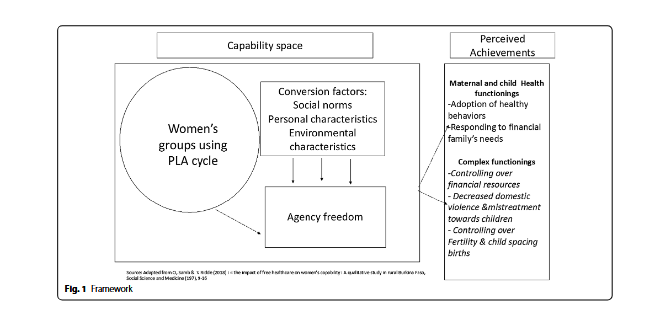
"The framework shed light on social and cultural conversion factors (women's status and cultural gender norms) obstructing women's full freedom in the context of implementing a participatory community intervention."
Community-based women's groups using a participatory learning and action (PLA) cycle involve a trained female facilitator discussing mothers' and children's health issues with women from her community. This approach is anchored in Freire's philosophy, which proposes that marginalised communities can mobilise themselves and take collective actions to address poverty and social issues. This study explored the perceived impact on women's capability of a project using women's groups practicing the PLA cycle to promote maternal and child health in Gulu, Northern Uganda.
To avoid creating parallel community structures, the team implemented the intervention by integrating the PLA approach into 12 preexisting savings groups. Over a five-day period, a local expert on the approach trained two women from each savings group to be facilitators, with a three-day refresher training in 2018. Three female supervisors (in charge of four groups each) supported the facilitators, attending the group meetings. Usually, the groups met monthly, but the groups took the initiative to meet weekly during the intervention. The PLA meetings followed a four-phase cycle: (1) identify and prioritise problems that may occur during and after delivery and during childhood; (2) plan activities to reduce these problems; (3) implement strategies to address the priority problems; (4) assess the activities. In phase 3, the facilitators invited men and other community members to discuss the implementation of the strategies. The groups used picture cards representing common maternal and child health problems to guide strategies to manage these problems. The project provided each group with US$30 monthly to add to their savings. The intervention ran from January 2017 to March 2020, and data collection took place in October 2019.
The team conducted a qualitative study based on three data collection methods: 14 in-depth individual interviews (IDIs) with participating women of childbearing age, five focus group discussions (FGDs) with female facilitators, and document analysis. They used Sen's capability approach as a conceptual framework (see above), which involves assessing well-being through examination of the real freedoms people have to live the life they want to live. The idea was to explore how the intervention enabled women to achieve capabilities in the area of maternal and child's health from basic health functioning to more complex functioning.
As quotations shared in the paper illustration, the intervention was found to have facilitated maternal and child health functioning. For example, women reported adopting safe and healthy behaviours for themselves and their children. By discussing and reflecting on knowledge about the root causes of health problems, they realised their ability to prevent common diseases affecting maternal and child health. They frequently mentioned how the knowledge they gained from the intervention was key to triggering their behaviour change. The facilitators referenced Medo Kero, an Acholi concept that means the ability or power to do something on our own - saying the intervention helped them understand that most diseases are preventable. At the community level, the intervention enabled the women to implement collective actions by providing social and financial support and mobilising internal resources. For example, most of the groups identified malaria as a problem for mothers and children. To tackle this problem, groups implemented strategies such as community sensitisation and home visits to check if household members were sleeping under mosquito bednets.
Women achieved other, more complex functioning, according to the evaluation. To cite one example, the women developed strategies to stop intimate partner violence (IPV), the level of which is high in Gulu as a result of the post-conflict situation. During their group meetings, women discussed domestic violence, its root causes, and its consequences. The intervention enabled creating a safe space where women who suffer from domestic violence shared their experiences and sought support from the group. Women exchanged advice on how to communicate with their spouses and, in some cases, asked if the facilitator could counsel them with their spouse as a couple. The invitation of men at phase 3, the facilitators acting as a counsellor, and the advice sharing among the group members contributed to reducing domestic violence. Women saw this outcome as a significant change that they attributed to the intervention. Relatedly, the facilitators perceived improved communication skills, networking, self-confidence, and an increase in their social status.
Although the intervention contributed to increasing women's capabilities in some areas of their lives, some social and cultural norms limited their full agency freedom. Accessing and owning assets, gendered division of labour, and women's status were found to be obstructions to increasing women's capabilities. Sample quotation: "Here in the Acholi culture, the men do not do work like cleaning and cooking. I might ask him, but I know he would not help me. Most Acholi men have many women, so they would just go to another woman when you ask them to work for you." (IDI#8)
The researchers explain: "The Sen capability framework allowed us to explore what women achieved (adoption of safe and healthy behaviors, freed from domestic violence), partly achieved (control financial resources, fertility, spacing births) and what they strived for (accessing economic opportunities, owning assets, and equal gender division of labor)....The flexibility of the framework allowed us to see that introducing a new resource (women's group intervention) into women's capability space contributed to opening-up new opportunities for some, but not all women, and not in a uniform way."
In conclusion: "The intersection of access to economic opportunities, individual histories, gender norms, and the values underlying status concepts influenced women's capabilities. To expand women's freedoms, we need more political and collective actions to reduce gender inequalities and question the values underlying women's social status."
BMC Women's Health (2021) 21:28 https://doi.org/10.1186/s12905-020-01170-8.
- Log in to post comments