










































Évaluation des capacités de communication des risques et d'engagement communautaire en Guinée [Assessment of Risk Communication and Community Engagement Capacities in Guinea]
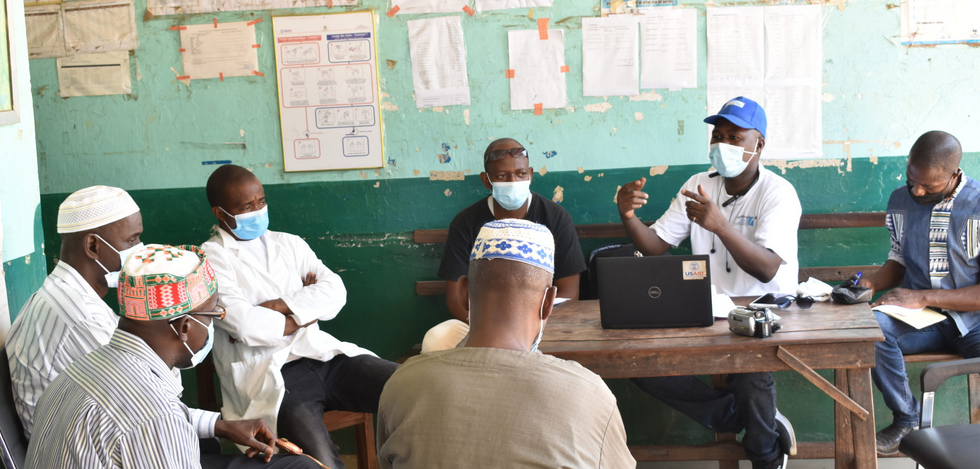
"Globalement, les capacités de communication des risques et d'engagement communautaire sont faibles." ["Overall, risk communication and community engagement capacities are weak."]
In Guinea, the mission of Breakthrough ACTION, a 5-year cooperative agreement of the United States Agency for International Development (USAID), is to increase the capacity of Guinean institutions to effectively address high-risk behaviours associated with priority zoonotic diseases and other emerging disease threats. These zoonoses were identified and prioritised by the Guinean government and its partners within the framework of the Global Health Security Program (GHSP). USAID provides support to increase host country progress toward implementing the Regulations International Health Organization (IHR) of the World Health Organization (WHO). One of the eight essential elements defined in the IHR is that countries have the capacity to implement risk communication, defined as both the large-scale communication of a potential risk and community engagement with affected groups. This assessment of RCCE capacities and needs takes into account the specificities of Guinea in order to formulate priority actions better suited to the local context and communication needs on priority zoonoses.
The WHO defines risk communication in reference to an exchange of information, advice, and opinions in real time between experts or leaders and the community facing a threat to its survival, health, or well-being - economic or social. The purpose of this approach is to ensure that anyone in danger can make informed decisions in order to minimise the effects of a threat such as an epidemic and to put in place protective and preventive actions. Risk communication uses a combination of communication and engagement strategies and tactics, including, but not limited to, media, social media, mass awareness campaigns, health promotion, stakeholder engagement, social mobilisation, and community engagement.
This work is a process of assessing the capacities and institutional needs of organisations evolving in the management of RCCE. The areas evaluated are those defined by the WHO and used in Guinea to fight epidemics and other public health emergencies. They constitute the pillars of interventions to address the social and behavioural determinants that promote community transmission of epidemics. These are: (i) the risk communication system, (ii) internal coordination and partners, (iii) public communication, (iv) community engagement, and (v) dynamic listening and rumour management. The evaluation process included the development and validation of the tool, stakeholder orientation, information collection, source triangulation, data analysis, and the formulation of recommendations on priority skills to be strengthened.
The assessment of RCCE capacities in the face of priority zoonoses involved 21 national and international organisations. The results of the evaluation showed a low level of documentation from organisations regarding RCCE. The organisational capacity of the RCCE system is weak. Mobilisation, training, and deployment of human resources constitute the greatest handicaps of the system. There is potentially large number of reserve personnel who deserve to be organised to better face future threats. Three major challenges were found:
- The data reveal a real lack of collaboration between national stakeholders, who often do not harmonise their data, plans, and intervention messages.
- The economic potential of the private sector to support communication interventions is underexploited.
- Social sciences are still struggling to make room for themselves among other public health disciplines, although their theories seem to be known more and more.
Furthermore:
- When planning interventions, the production and use of evidence is not a common habit. Carrying out a rapid situational analysis is often dependent on the emergence of community incidents likely to hinder the normal course of interventions. The difficulty lies in the fact that activities are decided in the short term.
- Organisations are not developing enough communication implementation plans. Programming based on a coherent theoretical framework is poorly practiced.
- There is no documented approach within organisations that guides the transmission of information to vulnerable groups.
- The process of designing, evaluating, and validating messages is not always clear. During broadcasting, the different communication techniques do not enter the feedback cycle.
- The use of voice technology, text messaging, social media, and the web is done at a very low level.
- Community engagement is a a practice that is most often observed within national organisations at the operational level.
- Some organisations claim to practice rumour management, but their practices are not documented. Behavioural monitoring very often boils down to measuring the scope of interventions by community agents who count the people affected by them. Efforts to evaluate the impact of activities and to monitor interventions produced by other communication channels are not effective.
Thus, despite the efforts invested in coordination mechanisms, the communication system remains fragile. This weakness results in inadequacies observed in communication processes, in public and community engagement, and in rumour management and behavioural monitoring. Coordinating bodies must strive to create a coherent and responsive system of risk communication. It is by succeeding in this challenge that other public health actors may recognise the place and value of communication in the response system against zoonotic epidemics. A capacity-building plan and training plan are presented in the report's annexes.
Emails from Stephanie Clayton to The Communication Initiative on November 20 2023 and November 27 2023. Image credit: Breakthrough ACTION